

Roman campaigning from 210 to 206 BC in Hispania
A common mistake as to Scipio’s character: “Being about to narrate the exploits of Publius Scipio in Iberia, and in fact all the achievements in his life, I think it necessary to direct my readers’ attention, to begin with, to his moral and mental qualities. For as he is perhaps the most illustrious man of any born before the present generation, everybody seeks to know what kind of man he was, and what advantages from natural ability or experience he enjoyed, to account for a career so crowded with brilliant achievement; Now all other writers represent him as a man favoured by fortune, who succeeded in his undertakings contrary to rational expectation, and by the mere force of circumstances. They consider apparently such men to be, so to speak, more god-like and worthy of admiration, than those who act in every case by calculation. They do not seem to be aware of the distinction between credit for good fortune and credit for good conduct in the case of such men; and that the former may be assigned to any one however commonplace, while the latter belongs to those alone who act from prudent calculation and clear intelligence: and it is these last whom we should look upon as the most god-like and god-beloved.”
Scipio’s use of religion compared with that of Lycurgus: “Now it seems to me that in his character and views Publius was very like Lycurgus the legislator of the Lacedaemonians. For we must not suppose that it was from superstition that Lycurgus continually consulted the Pythian priestess in the establishment of the Lacedaemonian constitution; nor that Publius depended on dreams and ominous words for his success in securing empire for his country. But as both saw that the majority of mankind cannot be got to accept contentedly what is new and strange, nor to face dangers with courage, without some hope of divine favour,—Lycurgus, by always supporting his own schemes by an oracular response from the Pythia, secured better acceptation and credit for his ideas; and Publius, by always in like manner instilling into the minds of the vulgar an opinion of his acting on some divine suggestion in the formation of his designs, caused those under his command to confront dangerous services with greater courage and cheerfulness. But that he invariably acted on calculation and with foresight, and that the successful issue of his plans was always in harmony with rational expectation, will be evident by what I am about to relate.”
Scipio’s first exploit, b.c. 218: “For that he was beneficent and high-minded is acknowledged; but that he was acute, sober-minded, and earnest in pursuit of his aims, no one will admit, except those who have lived with him, and contemplated his character, so to speak, in broad daylight. Of such Gaius Laelius was one. He took part in everything he did or said from boyhood to the day of his death; and he it was who convinced me of this truth: because what he said appeared to me to be likely in itself, and in harmony with the achievements of that great man. He told me that the first brilliant exploit of Publius was when his father fought the cavalry engagement with Hannibal near the Padus. He was then, as it seems, eighteen years old and on his first campaign. His father had given him a squadron of picked cavalry for his protection; but when in the course of the battle he saw his father surrounded by the enemy, with only two or three horsemen near him, and dangerously wounded, he first tried to cheer on his own squadron to go to his father’s assistance, but when he found them considerably cowed by the numbers of the enemy surrounding them, he appears to have plunged by himself with reckless courage into the midst of the enemy: whereupon, his comrades being forced to charge also, the enemy were overawed and divided their ranks to let them pass; and Publius the elder, being thus unexpectedly saved, was the first to address his son as his preserver in the hearing of the whole army. Having gained an acknowledged reputation for bravery by this exploit, he ever afterwards freely exposed himself to every sort of personal danger, whenever his country rested its hope of safety on him. And this is not the conduct of a general who trusts to luck, but of one who has a clear head.”
“Publius was believed by all who had heard previously about his dream to have held commune with the gods, not merely in his sleep, but rather in a waking vision, and by day. But in point of fact there was no dream at all: Scipio was kind, open-handed, and courteous, and by these means had conciliated the favour of the multitude. But by a dexterous use of the occasion, both with the people and his mother, he obtained his purpose, and moreover got the reputation of acting under divine inspiration. For those persons, who, from dulness or want of experience, or idleness, can never take a clear view of the occasions or causes or connexion of events, are apt to give the gods and chance the credit for what is really effected by sagacity and far-seeing calculation. I have thought it worth while to say thus much, that my readers may not be misled by unfounded gossip to pass over this great man’s finest and most splendid qualities, I mean his wealth of resource and untiring diligence; which will become still more apparent when we come to recount his actual achievements.”
Speech of Publius Scipio to the soldiers in Spain,b.c. 210: “Such was the man who now assembled the soldiers and exhorted them not to be dismayed by the disaster which had befallen them (at Cannae in 216) . “For,” said he, “Romans have never been beaten by Carthaginians in a trial of valour. It was the result of treachery on the part of the Celtiberians, and of rashness, the two commanders getting cut off from each other owing to their trust in the alliance of these men. But now6 these two disadvantages are on the side of the enemy: for they are encamped at a wide distance from each other; and by their tyrannical conduct to their allies have alienated them all, and made them hostile to themselves. The consequence is that some of them are already sending messages to us; while the rest, as soon as they dare, and see that we have crossed the river, will gladly join us; not so much because they have any affection for us, as because they are eager to punish the outrages of the Carthaginians. Most important of all is the fact that the enemy are at variance with each other, and will refuse to fight against us in a body, and by thus engaging in detail will be more easily dealt with by us.” Looking to these facts, therefore, he bade them cross the river with confidence, and undertook that he and the other officers would see to the next step to be taken. Scipio crosses the Ebro, and swoops down upon New Carthage: With these words he left his colleague, Marcus Silanus, with five hundred horse to guard the ford, and to protect the allies on the north of the river, while he himself began taking his army across, without revealing his design to any one. As a matter of fact he had resolved to do nothing of what he gave out publicly, and had made up his mind to make a rapid attack upon the town called Iberian Carthage. This may be looked upon as the first and strongest proof of the judgment which I lately passed upon him. He was now only in his twenty-seventh year: and yet he, in the first place, undertook to accomplish what the magnitude of the previous disasters had made the world look upon as completely hopeless; and, in the second place, having undertaken it, he left on one side the plain and obvious course, and conceived and carried out a plan which was a surprise to the enemy himself. This could only be the result of the closest calculation.”
Scipio’s careful inquiries as to the state of things in Spain: “The fact is that he had made minute inquiries, before leaving Rome, both about the treason of the Celtiberians, and the separation of the two Roman armies; and had inferred that his father’s disaster was entirely attributable to these. He had not therefore shared the popular terror of the Carthaginians, nor allowed himself to be overcome by the general panic. And when he subsequently heard that the allies of Rome north of the Ebro were remaining loyal, while the Carthaginian commanders were quarrelling with each other, and maltreating the natives subject to them, he began to feel very cheerful about his expedition, not from a blind confidence in Fortune, but from deliberate calculation. Accordingly, when he arrived in Iberia, he learnt, by questioning everybody and making inquiries about the enemy from every one, that the forces of the Carthaginians were divided into three. Mago, he was informed, was lingering west of the pillars of Hercules among the Conii; Hasdrubal, the son of Gesco, in Lusitania, near the mouth of the Tagus; while the other Hasdrubal was besieging a certain city of the Caspetani; and none of the three were less than ten days’ march from the New Town. Now he calculated that, if he decided to give the enemy battle, it would be risking too much to do so against all three at once, because his predecessors had been beaten, and because the enemy would vastly out-number him; if, on the other hand, he were to march rapidly to engage one of the three, and should then find himself surrounded—which might happen by the one attacked retreating, and the others coming up to his relief,—he dreaded a disaster like that of his uncle Gnaeus and his father Publius.”
He determines to attempt New Carthage: “He therefore rejected that idea altogether: but being informed that New Carthage was the most important source of supplies to the enemy and of damage to the Romans in the present war, he had taken the trouble to make minute inquiries about it during the winter from those who were well informed. He learnt that it was nearly the only town in Iberia which possessed a harbour suitable for a fleet and naval force; that it lay very conveniently for the Carthaginians to make the sea passage from Libya; that they in fact had the bulk of their money and war material in it, as well as their hostages from the whole of Iberia; that, most important of all, the number of fighting men garrisoning the citadel only amounted to a thousand,—because no one would ever suppose that, while the Carthaginians commanded nearly the whole of Iberia, any one would conceive the idea of assaulting this town; that the other inhabitants were exceedingly numerous, but all consisted of craftsmen, mechanics, and fisher-folk, as far as possible removed from any knowledge of warfare. All this he regarded as being fatal to the town, in case of the sudden appearance of an enemy. Nor did he moreover fail to acquaint himself with the topography of New Carthage, or the nature of its defences, or the lie of the lagoon: but by means of certain fishermen who had worked there he had ascertained that the lagoon was quite shallow and fordable at most points; and that, generally speaking, the water ebbed every day towards evening sufficiently to secure this. These considerations convinced him that, if he could accomplish his purpose, he would not only damage his opponents, but gain a considerable advantage for himself; and that, if on the other hand he failed in effecting it, he would yet be able to secure the safety of his men owing to his command of the sea, provided he had once made his camp secure,—and this was easy, because of the wide dispersion of the enemy’s forces. He had therefore, during his residence in winter quarters, devoted himself to preparing for this operation to the exclusion of every other: and in spite of the magnitude of the idea which he had conceived, and in spite of his youth, he concealed it from all except Gaius Laelius, until he had himself decided to reveal it.”
“But although historians agree in attributing these calculations to him; yet, when they come to narrate their issue, they somehow or another attribute the success obtained not to the man and his foresight, but to the gods and to Fortune, and that, in spite of all probability, and the evidence of those who lived with him; and in spite of the fact that Publius himself in a letter addressed to Philip has distinctly set forth that it was upon the deliberate calculations, which I have just set forth, that he undertook the Iberian campaign generally, and the assault upon New Carthage in particular.”
Scipio discloses his intention of assaulting New Carthage: “The fleet arrived to the hour, and Publius then thought it time to summon a meeting of his men and to encourage them to the undertaking by the use of the same arguments by which he had convinced himself, and which I have just now detailed. He pointed out to them that the plan was practicable; and briefly summing up the blow which their success would be to their enemies, and the advantage it would be to themselves, he ended by promising crowns of gold to those who first mounted the walls, and the usual rewards to those who displayed conspicuous gallantry. And finally he declared that “Poseidon had appeared to him in his sleep, and originally suggested his plan to him; and had promised to give him such signal aid in the actual hour of battle that his assistance should be made manifest to all.” The skilful mixture in this speech of accurate calculation with promises of gold crowns, and a reference to Divine Providence, created a great impression and enthusiasm in the minds of the young soldiers.“
“Meanwhile Publius, though throwing himself heartily into the struggle, yet took all possible precautions to protect his life. He had three men with him carrying large shields, which they held in such a position as to completely protect him from the side of the wall; and accordingly he went along the lines, or mounted on elevated ground, and contributed greatly to the success of the day. For he was enabled to see all that was going on, and at the same time, by being himself in view of all, inspired great zeal in the hearts of the combatants. The result was that nothing was omitted which could contribute to the success of the battle; but any help he saw to be at any moment required was rapidly and thoroughly supplied.”
Scipio crosses the lagoon and gets his men upon the wall: “Just when the struggle at the ladders was at its hottest the ebb of the tide began. The water began gradually to leave the edges of the lagoon, and the current ran with such violence, and in such a mass through its channel into the adjoining sea, that to those who were unprepared for the sight it appeared incredible. Being provided with guides, Scipio at once ordered his men, who had been stationed ready for this service, to step in and to fear nothing. His was a nature especially fitted to inspire courage and sympathy with his own feelings. So now the men at once obeyed him, and when the army saw them racing each other across the marsh, it could not but suppose that the movement was a kind of heaven-sent inspiration. This reminded them of the reference Scipio had made to Poseidon, and the promises contained in his harangue: and their enthusiasm rose to such a height that they locked their shields above their heads, and, charging up to the gate, they began trying to hew their way through the panels of the doors with their axes and hatchets.”
Mago surrenders the citadel: “Scipio himself with about a thousand men now pressed on towards the citadel. When he arrived there, Mago at first thought of resistance; but afterwards, when he was satisfied that the city was completely in the power of the enemy, he sent to demand a promise of his life, and then surrendered. Sack of the city: This being concluded, the signal was given to stop the slaughter: whereupon the soldiers left off slaying, and turned to plunder. When night fell those of the soldiers to whom this duty had been assigned remained in the camp, while Scipio with his thousand men bivouacked in the citadel; and summoning the rest from the dwelling-houses by means of the Tribunes, he ordered them to collect all their booty into the market-place by maniples, and to take up their quarters for the night by these several heaps. He then summoned the light-armed from the camp, and stationed them upon the eastern hill.”
“Thus did the Romans become masters of Carthage in Iberia.”
The Roman customs in the distribution of booty: “But I have spoken fully before, when discussing the Roman constitution, on the subject of the distribution of booty, showing how no one is excluded from a share in it, in accordance with the oath which all take upon first joining the camp. I may now add that the arrangement whereby the Roman army is thus divided, half being engaged in gathering booty and half remaining drawn up in reserve, precludes all danger of a general catastrophe arising from personal rivalry in greed. For as both parties feel absolute confidence in the fair dealing of each in respect to the booty,—the reserves no less than the plunderers,—no one leaves the ranks, which has been the most frequent cause of disaster in the case of other armies.”
“For, as the majority of mankind encounter miseries and embrace dangers for the sake of gain, it is plain that when such opportunity is presented to them as this, the men in the reserve or in the camp would be with difficulty induced to abstain from taking advantage of it; because the usual idea is that everything belongs to the man who actually takes it: and though a general or king may be careful to order all booty to be brought into the common stock, yet everybody considers that what he can conceal is his own. The result is that, while the ruck of the army cannot be prevented from eagerly devoting themselves to plunder, they often run the risk of a complete overthrow: and it has often in fact happened that after a successful movement, such as the carrying of an entrenched camp or the capture of a city, the victorious army has, from no other cause but this, been not only ejected but even utterly defeated. Therefore there is nothing about which leaders ought to exercise more care or foresight, than that, on such an occasion, all may have an absolutely equal prospect of sharing in the booty.”
Scipio’s treatment of the prisoners: “Thus on the present occasion, while the Tribunes were busied in the distribution of the spoil; the Roman commander caused the prisoners, who numbered little short of ten thousand, to be assembled; The citizens are dismissed to their homes. and having first ordered them to be divided into two groups, one containing the citizens and their wives and children, the other the craftsmen, he exhorted the first of these to be loyal to the Romans, and to remember the favour which they were now receiving, and allowed them all to depart to their own houses. With tears of joy at this unexpected preservation, they bowed in reverence to Scipio and dispersed.The skilled slaves are promised their freedom at the end of the war. He then told the craftsmen that they were for the present public slaves of Rome, but that, if they showed themselves loyal and zealous in their several crafts, he promised them their freedom, as soon as the war with the Carthaginians had been brought to a successful issue. He then bade them go get their names enrolled in the office of the Quaestor, and appointed a Roman overseer for every thirty of them, their whole number being about two thousand. Some are drafted into the navy: From the remaining captives he selected the strongest, those who were in the prime of youth and physical vigour, and assigned them to serve on board ship: and having thus increased the number of his naval allies by one half, he manned the ships taken from the enemy as well as his own; so that the number of men on board each vessel were now little short of double what it was before. For the captured ships numbered eighteen, his original fleet thirty-five. These men he also promised their freedom, if they showed themselves loyal and zealous, as soon as they had conquered the Carthaginians. By this treatment of the captives he inspired the citizens with warm feelings of loyalty and fidelity, and the handicraftsmen with great readiness to serve, from the hope held out to them of recovering their freedom.”

Scipio Africanus – detail of painting by Giovanni Battista Tiepolo, “Scipio Africanus is shown releasing the nephew of the Prince of Nubia after he was captured by Roman soldiers” Walters Art Museum
Mago is entrusted to Lachus: “He next took Mago and the Carthaginians with him separately, consisting of one member of the Council of ancients and fifteen of the Senate. These he put under the charge of Gaius Laelius, with orders that he should take due care of them. The hostages: He next summoned the hostages, who numbered more than three hundred. Such of them as were children, he called to him one by one, and stroking their heads told them not to be afraid, for in a few days they would see their parents. The others also he exhorted to be of good cheer, and to write word to their relations in their several cities, first, that they were safe and well; and, secondly, that the Romans were minded to restore them all unharmed to their homes, if only their relations adopted the Roman alliance. With these words, having already selected from the spoils such articles as were fitting for his purpose, he presented each with what was suitable to their sex and age: the girls with ear-rings and bracelets, the young men with daggers and swords. The women: Among the captive women was the wife of Mandonius, brother of Andobalus king of the Ilergētes. This woman fell at his feet and besought him with tears to protect their honour better than the Carthaginians had done. Touched by her distress Scipio asked her in what respect she and the other women were left unprovided. She was a lady of advanced years and of a certain majestic dignity of appearance: and upon her meeting his question by perfect silence, he summoned the men who had been appointed to take charge of the women; and when they reported that they had supplied them with all necessaries in abundance, and when the woman again clasped his knees and repeated the same request, Scipio felt still more embarrassed; and, conceiving the idea that their guardians had neglected them, and were now making a false report, he bade the women fear nothing, for that he would appoint different men to see to their interests, and secure that they were not left in want of anything. Then after a brief hesitation the woman said, “You mistake my meaning, General, if you think that we are asking you for food.” Scipio then at length began to understand what she wished to convey; and seeing under his eyes the youthful beauty of the daughters of Andobalus, and of many of the other nobles, he could not refrain from tears, while the aged lady indicated in a few words the danger in which they were. He showed at once that he understood her words: and taking her by the hand, he bade her and the others also be of good cheer, for that he would watch over them as he would over his own sisters and daughters, and would accordingly put men in charge of them on whom he could rely.”
“It was on this occasion that some young Romans fell in with a girl surpassing all the other women in bloom and beauty; and seeing that Scipio was fond of the society of women, they brought her to him, and, placing her before him, said that they desired to present the damsel to him. He was struck with admiration for her beauty, and replied that, if he had been in a private position, he could have received no present that would have given him greater pleasure; but as general it was the last in the world which he could receive. He meant to convey, I presume, by this ambiguous answer that, in hours of rest and idleness, such things are the most delightful enjoyments and pastimes for young men; whereas in times of activity they are hindrances physically and mentally. However that may be, he thanked the young men; but called the girl’s father, and handing her over at once to him, told him to bestow her in marriage on whichever of the citizens he chose. By this display of continence and self-control he gained the warm respect of his men.”
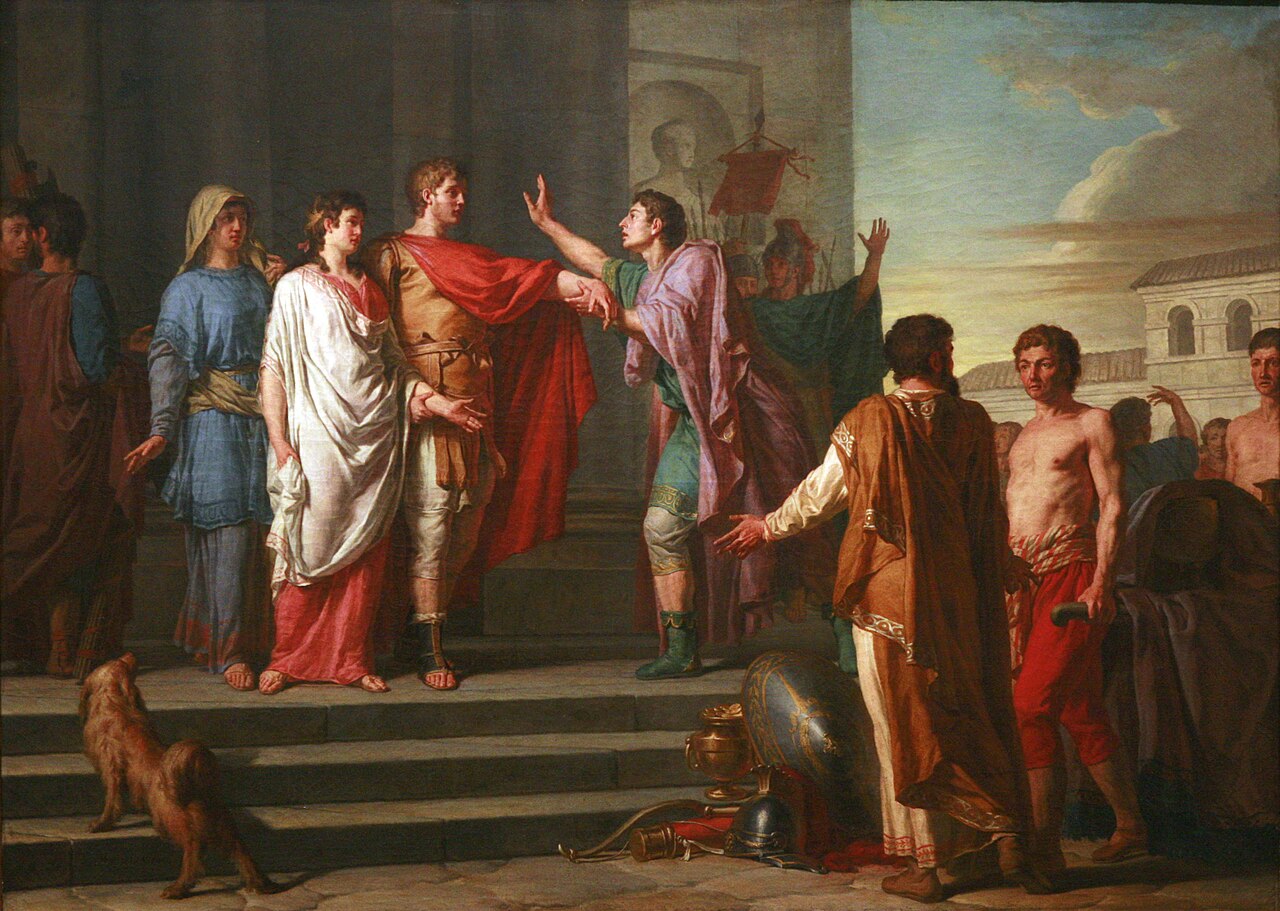
Continence of Scipio, Nicolas-Guy Brenet
Laelius sent to Rome with the news. b.c. 209: “Having made these arrangements, and handed over the rest of the captives to the Tribunes, he despatched Gaius Laelius on board a quinquereme to Rome, with the Carthaginian prisoners and the noblest of the others, to announce at home what had taken place. For as the prevailing feeling at Rome was one of despair of success in Iberia, he felt certain that on this news their spirits would revive, and that they would make much more strenuous efforts to support him.” -Polybius The Histories. Bk 10 sections 2-19.
Winter of b.c. 209-208. See supra. ch. 20 The adhesion of Edeco, prince of the Edetani: “In Iberia Publius Scipio took up his winter quarters at Tarraco; and secured the fidelity and affection of the Iberians, to begin with, by the restoration of the hostages to their respective families. He found a voluntary supporter of his measures in the person of Edeco, the prince of the Edetani; who no sooner heard that New Carthage had been taken, and that Scipio had got his wife and children into his hands, than, concluding that the Iberians would change sides, he resolved to take the lead in the movement: conceiving that, by acting thus, he would best be able to get back his wife and children, and at the same time have the credit of joining the Romans by deliberate choice, and not under compulsion. And so it turned out. For as soon as the armies were dismissed to their winter quarters, he came to Tarraco, accompanied by his kinsfolk and friends; and there being admitted to an interview with Scipio, he said that “he thanked the gods heartily that he was the first of the native princes to come to him; for whereas the others were still sending ambassadors to the Carthaginians and looking to them for support,—even while stretching out their hands to the Romans,—he was come there to offer not only himself, but his friends and kinsfolk also, to the protection of Rome. If therefore he should have the honour to be regarded by him as a friend and ally, he would be able to render him important service both in the present and the future. For as soon as the Iberians saw that he had been admitted to Scipio’s friendship, and had obtained what he asked, they would all come in with a similar object, hoping to have their relatives restored, and to enjoy the alliance of Rome. Their affection being secured for the future by receiving such a mark of honour and benevolence, he would have in them sincere and ready coadjutors in all his future undertakings. He therefore asked to have his wife and children restored to him, and to be allowed to return home an acknowledged friend of Rome; in order that he might have a reasonable pretext for showing, to the best of his power, his own and his friends’ affection for Scipio himself and for the Roman cause.”
Edeco is followed by other tribes. b.c. 209-8: When Edeco had finished his speech, Scipio, who had been ready to gratify him from the first, and took the same view as to the policy of the proceeding, delivered him his wife and children, and granted the friendship which he asked. More than this, his subtle intellect made an extraordinary impression on the Iberian in the course of the interview; and having held out splendid hopes to all his companions for the future, he allowed him to return to his own country. This affair having rapidly got wind, all the tribes living north of the Ebro, such as had not done so before, joined the Romans with one consent.
“This has often happened to people before. For though, as I have many times remarked, success in a campaign and victory over one’s enemies are great things, it requires much greater skill and caution to use such successes well. Accordingly, you will find that those who have gained victories are many times more numerous than those who have made good use of them. The Carthaginians at this crisis are an instance in point. After conquering the Roman armies, and slaying both the generals, Publius and Gnaeus Scipio, imagining that Iberia was their own without dispute, they began treating the natives tyrannically; and accordingly found enemies in their subjects instead of allies and friends. And they were quite rightly served, for imagining that the conduct necessary for keeping power was something different from that necessary for obtaining it; and for failing to understand that they keep empire best, who best maintain the same principles in virtue of which they gained it. And yet it is obvious enough, and has been again and again demonstrated, that men gain power by beneficent actions, and by holding out hopes of advantage to those with whom they are dealing; but that, as soon as they have got what they wanted, and begin to act wickedly and rule despotically, it is but natural that, as their rulers have changed, the feelings of the subjects should change too. So it was with the Carthaginians.”
“Andobales had long been in communication with Scipio: and, on the latter approaching the district in which he was entrenched, he left his camp with his friends and came to Scipio. In this interview he entered upon a defence of himself in regard to his former friendship with the Carthaginians, and spoke of the services he had done them, and the fidelity which he had shown to them. He then went on to narrate the injustice and tyranny which he had experienced at their hands; and demanded that Scipio himself should be the judge of his pleas. If he were shown to be making ungrounded complaints against the Carthaginians, he might justly conclude him incapable of keeping faith with the Romans either: but if, on a review of these numerous acts of injustice he were proved to have had no other course than to desert the Carthaginians, Scipio might confidently expect that, if he now elected to join the Romans, he would be firm in his loyalty to them. Whereupon Scipio with emotion bade them “fear nothing, for they would experience nothing but kindness at the hands of the Romans.” He at once handed over his daughters to Andobales; and next day made the treaty with him, the chief provision of which was that he should follow the Roman commanders and obey their commands. This being settled, he returned to his camp; brought over his army to Scipio; and, having joined camps with the Romans, advanced with them against Hasdrubal.
“All the Iberians of that district, who were in alliance at that time with the Carthaginians, came in and submitted to the Roman obedience, and in addressing Scipio called him “king.”Scipio’s self-restraint.The first to do this and to bow the knee before him had been Edeco, and the next Andobales. On these occasions Scipio had passed the word over without remark; but after the battle, when all alike addressed him by that title, his attention was drawn to it; and he therefore summoned the Iberians to a meeting, and told them that “he quite wished to be called a man of royal liberality by them all, and to be so in the truest sense, but that he had no wish to be a ‘king,’ nor to be called one by any one; they should address him as general.”
“Even at this early period of his career, an observer might have remarked the loftiness of Scipio’s character. He was still quite young. His good fortune had been so persistent, that all who came under his rule were led naturally to think and speak of him as a king. Yet he did not lose his self-control; but deprecated this popular impulse and this show of dignity. But this same loftiness of character was still more admirable in the closing scenes of his life, when, in addition to his achievements in Iberia, he crushed the Carthaginians; reduced the largest and fairest districts of Libya, from the Altars of Philaenus to the Pillars of Hercules, under the power of his country; conquered Asia and the kings of Syria; made the best and largest part of the world subject to Rome; and in doing so had numerous opportunities of acquiring regal sway, in whatever parts of the world suited his purpose or wish. For such achievements were enough to have kindled pride, not merely in any human breast, but even, if I may say so without irreverence, in that of a god. But Scipio’s greatness of soul was so superior to the common standard of mankind, that he again and again rejected what Fortune had put within his grasp, that prize beyond which men’s boldest prayers do not go—the power of a king: and he steadily preferred his country and his duty to that royalty, which men gaze at with such admiration and envy.” -Polybius The Histories. Bk 10 sections 34-40.
Hasdrubal falls in the battle (Battle of the Metaurus, b.c. 207):
After the losing to Publius Scipio in battle at Baecula, Hasdrubal made good his passage over the Western Pyrenees, and thence through the Cevennes, b.c. 208. In the spring of b.c. 207 he crossed the Alps and descended into Italy, crossed the Po, and besieged Placentia. Thence he sent a letter to his brother Hannibal announcing that he would march southward by Ariminum and meet him in Umbria. The letter fell into the hands of the Consul Nero, who was at Venusia, and who immediately made a forced march northward, joined his colleague at Sena, and the next day attacked Hasdrubal.
“Hasdrubal had behaved on this occasion, as throughout his whole life, like a brave man, and died fighting: and he deserves not to be passed over without remark. I have already stated that Hannibal was his brother, and on his departure to Italy entrusted the command in Iberia to him. I have also described his many contests with the Romans, and the many embarrassing difficulties with which he had to struggle, caused by the generals sent from Carthage to Iberia; and how in all these matters he had supported these vicissitudes and reverses in a noble spirit worthy of a son of Barcas. But I will now speak of his last contest, and explain why he seems to me pre-eminently to deserve respectful attention and imitation. Most generals and kings, when entering upon decisive battles, place before their eyes the glory and advantages to be obtained from victory, and frequently consider and contrive what use they will make of every success; but they do not go on to review the chances of failure, nor contemplate the plan to be adopted, or the action to be taken, in the case of reverse. Yet the former is obvious, the latter requires foresight. Therefore it is that most of them, though in many instances their soldiers have fought nobly, by their own folly and imprudence in this respect have added dishonour to defeat: have disgraced their previous achievements, and rendered themselves, during the remainder of their lives, objects of reproach and contempt. It is easy to see that many leaders make this fatal mistake, and that the difference between one man and another in these points is most signal; for history is full of such instances. Hasdrubal, on the contrary, as long as there was reasonable hope of being able to accomplish anything worthy of his former achievements, regarded his personal safety in battle as of the highest consequence; but when Fortune deprived him of all hopes for the future, and reduced him to the last extremities, though neglecting nothing either in his preparations or on the field that might secure him the victory, nevertheless considered how, in case of total overthrow, he might face his fate and suffer nothing unworthy of his past career.”
“These remarks are meant for those engaged in active operations, that they may neither dash the hopes of those who rely upon them by a heedless seeking of danger, nor by an unworthy clinging to life, add disgrace and shame to the catastrophies which befall them.” -Polybius The Histories. Bk 11 section 2.
Scipio’s idea of transferring the war to Africa: When every one complimented Scipio after he had driven the Carthaginians from Iberia, and advised him straightway to take some rest and ease, as having put a period to the war, he answered that he “congratulated them on their sanguine hopes; for himself he was now more than ever revolving in his mind how to begin the war with Carthage. Up to that time the Carthaginians had waged war upon the Romans; but that now fortune put it in the power of the Romans to make war upon them….”-Polybius The Histories. Bk 11 section 24.
A Mutiny in Spain:
Scipio appeases a mutiny in the Roman camp, at Sucro. Livy, 28, 24. In the autumn of b.c. 206: “When a mutiny broke out among part of the troops in the Roman camp, Scipio, though he had now had a very adequate experience of the difficulties of administration, never felt himself more at a loss how to act or in greater embarrassment. And naturally so. For as in the case of the body, causes of mischief, such as cold, heat, fatigue, or wounds, may be avoided by precautions, or easily relieved when they occur; while those which arise from within the body itself, such as tumours or diseases, are difficult to foresee and difficult to relieve when they do exist, so it is, we must believe, with political and military administration. Against plots from without, and the attacks of enemies, the precautions to be taken and the measures for relief may readily be learned by those who pay the requisite attention; but to decide on the right method of resisting intestine factions, revolutions, and disturbances is difficult, and requires great tact and extreme acuteness; and, moreover, the observation of one maxim suitable in my opinion to all armies, states, and bodies alike, which is this: never in such cases to allow any lengthened idleness or repose, and least of all at a time of success and when provisions are abundant.”
“Being, then, as I have all along said, a man eminently careful, acute, and prompt, Scipio summoned a meeting of the military tribunes and proposed a solution of the existing troubles as follows. He said that “he must promise the soldiers the settlement of their pay; and, in order to create a belief in his promise, he must now take public steps to exact with all speed the contributions which had been already imposed upon the cities for the support of the whole army, with the distinct understanding that the object of that measure was the settlement of the pay: and these same tribunes should return to the army and urge and entreat the men to abandon their rebellious spirit, and come to him to receive their pay, either singly or, if they preferred it, in a body. And when this was done he would consider, as circumstances arose, what measures it was necessary to take.”
“With this suggestion in their minds these officers deliberated on the means of raising money; and having communicated their decisions to Scipio, he said that he would now consult them on the next necessary step. They accordingly resolved that they would name a day on which all were to appear; and that then they would pardon the general body of the men, but severely punish the instigators of the mutiny, who were as many as thirty-five. The day having arrived, and the mutineers having appeared to make terms and receive their pay, Scipio gave secret instructions to the tribunes, who had been sent on the mission to them, to meet them; and, each of them selecting five of the ringleaders, to greet them with politeness and invite them, if possible, to their own tent, or, if they could not do that, to dinner or some such entertainment. But to the troops with him he sent round orders to have provisions for a considerable period ready in three days’ time, because they were to march against the deserter Andobales under Marcus Silanus. When they heard this the mutineers were much emboldened, because they imagined that they would have everything in their own hands, as the other troops would be gone by the time they joined the general.”
The mutiny suppressed and the ringleaders executed at New Carthage: “Upon the approach of the mutineers, Scipio gave orders to his army to march out the next morning at daybreak with their baggage. But he instructed the tribunes and praefects that, as soon as they met the mutineers, they should order their men to put down their baggage, and keep them under arms at the city gate; and then, placing a detachment at each of the gates, take good care that none of the mutineers should leave the city. The officers who had been sent to meet the men fell in with them on their arrival, and took the ringleaders with every appearance of civility to their own tents, in accordance with the arrangement that had been made. At the same time orders had been given to them to arrest the thirty-five immediately after dinner, and to keep them in fetters: without allowing any one in the tent to go out, except the messenger who was to inform the general from each of them that this had been accomplished.”
“The tribunes having done as they were ordered, at daybreak next morning, seeing that the new arrivals were collected in the market-place, the general gave the signal for the assembly of the army. The signal was as usual promptly obeyed by all, for they were curious to see how the general would demean himself in their presence, and what he would say to them about the business in hand. As soon as they were come together, Scipio sent word to the tribunes to bring their soldiers under arms, and station them round the assembled men. He then came forward himself. His first appearance caused an immediate change of feeling. The soldiers supposed that he was still unwell, and when they suddenly saw him, contrary to all expectations, with all the appearance of full health and strength, they were struck with terror.”
Scipio’s speech to the mutineers: He began his speech by saying that he wondered what their grievances were, or what they looked for forward that induced them to mutiny. For that there were three motives only on which men usually venture to rebel against their country and their commanders,—discontent and anger with their officers; dissatisfaction with their present position; or, lastly, hopes of something better and more glorious. “Now, I ask you,” he continued, “which of these can you allege? It is with me, I presume, that you are dissatisfied, because I did not pay you your wages. But this cannot be laid to my charge; for while I was in office your pay was never short. The fault then may lie with Rome that the accumulated arrears have not been settled. Which was your proper course then in that case? To have brought forward your complaint thus, as rebels and enemies to the country that nurtured you, or to have come personally to me and stated your case, and to have begged your friends to support and help you? The latter would have been the better plan in my opinion. In those who serve others for pay it is sometimes pardonable to revolt against their paymasters; but in the case of those who are fighting for themselves, for their own wives and children, it can in no circumstances be conceded. It is just as though, on73the plea of being wronged in money matters by his own father, a man were to come in arms to slay him from whom he received his own life. Or perhaps you may allege that I imposed greater hardships and dangers on you than on the others, and gave the rest more than their share of profits and booty. But you can neither venture to say this, nor, if you did venture, could you prove it. What then is your grievance against me at this moment, I should like to ask, that you have mutinied? I believe that not one of you will be able to express or even conceive it.
“Nor again can it have been any dissatisfaction with the position of affairs. For when was any prosperity greater? When has Rome won more victories, when have her arms had brighter prospects than now? But perhaps some faint-heart will say that our enemies have more numerous advantages, fairer and more certain prospects than ourselves. Which, pray, of these enemies? Is it Andobales and Mandonius? But which of you is ignorant of the fact that these men first betrayed the Carthaginians and joined us, and now once more, in defiance of their oaths and pledges, have come forward as our opponents? It is a fine thing surely to become the enemies of your country in reliance on such men as these! Nor again had you any prospect of becoming masters of Iberia by your own prowess: for you would not have been strong enough, even in conjunction with Andobales, to meet us in the field, to say nothing of doing so without such aid. I should like then to ask,—what was it in which you trusted? Surely not in the skill and valour of the leaders whom you have now elected, or in the fasces and axes which were borne in front of them,—men of whom I will not deign to say even another word. All this, my men, is absolutely futile; nor will you be able to allege even the smallest just complaint against me or your country. Wherefore I will undertake your defence to Rome and myself, by putting forward a plea which all the world will acknowledge to hold good. And it is that, a crowd is ever easily misled and easily induced to any error. Therefore it is that crowds are like the sea, which in its own nature is safe and quiet; but, when winds fall violently upon it, assumes the character of the blasts which lash it into fury: thus a multitude also is ever found to be what its leaders and counsellors are. Acting on this consideration, I and all my fellow-officers hereby offer you pardon and amnesty for the past: but to the guilty authors of the mutiny we are resolved to show no mercy, but to punish them as their misconduct to their country and to ourselves deserves.”
Execution of the ringleaders: “Just as he said these words, the soldiers, who were posted under arms round the assembly, clashed their swords against their shields: and at the same instant the ringleaders of the mutiny were brought in, stripped and in chains. But such terror was inspired in the men by the threatening aspect of the surrounding troops, and by the dreadful spectacle before them, that, while the ringleaders were being scourged and beheaded, they neither changed countenance nor uttered a sound, but remained all staring open-mouthed and terrified at what was going on. So the ringleaders of the mischief were scourged and dragged off through the crowd dead; but the rest of the men accepted with one consent the offer of an amnesty from the general and officers; and then voluntarily came forward, one by one, to take an oath to the tribunes that they would obey the orders of their commanders and remain loyal to Rome.”
“Having thus crushed what might have been the beginning of serious danger, Scipio restored his troops to their former good disposition….”-Polybius The Histories. Bk 11 sections 25-30.
Scipio’s address to his soldiers: “Scipio at once summoned a meeting of the soldiers in New Carthage, and addressed them on the subject of the audacious proceedings of Andobales, and his treachery to them; and by dwelling at great length on these topics he inspired the men with a very great eagerness to attack these princes. He then proceeded to enumerate the battles they had already fought against the Iberians and Carthaginians combined, the Carthaginians acting as leaders in the campaigns. “Seeing,” he added, “that you always beat them, it does not now become you to fear defeat in a war against Iberians by themselves, and led by Andobales. I will not therefore even accept any Iberian of them all as a partner in the struggle, but I will undertake the campaign by the unassisted services of my Roman soldiers: in order to make it plain to all that it was not, as some assert, by the aid of Iberians that we defeated the Carthaginians and drove them from Iberia; but that it was by Roman valour and your own gallantry that we have conquered Carthaginian and Celtiberian combined. Let nothing therefore disturb your confidence in each other: but, if you have ever done it before, approach this undertaking with courage undismayed. For securing the victory I will with God’s help make every necessary provision.” This speech filled the troops with such zeal and confidence, that they presented all the appearance of men whose enemies are in full view, and who are on the very point of closing with them.” -Polybius The Histories. Bk 11 section 31.
Note: Scipio’s Spanish campaign culminated in the victory at Ilipa in 206 BC against Hannibal’s brother Mago Barca, leading to the Roman conquest of Carthaginian Iberia.
Publius Cornelius Scipio Africanus in Africa, B.C 204-201:

African Scipio military campaign in 204-201 BC
Elected Consul for b.c. 205. Next spring (b.c. 204) he crossed to Africa with a year’s additional imperium. In the course of this year he ravaged the Carthaginian territory and besieged Utica (Livy, 29, 35), and at the beginning of b.c. 203 his imperium was prolonged till he should have finished the war …
b.c. 203. Cn. Servilius Caepio, C. Servilius Geminus Coss. Livy, 30, 1: “While the Consuls were thus engaged, Scipio in Libya learnt during the winter that the Carthaginians were fitting out a fleet; he therefore devoted himself to similar preparations as well as to pressing on the siege of Utica. He did not, however, give up all hopes of Syphax; but as their forces were not far apart he kept sending messages to him, convinced that he would be able to detach him from the Carthaginians. He still cherished the belief that Syphax was getting tired of the girl for whose sake he had joined the Carthaginians, and of his alliance with the Punic people generally; for the Numidians, he knew, were naturally quick to feel satiety, and constant neither to gods nor men. Scipio’s mind, however, was distracted with various anxieties, and his prospects were far from seeming secure to him; for he shrank from an engagement in the open field on account of the enemy’s great superiority in numbers. He therefore seized an opportunity which now presented itself. Some of his messengers to Syphax reported to him that the Carthaginians had constructed their huts in their winter camp of various kinds of wood and boughs without any earth; while the old army of the Numidians made theirs of reeds, and the reinforcements which were now coming in from the neighbouring townships constructed theirs of boughs only, some of them inside the trench and palisade, but the greater number outside. Scipio therefore made up his mind that the manner of attacking them, which would be most unexpected by the enemy and most successful for himself, would be by fire. He therefore turned his attention to organising such an attack. The proposal of Syphax: Now, in his communications with Scipio, Syphax was continually harping upon his proposal that the Carthaginians should evacuate Italy and the Romans Libya; and that the possessions held by either between these two countries should remain in statu quo. Hitherto Scipio had refused to listen to this suggestion, but he now gave Syphax a hint by the mouth of his messengers that the course he wished to see followed was not impossible. Greatly elated at this, Syphax became much bolder than before in his communications with Scipio; the numbers of the messengers sent backwards and forwards, and the frequency of their visits, were redoubled; and they sometimes even stayed several days in each other’s camps without any thought of precaution. On these occasions Scipio always took care to send, with the envoys, some men of tried experience or of military knowledge, dressed up as slaves in rough and common clothes, that they might examine and investigate in security the approaches and entrances to both the entrenchments. For there were two camps, one that of Hasdrubal, containing thirty thousand infantry and three thousand cavalry; and another about ten stades distant from it of the Numidians, containing ten thousand cavalry and about fifty thousand infantry. The latter was the easier of approach, and its huts were well calculated for being set on fire, because, as I said before, the Numidians had not made theirs of timber and earth, but used simply reeds and thatch in their construction.”
Spring of b.c. 203: “By the beginning of spring Scipio had completed the reconnaissances necessary for this attempt upon the enemy; and he began launching his ships, and getting the engines on them into working order, as though with the purpose of assaulting Utica by sea. With his land forces he once more occupied the high ground overlooking the town, and carefully fortified it and secured it by trenches. He wished the enemy to believe that he was doing this for the sake of carrying on the siege; but he really meant it as a cover for his men, who were to be engaged in the undertaking described above, to prevent the garrison sallying out, when the legions were separated from their lines, assaulting the palisade which was so near to them, and attacking the division left in charge of it. Whilst in the midst of these preparations, he sent to Syphax inquiring whether, “in case he agreed to his proposals, the Carthaginians would assent, and not say again that they would deliberate on the terms?” He ordered these legates at the same time not to return to him, until they had received an answer on these points. When the envoys arrived, the Numidian king was convinced that Scipio was on the point of concluding the agreement, partly from the fact that the ambassadors said that they would not go away until they got his answer, and partly because of the anxiety expressed as to the disposition of the Carthaginians. He therefore sent immediately to Hasdrubal, stating the facts and urging him to accept the peace. Meanwhile he neglected all precautions himself, and allowed the Numidians, who were now joining, to pitch their tents where they were, outside the lines. Scipio in appearance acted in the same way, while in reality he was pushing on his preparations with the utmost care. When a message was returned from the Carthaginians bidding Syphax complete the treaty of peace, the Numidian king, in a state of great exaltation, communicated the news to the envoys; who immediately departed to their own camp to inform Scipio from the king of what had been done. As soon as he heard it, the Roman general at once sent fresh envoys to inform Syphax that Scipio was quite satisfied and was anxious for the peace; but that the members of his council differed from him, and held that they should remain as they were. The ambassadors duly arrived and informed the Numidians of this. Scipio sent this mission to avoid the appearance of a breach of truce, if he should perform any act of hostility while negotiations for peace were still going on between the parties. He considered that, by making this statement, he would be free to act in whatever way he chose without laying himself open to blame.”
“Syphax’s annoyance at this message was great, in proportion to the hopes he had previously entertained of making the peace. He had an interview with Hasdrubal, and told him of the message he had received from the Romans; but though they deliberated long and earnestly as to what they ought to do, they neither had any idea or conjecture as to what was really going to happen. For they had no anticipation whatever as to the need of taking precautions, or of any danger threatening them, but were all eagerness and excitement to strike some blow, and thus provoke the enemy to descend into the level ground. Scipio discloses his project: Meanwhile Scipio allowed his army generally, by the preparations he was making and the orders he was issuing, to imagine that his aim was the capture of Utica; but summoning the most able and trusty Tribunes at noon, he imparted to them his design, and ordered them to cause their men to get their supper early, and then to lead the legions outside the camp as soon as the buglers gave the usual signal by a simultaneous blast of their bugles. For it is a custom in the Roman army for the trumpeters and buglers to sound a call near the commander’s tent at supper time, that the night pickets may then take up their proper positions. Scipio next summoned the spies whom he had sent at different times to reconnoitre the enemy’s quarters, and carefully compared and studied the accounts they gave about the roads leading to the hostile camps and the entrances to them, employing Massanissa to criticise their words and assist him with his advice, because he was acquainted with the locality.”
Destruction of the camp of Syphax by C. Laelius and Massanissa, and of Hasdrubal: “Everything being prepared for his expedition, Scipio left a sufficiently strong guard in the camp, and got the rest of the men on the march towards the end of the first watch, the enemy being about sixty stades distant. Arrived in the neighbourhood of the enemy, about the end of the third watch, he assigned to Gaius Laelius and Massanissa half his Roman soldiers and all his Numidians, with orders to attack the camp of Syphax, urging them to quit themselves like brave men and do nothing carelessly; with the clear understanding that, as the darkness hindered and prevented the use of the eyes, a night attack required all the more the assistance of a cool head and a firm heart. The rest of the army he took the command of in person, and led against Hasdrubal. He had calculated on not beginning his assault until Laelius’s division had set fire to the enemy’s huts; he therefore proceeded slowly. The latter meanwhile advanced in two divisions, which attacked the enemy simultaneously. The construction of the huts being as though purposely contrived to be susceptible of a conflagration, as I have already explained, as soon as the front rank men began to set light to them, the fire caught all the first row of huts fiercely, and soon got beyond all control, from the closeness of the huts to each other, and the amount of combustible material which they contained. Laelius remained in the rear as a reserve; but Massanissa, knowing the localities through which those who fled from the fire would be sure to retreat, stationed his own soldiers at those spots. Not a single Numidian had any suspicion of the true state of the case, not even Syphax himself; but thinking that it was a mere accidental conflagration of the rampart, some of them started unsuspiciously out of bed, others sprang out of their tents in the midst of a carouse and with the cup actually at their lips. The result was that numbers of them got trampled to death by their own friends at the exits from the camp; many were caught by the flames and burnt to death; while all those who escaped the flame fell into the hands of the enemy, and were killed, without knowing what was happening to them or what they were doing.
“At the same time the Carthaginians, observing the proportions of the conflagration and the hugeness of the flame that was rising, imagined that the Numidian camp had been accidentally set on fire. Some of them therefore started at once to render assistance, and all the rest hurried outside their own camp unarmed, and stood there gazing in astonishment at the spectacle. Everything having thus succeeded to his best wishes, Scipio fell upon these men outside their camp, and either put them to the sword, or, driving them back into the camp, set fire to their huts. The disaster of the Punic army was thus very like that which had just befallen the Numidians, fire and sword in both cases combining to destroy them. Hasdrubal immediately gave up all idea of combating the fire, for he knew from the coincidence of the two that the fire in the Numidian camp was not accidental, as he had supposed, but had originated from some desperate design of the enemy. He therefore turned his attention to saving his own life, although there was now little hope left of doing so. For the fire was spreading rapidly and was catching everywhere; while the camp gangways were full of horses, beasts of burden, and men, some of them half dead and devoured by the fire, and others in a state of such frantic terror and mad excitement that they prevented any attempts at making a defence, and by the utter tumult and confusion which they created rendered all chance of escape hopeless. The case of Syphax was the same as that of Hasdrubal, as it was also that of the other officers. The two former, however, did manage to escape, accompanied by a few horsemen: but all those myriads of men, horses, and beasts of burden, either met a miserable and pitiable death from the fire, or, if they escaped the violence of that, some of the men perished ignominiously at the hands of the enemy, cut down naked and defenceless, not only without their arms, but without so much as their clothes to cover them. The whole place was filled with yells of pain, confused cries, terror, and unspeakable din, mingled with a conflagration which spread rapidly and blazed with the utmost fierceness. It was the combination and suddenness of these horrors that made them so awful, any one of which by itself would have been sufficient to strike terror into the hearts of men. It is accordingly impossible for the imagination to exaggerate the dreadful scene, so completely did it surpass in horror everything hitherto recorded. Of all the brilliant achievements of Scipio this appears to me to have been the most brilliant and the most daring….”
Hasdrubal at Anda, see Appian, 8, 24: “When day broke, and he found the enemy either killed or in headlong flight, Scipio exhorted his Tribunes to activity, and at once started in pursuit. At first the Carthaginian general seemed inclined to stand his ground, though told of Scipio’s approach, trusting in the strength of the town [of Anda]; but when he saw that the inhabitants were in a mutinous state, he shrank from meeting the attack of Scipio, and fled with the relics of his army, which consisted of as many as five hundred cavalry and about two thousand infantry. The inhabitants of the town thereupon submitted unconditionally to the Romans, and were spared by Scipio, who, however, gave up two neighbouring towns to the legions to plunder. This being done he returned to his original entrenchment. Dismay at Carthage: Baffled in the hopes which they had entertained of the course which the campaign would take, the Carthaginians were deeply depressed. They had expected to shut up the Romans on the promontory near Utica, which had been the site of their winter quarters, and besiege them there with their army and fleet both by sea and land. With this view all their preparations had been made; and when they saw, quite contrary to their calculations, that they were not only driven from the open country by the enemy, but were in hourly expectation of an attack upon themselves and their city, they became completely disheartened and panic-stricken. Their circumstances, however, admitted of no delay. They were compelled at once to take precautions and adopt some measures for the future. The Senate, however, resolves to continue their resistance: But the senate was filled with doubt and varied and confused suggestions. Some said that they ought to send for Hannibal and recall him from Italy, their one hope of safety being now centred in that general and his forces. Others were for an embassy to Scipio to obtain a truce and discuss with him the terms of a pacification and treaty. Others again were for keeping up their courage and collecting their forces, and sending a message to Syphax; who, they said, was at the neighbouring town of Abba, engaged in collecting the remnants of his army. This last suggestion was the one which ultimately prevailed. The Government of Carthage accordingly set about collecting troops, and sent a despatch to Syphax begging him to support them and abide by his original policy, as a general with an army would presently join him.”
“Meanwhile the Roman commander was pressing on the siege of Utica. But when he heard that Syphax was still in position, and that the Carthaginians were once more collecting an army, he led out his forces and pitched his camp close under the walls of Utica. At the same time he divided the booty among the soldiers… The merchants who purchased them from the soldiers went away with very profitable bargains; for the recent victory inspired the soldiers with high hopes of a successful conclusion of the campaign, and they therefore thought little of the spoils already obtained, and made no difficulties in selling them to the merchants.”
Syphax is persuaded by Sophanisba to stand by the Carthaginians still: The Numidian king and his friends were at first minded to continue their retreat to their own land. But while deliberating on this, certain Celtiberes, over four thousand in number, who had been hired as soldiers by the Carthaginians, arrived in the vicinity of Abba. Encouraged by this additional strength the Numidians stopped on their retreat. And when the young lady, who was daughter of Hasdrubal and wife of Syphax, added her earnest entreaties that he would remain and not abandon the Carthaginians at such a crisis, the Numidian king gave way and consented to her prayer. The approach of these Celtiberes did a great deal also to encourage the hopes of the Carthaginians: for instead of four thousand, it was reported at Carthage that they were ten thousand, and that their bravery and the excellency of their arms made them irresistible in the field. Excited by this rumour, and by the boastful talk which was current among the common people, the Carthaginians felt their resolution to once more take the field redoubled. The Carthaginians again take the field: And finally, within thirty days, they pitched a camp in conjunction with the Numidians and Celtiberes on what are called the Great Plains, with an army amounting to no less than thirty thousand.”
The battle on the Great Plains. 24th June, b.c. 203: When news of these proceedings reached the Roman camp Scipio immediately determined to attack. Leaving orders, therefore, to the army and navy, which were besieging Utica, as to what they were to do, he started with all his army in light marching order. On the fifth day he reached the Great Plains, and during the first day after his arrival encamped on a piece of rising ground about thirty stades from the enemy. Next day he descended into the plain and drew up his army at a distance of seven stades from the enemy, with his cavalry forming an advanced guard. After skirmishing attacks carried on by both sides during the next two days, on the fourth both armies were deliberately brought out into position and drawn up in order of battle. Scipio followed exactly the Roman system, stationing the maniples of hastati in the front, behind them the principes, and lastly the triarii in the rear. Of his cavalry he stationed the Italians on the right wing, the Numidians and Massanissa on the left. Syphax and Hasdrubal stationed the Celtiberes in the centre opposite the Roman cohorts, the Numidians on the left, and the Carthaginians on the right. The Roman wings are both victorious: At the very first charge the Numidians reeled before the Italian cavalry, and the Carthaginians before those under Massanissa; for their many previous defeats had completely demoralised them. But the Celtiberes fought gallantly, for they had no hope of saving themselves by flight, being entirely unacquainted with the country; nor any expectation of being spared if they were taken prisoners on account of their perfidy to Scipio: for they were regarded as having acted in defiance of justice and of their treaty in coming to aid the Carthaginians against the Romans, though they had never suffered any act of hostility at Scipio’s hands during the campaigns in Iberia. The Celtiberes, on the centre, are cut to pieces after a gallant resistance: When, however, the two wings gave way these men were surrounded by the principes and triarii, and cut to pieces on the field almost to a man. Thus perished the Celtiberes, who yet did very effective service to the Carthaginians, not only during the whole battle, but during the retreat also; for, if it had not been for the hindrance caused by them, the Romans would have pressed the fugitives closely, and very few of the enemy would have escaped. Syphax and Hasdrubal escape: As it was, owing to the delay caused by these men, Syphax and his cavalry effected their retreat to his own kingdom in safety; while Hasdrubal with the survivors of his army did the same to Carthage.”
Scipio receives the submission of the country, while Laelius goes in pursuit of Syphax: “After making the necessary arrangements as to the booty and prisoners, Scipio summoned a council of war to consult as to what to do next. It was resolved that Scipio himself and one part of the army should stay in the country and visit the various towns; while Laelius and Massanissa, with the Numidians and the rest of the Roman legions, should pursue Syphax and give him no time to deliberate or make any preparations. This being settled the commanders separated; the two latter going with their division in pursuit of Syphax, Scipio on a round of the townships. Some of these were terrified into a voluntary submission to the Romans, others he promptly took by assault. The whole country was ripe for a change, owing to the constant series of miseries and contributions, under which it had been groaning from the protracted wars in Iberia.”
A panic at Carthage: “In Carthage meanwhile, where the panic had been great enough before, a still wilder state of excitement prevailed, after this second disaster, and the disappointment of the hopes of success which they had entertained. However, those of the counsellors who claimed the highest character for courage urged that they should go on board their ships and attack the besiegers of Utica, try to raise the blockade, and engage the enemy at sea, who were not in a forward state of preparation in that department; that they should recall Hannibal, and without delay test to the utmost this one more chance: for both these measures offered great and reasonable opportunities of securing their safety. Others declared that their circumstances no longer admitted of these measures: what they had to do was to fortify their town and prepare to stand a siege; for chance would give them many occasions of striking a successful blow if they only held together. At the same time they advised that they should deliberate on coming to terms and making a treaty, and see on what conditions and by what means they might extricate themselves from the danger. After a long debate, all these proposals were adopted together.”
“Upon this decision being come to, those who were to sail to Italy went straight from the council chamber to the sea, while the Navarch went to prepare the ships. The rest began to take measures for securing the city, and remained in constant consultation on the measures necessary for the purpose.”
“Meanwhile Scipio’s camp was getting gorged with booty; for he found no one to resist him, and everybody yielded to his attacks. He therefore determined to despatch the greater part of the booty to his original camp; while he advanced with his army in light marching order to seize the entrenchment near Tunes, and pitched his camp within the view of the inhabitants of Carthage, thinking that this would do more than anything else to strike terror into their hearts and lower their courage.”
“The Carthaginians had in a few days manned and provisioned their ships, and were engaged in getting under sail and carrying out their plan of operations, when Scipio arrived at Tunes, and, the garrison flying at his approach, occupied the town, which is about a hundred stades from Carthage, of remarkable strength both natural and artificial, and visible from nearly every point of Carthage.”
Scipio recalled to Utica by the fear of an attack upon his fleet: “Just as the Romans pitched their camp there, the Carthaginians were putting out to sea on board their ships to sail to Utica. Seeing the enemy thus putting out, and fearing some misfortune to his own fleet, Scipio was rendered exceedingly anxious, because no one there was prepared for such an attack, or had anything in readiness to meet the danger. He therefore broke up his camp and marched back in haste to support his men. There he found his decked ships thoroughly well fitted out for raising siege-engines and applying them to walls, and generally for all purposes of an assault upon a town, but not in the least in the trim for a sea-fight; while the enemy’s fleet had been under process of rigging for this purpose the whole winter. He therefore gave up all idea of putting to sea to meet the enemy and accepting battle there; but anchoring his decked ships side by side he moored the transports round them, three or four deep; and then, taking down the masts and yard-arms, he lashed the vessels together firmly by means of these, keeping a space between each sufficient to enable the light craft to sail in and out….” -Polybius The Histories. bk 14 sections 1-10
A slight success on the part of the Carthaginian fleet at Utica (14, 10) had been more than outweighed by the capture of Syphax by Laelius [Livy, 39, 11]. Negotiations for peace followed, and an armistice, in the course of which occurred the incident referred to in the first extract of this book.
Some transports under Cn. Octavius wrecked in the Bay of Carthage, and taken possession of by the Carthaginians in spite of the truce. Autumn of b.c. 203. See Livy, 30, 24: “The Carthaginians having seized the transports as prizes of war, and with them an extraordinary quantity of provisions, Scipio was extremely enraged, not so much at the loss of the provisions, as by the fact that the enemy had thereby obtained a vast supply of necessaries; and still more at the Carthaginians having violated the sworn articles of truce, and commenced the war afresh. He therefore at once selected Lucius Sergius, Lucius Baebius, and Lucius Fabius to go to Carthage, to remonstrate on what had taken place, and at the same time to announce that the Roman people had ratified the treaty; for he had lately received a despatch from home to that effect. Upon their arrival in Carthage these envoys first had an audience of the Senate, and then were introduced to a meeting of the people. Speech of the Roman envoys: On both occasions they spoke with great freedom on the situation of affairs, reminding their hearers that “Their ambassadors who had come to the Roman camp at Tunes, on being admitted to the council of officers, had not been content with appealing to the gods and kissing the ground, as other people do, but had thrown themselves upon the earth, and in abject humiliation had kissed the feet of the assembled officers; and then, rising from the ground, had reproached themselves for breaking the existing treaty between the Romans and Carthaginians, and acknowledged that they deserved every severity at the hands of the Romans; but intreated to be spared the last severities, from a regard to the vicissitudes of human fortune, for their folly would be the means of displaying the generosity of the Romans. Remembering all this, the general and the officers then present in the council were at a loss to understand what had encouraged them to forget what they then said, and to venture to break their sworn articles of agreement. Plainly it was this—they trusted in Hannibal and the forces that had arrived with him. But they were very ill advised. Hannibal leaves Italy, 23d June, b.c. 203: All the world knew that he and his army had been driven these two years past from every port of Italy, and had retreated into the neighbourhood of the Lacinian promontory, where they had been so closely shut up and almost besieged, that they had barely been able to get safe away home. Not that, even if they had come back,” he added, “as conquerors, and were minded to engage us who have already defeated you in two consecutive battles, ought you to entertain any doubt as to the result, or to speculate on the chance of victory. The certainty of defeat were a better subject for your reflections: and when that takes place, what are the gods that you will summon to your aid? And what arguments will you use to move the pity of the victors for your misfortunes? You must needs expect to be debarred from all hope of mercy from gods and men alike by your perfidy and folly.”
Treacherous attempt on the lives of the Roman envoys: “After delivering this speech the envoys retired. Some few of the citizens were against breaking the treaty; but the majority, both of the politicians and the Senate, were much annoyed by its terms, and irritated by the plain speaking of the envoys; and, moreover, could not make up their minds to surrender the captured transports and the provisions which were on board them. But their main motive was a confident hope that they might yet conquer by means of Hannibal. The people therefore voted to dismiss the envoys without an answer. Moreover, the political party, whose aim it was to bring on the war at all hazards, held a meeting and arranged the following act of treachery. They gave out that it was necessary to make provision for conducting the envoys back to their camp in safety. They therefore at once caused two triremes to be got ready to convoy them; but at the same time sent a message to the Navarch Hasdrubal to have some vessels ready at no great distance from the Roman camp, in order that, as soon as the convoys had taken leave of the Roman envoys, he might bear down upon their ships and sink them; for the Carthaginian fleet was stationed at the time close under Utica. Having made this arrangement with Hasdrubal, they despatched the envoys, with instructions to the officers of the convoys to leave them and return, as soon as they had passed the mouth of the River Macara; for it was from this point that the enemy’s camp came into sight. Therefore, according to their instructions, as soon as they had passed this point, the officers of the convoys made signs of farewell to the Roman envoys and returned. Lucius and his colleagues suspected no danger, and felt no other annoyance at this proceeding than as regarding it as a mark of disrespect. But no sooner were they left thus alone, than three Carthaginian vessels suddenly started out to attack them, and came up with the Roman quinquereme. They failed, indeed, to stave her in, because she evaded them; nor did they succeed in boarding her, because the men resisted them with great spirit. But they ran up alongside of the vessel, and kept attacking her at various points, and managed to wound the marines with their darts and kill a considerable number of them; until at last the Romans, observing that their forage parties along the shore were rushing down to the beach to their assistance, ran their ships upon land. Most of the marines were killed, but the envoys had the unexpected good fortune to escape with their lives.”
Renewal of hostilities: “This was the signal for the recommencement of the war in a fiercer and more angry spirit than before. The Romans on their part, looking upon themselves as having been treated with perfidy, were possessed with a furious determination to conquer the Carthaginians; while the latter, conscious of the consequences of what they had done, were ready to go all lengths to avoid falling under the power of the enemy. With such feelings animating both sides, it was quite evident that the result would have to be decided on the field of battle. Consequently everybody, not only in Italy and Libya, but in Iberia, Sicily, and Sardinia, was in a state of excited expectation, watching with conflicting feelings to see what would happen. Hannibal’s cavalry reinforced by Tychaeus: But meanwhile Hannibal, finding himself too weak in cavalry, sent to a certain Numidian named Tychaeus, who was a friend of Syphax, and was reputed to possess the most warlike cavalry in Libya, urging him “to lend his aid, and not let the present opportunity slip; as he must be well aware that, if the Carthaginians won the day, he would be able to maintain his rule; but if the Romans proved victorious, his very life would be in danger, owing to the ambition of Massanissa.” This prince was convinced by these arguments, and joined Hannibal with two thousand horsemen.”
b.c. 202. Scipio traverses the Carthaginian territory, and summons Massanissa to his aid: “Having secured his fleet, Scipio left Baebius in command of it in his place, while he himself went a round of the cities. This time he did not admit to mercy those who voluntarily surrendered, but carried all the towns by force, and enslaved the inhabitants, to show his anger at the treachery of the Carthaginians. To Massanissa he sent message after message, explaining to him how the Punic government had broken the terms, and urging him to collect the largest army he was able and join him with all speed. For as soon as the treaty had been made, Massanissa, as I have said, had immediately departed with his own army and ten Roman cohorts, infantry and cavalry, accompanied by some commissioners from Scipio, that he might not only recover his own kingdom, but secure the addition of that of Syphax also, by the assistance of the Romans. And this purpose was eventually effected.”
Scipio orders the Carthaginian envoys to be released: “It happened that just at this time the envoys from Rome arrived at the naval camp. Those of them who had been sent by the Roman government, Baebius at once caused to be escorted to Scipio, while he retained those who were Carthaginians. The latter were much cast down, and regarded their position as one of great danger; for when they were informed of the impious outrage committed by their countrymen on the persons of the Roman envoys, they thought there could be no doubt that the vengeance for it would be wreaked upon themselves. But when Scipio learnt from the recently-arrived commissioners that the senate and people accepted with enthusiasm the treaty which he had made with the Carthaginians, and were ready to grant everything he asked, he was highly delighted, and ordered Baebius to send the envoys home with all imaginable courtesy. And he was very well advised to do so, in my opinion. For as he knew that his countrymen made a great point of respecting the rights of ambassadors, he considered in his own mind, not what the Carthaginians deserved to have done to them, but what it was becoming in Romans to inflict. Therefore, though he did not relax his own indignation and anger at what they had done, he yet endeavoured, in the words of the proverb, “to maintain the good traditions of his sires.” The result was that, by this superiority in his conduct, a very decided impression was made upon the spirits of the Carthaginians and of Hannibal himself.”
Hannibal moves to Zama: “When the people of Carthage saw the cities in their territory being sacked, they sent a message to Hannibal begging him to act without delay, to come to close quarters with the enemy, and bring the matter to the decision of battle. He bade the messengers in answer “to confine their attention to other matters, and to leave such things to him, for he would choose the time for fighting himself.” Some days afterwards he broke up his quarters at Adrumetum, and pitched his camp near Zama, a town about five days march to the west of Carthage. From that place he sent spies to ascertain the place, nature, and strength of the Roman general’s encampment. These spies were caught and brought to Scipio, who, so far from inflicting upon them the usual punishment of spies, appointed a tribune to show them everything in the camp thoroughly and without reserve; and when this had been done, he asked the men whether the appointed officer had been careful to point out everything to them. Upon their replying that he had, he gave them provisions and an escort, and despatched them with injunctions to be careful to tell Hannibal everything they had seen. On their return to his camp, Hannibal was so much struck with the magnanimity and high courage of Scipio, that he conceived a lively desire for a personal interview with him. With this purpose he sent a herald to say that he was desirous of a parley to discuss the matters at issue. When the herald had delivered his message, Scipio at once expressed his consent, and said that he would himself send him a message when it suited him to meet, naming the time and place. The herald returned to Hannibal with this answer. Arrival of Massanissa: Next day Massanissa arrived with six thousand infantry and about four thousand cavalry. Scipio received him with cordiality, and congratulated him on having added to his sway all those who had previously been subject to Syphax. Thus reinforced, he removed his camp to Naragara: selecting it as a place which, among other advantages, enabled him to get water within a javelin’s throw.”
“From this place he sent to the Carthaginian general, informing him that he was ready to meet him, and discuss matters with him. On hearing this, Hannibal moved his quarters to within thirty stades of Scipio, and pitched his camp on a hill, which seemed a favourable position for his present purpose, except that water had to be fetched from a considerable distance, which caused his soldiers great fatigue.”
Meeting of Scipio and Hannibal: “Next day both commanders advanced from their camps attended by a few horsemen. Presently they left these escorts and met in the intervening space by themselves, each accompanied by an interpreter. Hannibal was the first to speak, after the usual salutation. Hannibal’s speech: He said that “He wished that the Romans had never coveted any possession outside Italy, nor the Carthaginians outside Libya; for these were both noble empires, and were, so to speak, marked out by nature. But since,” he continued, “our rival claims to Sicily first made us enemies, and then those for Iberia; and since, finally, unwarned by the lessons of misfortune, we have gone so far that the one nation has endangered the very soil of its native land, and the other is now actually doing so, all that there remains for us to do is to try our best to deprecate the wrath of the gods, and to put an end, as far as in us lies, to these feelings of obstinate hostility. I personally am ready to do this, because I have learnt by actual experience that Fortune is the most fickle thing in the world, and inclines with decisive favour now to one side and now to the other on the slightest pretext, treating mankind like young children.”
“But it is about you that I am anxious, Scipio. For you are still a young man, and everything has succeeded to your wishes both in Iberia and Libya, and you have as yet never experienced the ebb tide of Fortune; I fear, therefore, that my words, true as they are, will not influence you. But do look at the facts in the light of one story, and that not connected with a former generation, but our own. Look at me! I am that Hannibal who, after the battle of Cannae, became master of nearly all Italy; and presently advancing to Rome itself, and pitching my camp within forty stades of it, deliberated as to what I should do with you and your country; but now I am in Libya debating with you, a Roman, as to the bare existence of myself and my countrymen. With such a reverse as that before your eyes, I beg you not to entertain high thoughts, but to deliberate with a due sense of human weakness on the situation; and the way to do that is among good things to choose the greatest, among evils the least. What man of sense, then, would deliberately choose to incur the risk which is now before you. If you conquer, you will add nothing of importance to your glory or to that of your country; while, if you are worsted, you will have been yourself the means of entirely cancelling all the honours and glories you have already won. What then is the point that I am seeking to establish by these arguments? It is that the Romans should retain all the countries for which we have hitherto contended—I mean Sicily, Sardinia, and Iberia; and that the Carthaginians should engage never to go to war with Rome for these; and also that all the islands lying between Italy and Libya should belong to Rome. For I am persuaded that such a treaty will be at once safest for the Carthaginians, and most glorious for you and the entire people of Rome.”
Scipio’s reply: “In reply to this speech of Hannibal, Scipio said “That neither in the Sicilian nor Iberian war were the Romans the aggressors, but notoriously the Carthaginians, which no one knew better than Hannibal himself. That the gods themselves had confirmed this by giving the victory, not to those who struck the first and unprovoked blow, but to those who only acted in self-defence. That he was as ready as any one to keep before his eyes the uncertainty of Fortune, and tried his best to confine his efforts within the range of human infirmity. But if,” he continued, “you had yourself quitted Italy before the Romans crossed to Libya with the offer of these terms in your hands, I do not think that you would have been disappointed in your expectation. But now that your departure from Italy has been involuntary, and we have crossed into Libya and conquered the country, it is clear that matters stand on a very different footing. But above all, consider the point which affairs have reached now. Your countrymen have been beaten, and at their earnest prayer we arranged a written treaty, in which, besides the offer now made by you, it was provided that the Carthaginians should restore prisoners without ransom, should surrender all their decked vessels, pay five thousand talents, and give hostages for their performance of these articles. These were the terms which I and they mutually agreed upon; we both despatched envoys to our respective Senates and people,—we consenting to grant these terms, the Carthaginians begging to have them granted. The Senate agreed: the people ratified the treaty. But though they had got what they asked, the Carthaginians annulled the compact by an act of perfidy towards us. What course is left to me? Put yourself in my place and say. To withdraw the severest clauses of the treaty? Are we to do this, say you, not in order that by reaping the reward of treachery they may learn in future to outrage their benefactors, but in order that by getting what they ask for they may be grateful to us? Why, only the other day, after obtaining what they begged for as suppliants, because your presence gave them a slender hope of success, they at once treated us as hated foes and public enemies. In these circumstances, if a still severer clause were added to the conditions imposed, it might be possible to refer the treaty back to the people; but, if I were to withdraw any of these conditions, such a reference does not admit even of discussion. What then is the conclusion of my discourse? It is, that you must submit yourselves and your country to us unconditionally, or conquer us in the field.”
The momentous issues depending on the battle of Zama, b.c. 202: “After these speeches Hannibal and Scipio parted without coming to any terms; and next morning by daybreak both generals drew out their forces and engaged.To the Carthaginians it was a struggle for their own lives and the sovereignty of Libya; to the Romans for universal dominion and supremacy. And could any one who grasped the situation fail to be moved at the story? Armies more fitted for war than these, or generals who had been more successful or more thoroughly trained in all the operations of war, it would be impossible to find, or any other occasion on which the prizes proposed by destiny to the combatants were more momentous. For it was not merely of Libya or Europe that the victors in this battle were destined to become masters, but of all other parts of the world known to history,—a destiny which had not to wait long for its fulfilment.”
Scipio’s order of battle: “Scipio placed his men on the field in the following order: the hastati first, with an interval between their maniples;behind them the principes, their maniples not arranged to cover the intervals between those of the hastati as the Roman custom is, but immediately behind them at some distance, because the enemy was so strong in elephants. In the rear of these he stationed the triarii. On his left wing he stationed Gaius Laelius with the Italian cavalry, on the right Massanissa with all his Numidians. The intervals between the front maniples he filled up with maniples of velites, who were ordered to begin the battle; but if they found themselves unable to stand the charge of the elephants, to retire quickly either to the rear of the whole army by the intervals between the maniples, which went straight through the ranks, or, if they got entangled with the elephants, to step aside into the lateral spaces between the maniples.”
Scipio’s speech to his men: “These dispositions made, he went along the ranks delivering an exhortation to the men, which, though short, was much to the point in the circumstances in which they were placed. He called upon them, “Remembering their former victories, to show themselves to be men of mettle and worthy their reputation and their country. To put before their eyes that the effect of their victory would be not only to make them complete masters of Libya, but to give them and their country the supremacy and undisputed lordship of the world. But if the result of the battle were unfavourable, those who fell fighting gallantly would have the record of having died for their country, while those that saved themselves by flight would spend the rest of their days as objects of pitying contempt and scorn. For there was no place in Libya which could secure their safety if they fled; while, if they fell into the hands of the Carthaginians, no one who looked facts in the face could doubt what would happen to them. May none of you,” he added, “learn that by experience! Since, then, Fortune puts before us the most glorious of rewards, in whichever way the battle is decided, should we not be at once the most mean-spirited and foolish of mankind if we abandon the most glorious alternative, and from a paltry clinging to life deliberately choose the worst of misfortunes? Charge the enemy then with the steady resolve to do one of two things, to conquer or to die! For it is men thus minded who invariably conquer their opponents, since they enter the field with no other hope of life.”
Hannibal’s order of battle: Such was Scipio’s address to his men. Meanwhile Hannibal had put his men also into position.His elephants, which numbered more than eighty, he placed in the van of the whole army. Next his mercenaries, amounting to twelve thousand, and consisting of Ligurians, Celts, Baliarians, and Mauretani; behind them the native Libyans and Carthaginians; and on the rear of the whole the men whom he had brought from Italy, at a distance of somewhat more than a stade. His wings he strengthened with cavalry, stationing the Numidian allies on the left wing, and the Carthaginian horsemen on the right. He ordered each officer to address his own men, bidding them rest their hopes of victory on him and the army he had brought with him; while he bade their officers remind the Carthaginians in plain terms what would happen to their wives and children if the battle should be lost. Hannibal’s speech to the “army of Italy:” While these orders were carried out by the officers, Hannibal himself went along the lines of his Italian army and urged them “to remember the seventeen years during which they had been brothers-in-arms, and the number of battles they had fought with the Romans, in which they had never been beaten or given the Romans even a hope of victory. Above all, putting aside minor engagements and their countless successes, let them place before their eyes the battle of the River Trebia against the father of the present Roman commander; and again the battle in Etruria against Flaminius; and lastly that at Cannae against Aemilius, with none of which was the present struggle to be compared, whether in regard to the number or excellence of the enemy’s men. Let them only raise their eyes and look at the ranks of the enemy; they would see that they were not merely fewer, but many times fewer than those with whom they had fought before, while, as to their soldierly qualities, there was no comparison. The former Roman armies had come to the struggle with them untainted by memories of past defeats: while these men were the sons or the remnants of those who had been beaten in Italy, and fled before him again and again. They ought not therefore,” he said, “to undo the glory and fame of their previous achievements, but to struggle with a firm and brave resolve to maintain their reputation of invincibility.”
Such were the addresses of the two commanders.
A stampede of the elephants: “All arrangements for the battle being complete, and the two opposing forces of Numidian cavalry having been for some time engaged in skirmishing attacks upon each other, Hannibal gave the word to the men on the elephants to charge the enemy. But as they heard the horns and trumpets braying all round them, some of the elephants became unmanageable and rushed back upon the Numidian contingents of the Carthaginian army; and this enabled Massanissa with great speed to deprive the Carthaginian left wing of its cavalry support. The rest of the elephants charged the Roman velites in the spaces between the maniples of the line, and while inflicting much damage on the enemy suffered severely themselves; until, becoming frightened, some of them ran away down the vacant spaces, the Romans letting them pass harmlessly along, according to Scipio’s orders, while others ran away to the right under a shower of darts from the cavalry, until they were finally driven clear off the field. Flight of the Carthaginian cavalry: It was just at the moment of this stampede of the elephants, that Laelius forced the Carthaginian cavalry into headlong flight, and along with Massanissa pressed them with a vigorous pursuit. While this was going on, the opposing lines of heavy infantry were advancing to meet others with deliberate step and proud confidence, except Hannibal’s “army of Italy,” which remained in its original position. When they came within distance the Roman soldiers charged the enemy, shouting as usual their war-cry, and clashing their swords against their shields: while the Carthaginian mercenaries uttered a strange confusion of cries, the effect of which was indescribable, for, in the words of the poet, the “voice of all was not one”—
“nor one their cry:
But manifold their speech as was their race.”
The fight of the heavy infantry: “The whole affair being now a trial of strength between man and man at close quarters, as the combatants used their swords and not their spears, the superiority was at first on the side of the dexterity and daring of the mercenaries, which enabled them to wound a considerable number of the Romans. The latter, however, trusting to the steadiness of their ranks and the excellence of their arms, still kept gaining ground, their rear ranks keeping close up with them and encouraging them to advance; while the Carthaginians did not keep up with their mercenaries nor support them, but showed a thoroughly cowardly spirit. The result was that the foreign soldiers gave way: and, believing that they had been shamelessly abandoned by their own side, fell upon the men on their rear as they were retreating, and began killing them; whereby many of the Carthaginians were compelled to meet a gallant death in spite of themselves. For as they were being cut down by their mercenaries they had, much against their inclination, to fight with their own men and the Romans at the same time; and as they now fought with desperation and fury they killed a good many both of their own men and of the enemy also. Thus it came about that their charge threw the maniples of the hastati into confusion; whereupon the officers of the principes caused their lines to advance to oppose them. However, the greater part of the mercenaries and Carthaginians had fallen either by mutual slaughter or by the sword of the hastati. Those who survived and fled Hannibal would not allow to enter the ranks of his army, but ordered his men to lower their spears and keep them back as they approached; and they were therefore compelled to take refuge on the wings or make for the open country.”
Final struggle between Hannibal’s reserves, his “army of Italy,” and the whole Roman infantry: “The space between the two armies that still remained in position was full of blood, wounded men, and dead corpses;and thus the rout of the enemy proved an impediment of a perplexing nature to the Roman general. Everything was calculated to make an advance in order difficult,—the ground slippery with gore, the corpses lying piled up in bloody heaps, and with the corpses arms flung about in every direction. However Scipio caused the wounded to be carried to the rear, and the hastati to be recalled from the pursuit by the sound of a bugle, and drew them up where they were in advance of the ground on which the fighting had taken place, opposite the enemy’s centre. He then ordered the principes and triarii to take close order, and, threading their way through the corpses, to deploy into line with the hastati on either flank. When they had surmounted the obstacles and got into line with the hastati, the two lines charged each other with the greatest fire and fury. The battle is decided by the return of the Roman and Numidian cavalry: Being nearly equal in numbers, spirit, courage, and arms, the battle was for a long time undecided, the men in their obstinate valour falling dead without giving way a step; until at last the divisions of Massanissa and Laelius, returning from the pursuit, arrived providentially in the very nick of time. Upon their charging Hannibal’s rear, the greater part of his men were cut down in their ranks; while of those who attempted to fly very few escaped with their life, because the horsemen were close at their heels and the ground was quite level. On the Roman side there fell over fifteen hundred, on the Carthaginian over twenty thousand, while the prisoners taken were almost as numerous.”
Hannibal escapes to Adrumetum: “Such was the end of this battle, fought under these famous commanders: a battle on which everything depended, and which assigned universal dominion to Rome. After it had come to an end, Scipio pushed on in pursuit as far as the Carthaginian camp, and, after plundering that, returned to his own. Hannibal, escaping with a few horsemen, did not draw rein until he arrived safely at Adrumetum. He had done in the battle all that was to be expected of a good and experienced general. First, he had tried by an interview with his opponent to see what he could do to procure a pacification; and that was the right course for a man, who, while fully conscious of his former victories, yet mistrusts Fortune, and has an eye to all the possible and unexpected contingencies of war. Next, having accepted battle, the excellence of his dispositions for a contest with the Romans, considering the identity of the arms on each side, could not have been surpassed. For though the Roman line is hard to break, yet each individual soldier and each company, owing to the uniform tactic employed, can fight in any direction, those companies, which happen to be in nearest contact with the danger, wheeling round to the point required. Again, the nature of their arms gives at once protection and confidence, for their shield is large and their sword will not bend: the Romans therefore are formidable on the field and hard to conquer.”
“Still Hannibal took his measures against each of these difficulties in a manner that could not be surpassed. He provided himself with those numerous elephants, and put them in the van, for the express purpose of throwing the enemy’s ranks into confusion and breaking their order. Again he stationed the mercenaries in front and the Carthaginians behind them, in order to wear out the bodies of the enemy with fatigue beforehand, and to blunt the edge of their swords by the numbers that would be killed by them; and moreover to compel the Carthaginians, by being in the middle of the army, to stay where they were and fight, as the poet says—
“That howsoe’er unwilling fight he must.”
But the most warlike and steady part of his army he held in reserve at some distance, in order that they might not see what was happening too closely, but, with strength and spirit unimpaired, might use their courage to the best advantage when the moment arrived. And, if in spite of having done everything that could be done, he who had never been beaten before failed to secure the victory now, we must excuse him. For there are times when chance thwarts the plans of the brave; and there are others again, when a man
“Though great and brave has met a greater still.”
And this we might say was the case with Hannibal on this occasion….
Scipio’s answer to the envoys from Carthage after Zama, who made extravagant displays of sorrow: “Manifestations of emotion which go beyond what is customary among a particular people, if they are thought to be the result of genuine feeling evoked by extraordinary disasters, excite pity in the minds of those who see or hear them; and we are all in a manner moved by the novelty of the spectacle. But when such things appear to be assumed for the purpose of taking in the spectators and producing a dramatic effect, they do not provoke pity, but anger and dislike. And this was the case in regard to the Carthaginian envoys. Scipio deigned to give a very brief answer to their prayers, saying that “They, at any rate, deserved no kindness at the hands of the Romans, since they had themselves confessed that they were the aggressors in the war, by having, contrary to their treaty obligations, taken Saguntum and enslaved its inhabitants, and had recently been guilty of treachery and breaking the terms of a treaty to which they had subscribed and sworn. It was from a regard to their own dignity, to the vicissitudes of Fortune, and to the dictates of humanity that the Romans had determined to treat them with lenity and behave with magnanimity. And of this they would be convinced if they would take a right view of the case. For they ought not to consider it a hardship if they found themselves charged to submit to any punishment, to follow a particular line of conduct, or to give up this or that; they ought rather to regard it as an unexpected favour that any kindness was conceded to them at all; since Fortune, after depriving them of all right to pity and consideration, owing to their own unrighteous conduct, had put them in the power of their enemies.” After this preamble he mentioned the concessions to be made to them, and the penalties to which they were to submit.
Terms imposed on Carthage after the battle of Zama,b.c. 202-201: The following are the heads of the terms offered them:—The Carthaginians to retain the towns in Libya, of which they were possessed before they commenced the last war against Rome, and the territory which they also heretofore held, with its cattle, slaves, and other stock: and from that day should not be subject to acts of hostility, should enjoy their own laws and customs, and not have a Roman garrison in their city. These were the concessions favourable to them. The clauses of an opposite character were as follows:—The Carthaginians to pay an indemnity to the Romans for all wrongs committed during the truce; to restore all captives and runaway slaves without limit of time; to hand over all their ships of war except ten triremes, and all elephants; to go to war with no people outside Libya at all, and with none in Libya without consent from Rome; to restore to Massanissa all houses, territory, and cities belonging to him or his ancestors within the frontiers assigned to that king; to supply the Roman army with provisions for three months, and with pay, until such time as an answer shall be returned from Rome on the subject of the treaty; to pay ten thousand talents of silver in fifty years, two hundred Euboic talents every year; to give a hundred hostages of their good faith,—such hostages to be selected from the young men of the country by the Roman general, and to be not younger than fourteen or older than thirty years.
A scene in the Carthaginian assembly. Hannibal persuades them to accept the treaty: This was the nature of Scipio’s answer to the envoys, who hastened home and communicated its terms to their countrymen. It was then that the story goes that, upon a certain Senator intending to speak against accepting the terms and actually beginning to do so, Hannibal came forward and pulled the man down from the tribune; and when the other senators showed anger at this breach of custom, Hannibal rose again and “owned that he was ignorant of such things; but said that they must pardon him if he acted in any way contrary to their customs, remembering that he had left the country when he was but fourteen, and had only returned when now past forty-five. Therefore he begged them not to consider whether he had committed a breach of custom, but much rather whether he were genuinely feeling for his country’s misfortunes; for that was the real reason for his having been guilty of this breach of manners. For it appeared to him to be astonishing, and, indeed, quite unaccountable, that any one calling himself a Carthaginian, and being fully aware of the policy which they had individually and collectively adopted against the Romans, should do otherwise than adore the kindness of Fortune for obtaining such favourable terms, when in their power, as a few days ago no one—considering the extraordinary provocation they had given—would have ventured to mention, if they had been asked what they expected would happen to their country, in case of the Romans proving victorious. Therefore he called upon them now not to debate, but unanimously to accept the terms offered, and with sacrifices to the gods to pray with one accord that the Roman people might confirm the treaty.” His advice being regarded as both sensible and timely, they resolved to sign the treaty on the conditions specified; and the senate at once despatched envoys to notify their consent…” -Polybius The Histories. bk 15 sections 1-19
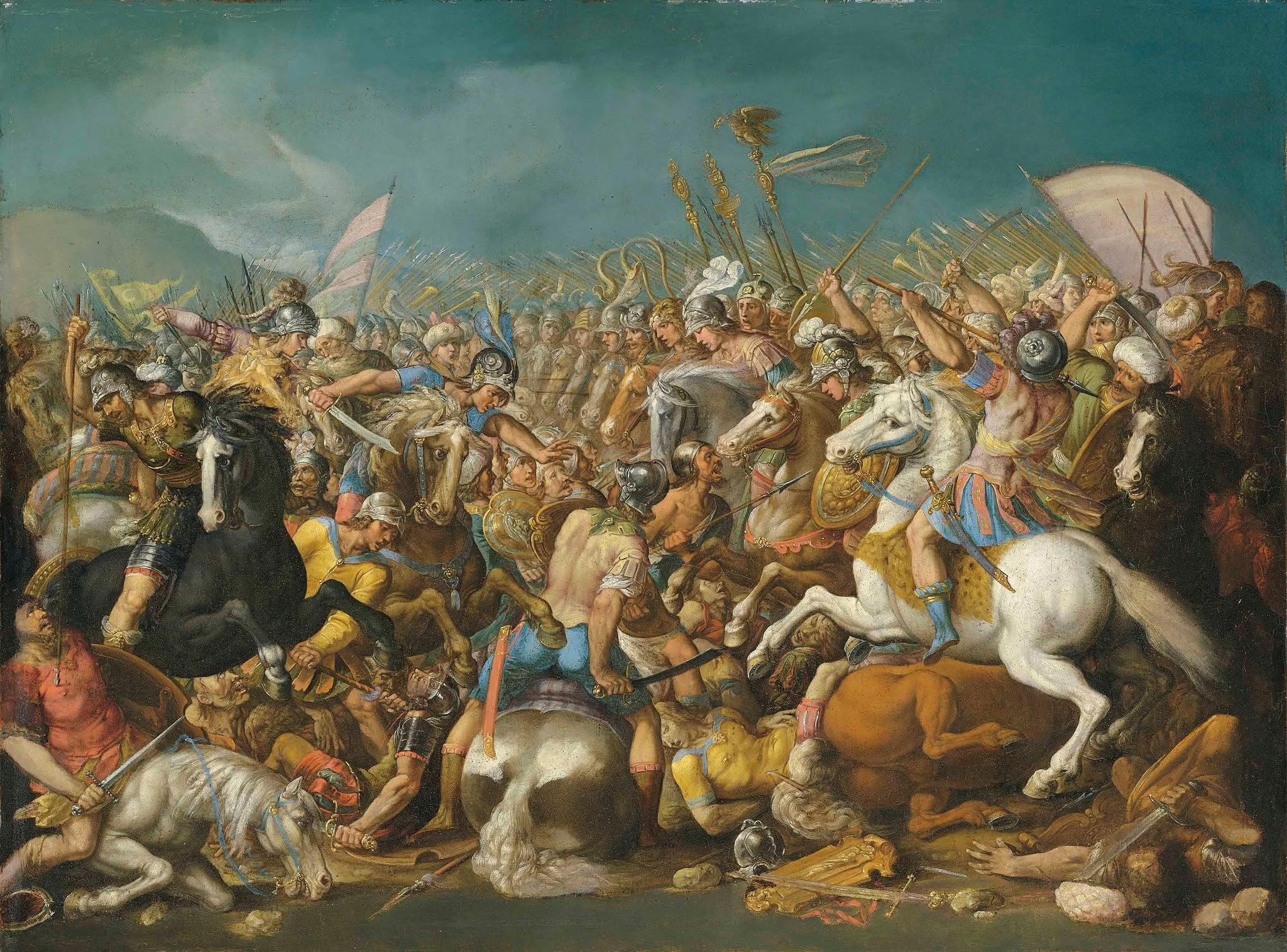
A classical battle, probably depicting the defeat of Hannibal by Scipio Africanus Major (circa 235-183 B.C.). 17th century
author Bernardino Cesari


