
Part I:
Polybius’ Theory of Political History:
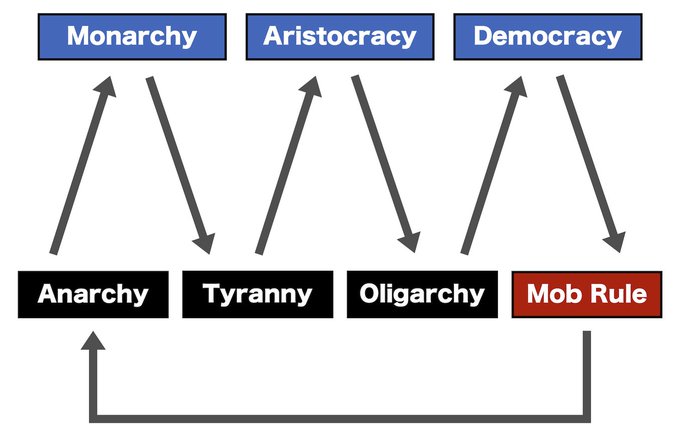
Polybius’ Famous Theory of Anacyclosis: circular cycle of regimes: Polybius believed that human societies naturally cycle through six forms of government in a continuous, repeating loop.
Polybius on the classification of polities: “Now, it is undoubtedly the case that most of those who profess to give us authoritative instruction on this subject distinguish three kinds of constitutions, which they designate kingship, aristocracy, democracy. But in my opinion the question might fairly be put to them, whether they name these as being the only ones, or as the best. In either case I think they are wrong. For it is plain that we must regard as the best constitution that which partakes of all these three elements. And this is no mere assertion, but has been proved by the example of Lycurgus, who was the first to construct a constitution—that of Sparta—on this principle. Nor can we admit that these are the only forms: for we have had before now examples of absolute and tyrannical forms of government, which, while differing as widely as possible from kingship, yet appear to have some points of resemblance to it; on which account all absolute rulers falsely assume and use, as far as they can, the title of king. Again there have been many instances of oligarchical governments having in appearance some analogy to aristocracies, which are, if I may say so, as different from them as it is possible to be. The same also holds good about democracy.”
Six forms of polity, and their natural cycle: “I will illustrate the truth of what I say. We cannot hold every absolute government to be a kingship, but only that which is accepted voluntarily, and is directed by an appeal to reason rather than to fear and force. Nor again is every oligarchy to be regarded as an aristocracy; the latter exists only where the power is wielded by the justest and wisest men selected on their merits. Similarly, it is not enough to constitute a democracy that the whole crowd of citizens should have the right to do whatever they wish or propose. But where reverence to the gods, succour of parents, respect to elders, obedience to laws, are traditional and habitual, in such communities, if the will of the majority prevail, we may speak of the form of government as a democracy. So then we enumerate six forms of government,—the three commonly spoken of which I have just mentioned, and three more allied forms, I mean despotism, oligarchy and mob-rule. The first of these arises without artificial aid and in the natural order of events. Next to this, and produced from it by the aid of art and adjustment, comes kingship; which degenerating into the evil form allied to it, by which I mean tyranny, both are once more destroyed and aristocracy produced. Again the latter being in the course of nature perverted to oligarchy, and the people passionately avenging the unjust acts of their rulers, democracy comes into existence; which again by its violence and contempt of law becomes sheer mob-rule. No clearer proof of the truth of what I say could be obtained than by a careful observation of the natural origin, genesis, and decadence of these several forms of government. For it is only by seeing distinctly how each of them is produced that a distinct view can also be obtained of its growth, zenith, and decadence, and the time, circumstance, and place in which each of these may be expected to recur. This method I have assumed to be especially applicable to the Roman constitution, because its origin and growth have from the first followed natural causes.”
The origin of the social compact: “What is the origin then of a constitution, and whence is it produced? Suppose that from floods, pestilences, failure of crops, or some such causes the race of man is reduced almost to extinction. Such things we are told have happened, and it is reasonable to think will happen again. Suppose accordingly all knowledge of social habits and arts to have been lost. Suppose that from the survivors, as from seeds, the race of man to have again multiplied. In that case I presume they would, like the animals, herd together; for it is but reasonable to suppose that bodily weakness would induce them to seek those of their own kind to herd with. And in that case too, as with the animals, he who was superior to the rest in strength of body or courage of soul would lead and rule them. For what we see happen in the case of animals that are without the faculty of reason, such as bulls, goats, and cocks,—among whom there can be no dispute that the strongest take the lead,—that we must regard as in the truest sense the teaching of nature. Originally then it is probable that the condition of life among men was this,—herding together like animals and following the strongest and bravest as leaders. The limit of this authority would be physical strength, and the name we should give it would be despotism. But as soon as the idea of family ties and social relation has arisen amongst such agglomerations of men, then is born also the idea of kingship, and then for the first time mankind conceives the notion of goodness and justice and their reverse.”
Origin of morality: “The way in which such conceptions originate and come into existence is this. The intercourse of the sexes is an instinct of nature, and the result is the birth of children. Now, if any one of these children who have been brought up, when arrived at maturity, is ungrateful and makes no return to those by whom he was nurtured, but on the contrary presumes to injure them by word and deed, it is plain that he will probably offend and annoy such as are present, and have seen the care and trouble bestowed by the parents on the nurture and bringing up of their children. For seeing that men differ from the other animals in being the only creatures possessed of reasoning powers, it is clear that such a difference of conduct is not likely to escape their observation; but that they will remark it when it occurs, and express their displeasure on the spot: because they will have an eye to the future, and will reason on the likelihood of the same occurring to each of themselves. Again, if a man has been rescued or helped in an hour of danger, and, instead of showing gratitude to his preserver, seeks to do him harm, it is clearly probable that the rest will be displeased and offended with him, when they know it: sympathising with their neighbour and imagining themselves in his case. Hence arises a notion in every breast of the meaning and theory of duty, which is in fact the beginning and end of justice. Similarly, again, when any one man stands out as the champion of all in a time of danger, and braves with firm courage the onslaught of the most powerful wild beasts, it is probable that such a man would meet with marks of favour and pre-eminence from the common people; while he who acted in a contrary way would fall under their contempt and dislike.”
Which transmutes despotism into kingship: “From this, once more, it is reasonable to suppose that there would arise in the minds of the multitude a theory of the disgraceful and the honourable, and of the difference between them; and that one should be sought and imitated for its advantages, the other shunned. When, therefore, the leading and most powerful man among his people ever encourages such persons in accordance with the popular sentiment, and thereby assumes in the eyes of his subject the appearance of being the distributor to each man according to his deserts, they no longer obey him and support his rule from fear of violence, but rather from conviction of its utility, however old he may be, rallying round him with one heart and soul, and fighting against all who form designs against his government. In this way he becomes a king instead of a despot by imperceptible degrees, reason having ousted brute courage and bodily strength from their supremacy.”
Which in its turn degenerates into tyranny: “This then is the natural process of formation among mankind of the notion of goodness and justice, and their opposites; and this is the origin and genesis of genuine kingship; for people do not only keep up the government of such men personally, but for their descendants also for many generations; from the conviction that those who are born from and educated by men of this kind will have principles also like theirs. But if they subsequently become displeased with their descendants, they do not any longer decide their choice of rulers and kings by their physical strength or brute courage; but by the differences of their intellectual and reasoning faculties, from practical experience of the decisive importance of such a distinction. In old times, then, those who were once thus selected, and obtained this office, grew old in their royal functions, making magnificent strongholds and surrounding them with walls and extending their frontiers, partly for the security of their subjects, and partly to provide them with abundance of the necessaries of life; and while engaged in these works they were exempt from all vituperation or jealousy; because they did not make their distinctive dress, food, or drink, at all conspicuous, but lived very much like the rest, and joined in the everyday employments of the common people. But when their royal power became hereditary in their family, and they found every necessary for security ready to their hands, as well as more than was necessary for their personal support, then they gave the rein to their appetites; imagined that rulers must needs wear different clothes from those of subjects; have different and elaborate luxuries of the table; and must even seek sensual indulgence, however unlawful the source, without fear of denial. These things having given rise in the one case to jealousy and offence, in the other to outburst of hatred and passionate resentment, the kingship became a tyranny; the first step in disintegration was taken; and plots began to be formed against the government, which did not now proceed from the worst men but from the noblest, most high-minded, and most courageous, because these are the men who can least submit to the tyrannical acts of their rulers.”
Tyranny is then displaced by aristocracy: “But as soon as the people got leaders, they co-operated with them against the dynasty for the reasons I have mentioned; and then kingship and despotism were alike entirely abolished, and aristocracy once more began to revive and start afresh. For in their immediate gratitude to those who had deposed the despots, the people employed them as leaders, and entrusted their interests to them; who, looking upon this charge at first as a great privilege, made the public advantage their chief concern, and conducted all kinds of business, public or private, with diligence and caution. Which degenerates into oligarchy: But when the sons of these men received the same position of authority from their fathers,—having had no experience of misfortunes, and none at all of civil equality and freedom of speech, but having been bred up from the first under the shadow of their fathers’ authority and lofty position,—some of them gave themselves up with passion to avarice and unscrupulous love of money, others to drinking and the boundless debaucheries which accompanies it, and others to the violation of women or the forcible appropriation of boys; and so they turned an aristocracy into an oligarchy. But it was not long before they roused in the minds of the people the same feelings as before; and their fall therefore was very like the disaster which befell the tyrants.” (italics are mine)*
Which is replaced by democracy: “For no sooner had the knowledge of the jealousy and hatred existing in the citizens against them emboldened some one to oppose the government by word or deed, than he was sure to find the whole people ready and prepared to take his side. Having then got rid of these rulers by assassination or exile, they do not venture to set up a king again, being still in terror of the injustice to which this led before; nor dare they intrust the common interests again to more than one, considering the recent example of their misconduct: and therefore, as the only sound hope left them is that which depends upon themselves, they are driven to take refuge in that; and so changed the constitution from an oligarchy to a democracy, and took upon themselves the superintendence and charge of the state. And as long as any survive who have had experience of oligarchical supremacy and domination, they regard their present constitution as a blessing, and hold equality and freedom as of the utmost value. Which degenerates into rule of corruption and violence, only to be stopped by a return to despotism: But as soon as a new generation has arisen, and the democracy has descended to their children’s children, long association weakens their value for equality and freedom, and some seek to become more powerful than the ordinary citizens; and the most liable to this temptation are the rich. So when they begin to be fond of office, and find themselves unable to obtain it by their own unassisted efforts and their own merits, they ruin their estates, while enticing and corrupting the common people in every possible way. By which means when, in their senseless mania for reputation, they have made the populace ready and greedy to receive bribes, the virtue of democracy is destroyed, and it is transformed into a government of violence and the strong hand. For the mob, habituated to feed at the expense of others, and to have its hopes of a livelihood in the property of its neighbours, as soon as it has got a leader sufficiently ambitious and daring, being excluded by poverty from the sweets of civil honours, produces a reign of mere violence. Then come tumultuous assemblies, massacres, banishments, redivisions of land; until, after losing all trace of civilisation, it has once more found a master and a despot.”
“This is the regular cycle of constitutional revolutions, and the natural order in which constitutions change, are transformed, and return again to their original stage. If a man have a clear grasp of these principles he may perhaps make a mistake as to the dates at which this or that will happen to a particular constitution; but he will rarely be entirely mistaken as to the stage of growth or decay at which it has arrived, or as to the point at which it will undergo some revolutionary change. However, it is in the case of the Roman constitution that this method of inquiry will most fully teach us its formation, its growth, and zenith, as well as the changes awaiting it in the future; for this, if any constitution ever did, owed, as I said just now, its original foundation and growth to natural causes, and to natural causes will owe its decay.”
“All those changes which I have enumerated come about by an undeviating law of nature; and reflected that every form of government that was unmixed, and rested on one species of power, was unstable; because it was swiftly perverted into that particular form of evil peculiar to it and inherent in its nature. For just as rust is the natural dissolvent of iron, wood-worms and grubs to timber, by which they are destroyed without any external injury, but by that which is engendered in themselves; so in each constitution there is naturally engendered a particular vice inseparable from it: in kingship it is absolutism; aristocracy it is oligarchy; in democracy lawless ferocity andviolence; and to these vicious states all these forms of government are, as I have lately shown, inevitably transformed.”- Polybius The Histories. Bk 6 sections 1-10.
Polybius argued that regimes were in an endless cycle, and the three basic forms of government are destined to degenerate into their lower forms — and lead back to anarchy.
But there’s a way to fix it…
Part II:
Polybius and the Roman Constitution:
“I am aware that some will be at a loss to account for my interrupting the course of my narrative for the sake of entering upon the following disquisition on the Roman constitution. But I think that I have already in many passages made it fully evident that this particular branch of my work was one of the necessities imposed on me by the nature of my original design; and I pointed this out with special clearness in the preface which explained the scope of my history. I there stated that the feature of my work which was at once the best in itself, and the most instructive to the students of it, was that it would enable them to know and fully realise in what manner, and under what kind of constitution, it came about that nearly the whole world fell under the power of Rome in somewhat less than fifty-three years,—an event certainly without precedent…What is really educational and beneficial to students of history is the clear view of the causes of events, and the consequent power of choosing the better policy in a particular case. Now in every practical undertaking by a state we must regard as the most powerful agent for success or failure the form of its constitution; for from this as from a fountain-head all conceptions and plans of action not only proceed, but attain their consummation.” – Polybius The Histories. Bk 6 Preface.
“I will now endeavour to describe that of Rome at the period of their disastrous defeat at Cannae…”
Triple element in the Roman Constitution: “As for the Roman constitution, it had three elements, each of them possessing sovereign powers: and their respective share of power in the whole state had been regulated with such a scrupulous regard to equality and equilibrium, that no one could say for certain, not even a native, whether the constitution as a whole were an aristocracy or democracy or despotism. And no wonder: for if we confine our observation to the power of the Consuls we should be inclined to regard it as despotic; if on that of the Senate, as aristocratic; and if finally one looks at the power possessed by the people it would seem a clear case of a democracy. What the exact powers of these several parts were, and still, with slight modifications, are, I will now state.
The Consuls: “The Consuls, before leading out the legions, remain in Rome and are supreme masters of the administration. All other magistrates, except the Tribunes, are under them and take their orders. They introduce foreign ambassadors to the Senate; bring matters requiring deliberation before it; and see to the execution of its decrees. If, again, there are any matters of state which require the authorisation of the people, it is their business to see to them, to summon the popular meetings, to bring the proposals before them, and to carry out the decrees of the majority. In the preparations for war also, and in a word in the entire administration of a campaign, they have all but absolute power. It is competent to them to impose on the allies such levies as they think good, to appoint the Military Tribunes, to make up the roll for soldiers and select those that are suitable. Besides they have absolute power of inflicting punishment on all who are under their command while on active service and they have authority to expend as much of the public money as they choose, being accompanied by a quaestor who is entirely at their orders. A survey of these powers would in fact justify our describing the constitution as despotic,—a clear case of royal government. Nor will it affect the truth of my description, if any of the institutions I have described are changed in our time, or in that of our posterity: and the same remarks apply to what follows.”
The Senate: “The Senate has first of all the control of the treasury, and regulates the receipts and disbursements alike. For the Quaestors cannot issue any public money for the various departments of the state without a decree of the Senate, except for the service of the Consuls. The Senate controls also what is by far the largest and most important expenditure, that, namely, which is made by the censors every lustrum for the repair or construction of public buildings; this money cannot be obtained by the censors except by the grant of the Senate. Similarly all crimes committed in Italy requiring a public investigation, such as treason, conspiracy, poisoning, or wilful murder, are in the hands of the Senate. Besides, if any individual or state470 among the Italian allies requires a controversy to be settled, a penalty to be assessed, help or protection to be afforded,—all this is the province of the Senate. Or again, outside Italy, if it is necessary to send an embassy to reconcile warring communities, or to remind them of their duty, or sometimes to impose requisitions upon them, or to receive their submission, or finally to proclaim war against them,—this too is the business of the Senate. In like manner the reception to be given to foreign ambassadors in Rome, and the answers to be returned to them, are decided by the Senate. With such business the people have nothing to do. Consequently, if one were staying at Rome when the Consuls were not in town, one would imagine the constitution to be a complete aristocracy: and this has been the idea entertained by many Greeks, and by many kings as well, from the fact that nearly all the business they had with Rome was settled by the Senate.”
The people: “After this one would naturally be inclined to ask what part is left for the people in the constitution, when the Senate has these various functions, especially the control of the receipts and expenditure of the exchequer; and when the Consuls, again, have absolute power over the details of military preparation, and an absolute authority in the field? There is, however, a part left the people, and it is a most important one. For the people is the sole fountain of honour and of punishment; and it is by these two things and these alone that dynasties and constitutions and, in a word, human society are held together: for where the distinction between them is not sharply drawn both in theory and practice, there no undertaking can be properly administered,—as indeed we might expect when good and bad are held in exactly the same honour. The people then are the only court to decide matters of life and death; and even in cases where the penalty is money, if the sum to be assessed is sufficiently serious, and especially when the accused have held the higher magistracies. And in regard to this arrangement there is one point deserving especial commendation and record. Men who are on trial for their lives at Rome, while sentence is in process of being voted,—if even only one of the tribes whose votes are needed to ratify the sentence has not voted,—have the privilege at Rome of openly departing and condemning themselves to a voluntary exile. Such men are safe at Naples or Praeneste or at Tibur, and at other towns with which this arrangement has been duly ratified on oath…”
“Again, it is the people who bestow offices on the deserving, which are the most honourable rewards of virtue. It has also the absolute power of passing or repealing laws; and, most important of all, it is the people who deliberate on the question of peace or war. And when provisional terms are made for alliance, suspension of hostilities, or treaties, it is the people who ratify them or the reverse…”
“These considerations again would lead one to say that the chief power in the state was the people’s, and that the constitution was a democracy.”
The mutual relation of the three: “Such, then, is the distribution of power between the several parts of the state. I must now show how each of these several parts can, when they choose, oppose or support each other…”
The Consul dependent on the Senate: “The Consul, then, when he has started on an expedition with the powers I have described, is to all appearance absolute in the administration of the business in hand; still he has need of the support both of people and Senate, and, without them, is quite unable to bring the matter to a successful conclusion. For it is plain that he must have supplies sent to his legions from time to time; but without a decree of the Senate they can be supplied neither with corn, nor clothes, nor pay, so that all the plans of a commander must be futile, if the Senate is resolved either to shrink from danger or hamper his plans. And again, whether a Consul shall bring any undertaking to a conclusion or no depends entirely upon the Senate: for it has absolute authority at the end of a year to send another Consul to supersede him, or to continue the existing one in his command. Again, even to the successes of the generals the Senate has the power to add distinction and glory, and on the other hand to obscure their merits and lower their credit. For these high achievements are brought in tangible form before the eyes of the citizens by what are called “triumphs.”
and on the people: “But these triumphs the commanders cannot celebrate with proper pomp, or in some cases celebrate at all, unless the Senate concurs and grants the necessary money. As for the people, the Consuls are pre-eminently obliged to court their favour, however distant from home may be the field of their operations; for it is the people, as I have said before, that ratifies, or refuses to ratify, terms of peace and treaties; but most of all because when laying down their office they have to give an account291 of their administration before it. Therefore in no case is it safe for the Consuls to neglect either the Senate or the goodwill of the people.”
The Senate controlled by the people: “As for the Senate, which possesses the immense power I have described, in the first place it is obliged in public affairs to take the multitude into account, and respect the wishes of the people; and it cannot put into execution the penalty for offences against the republic, which are punishable with death, unless the people first ratify its decrees. Similarly even in matters which directly affect the senators,—for instance, in the case of a law diminishing the Senate’s traditional authority, or depriving senators of certain dignities and offices, or even actually cutting down their property,—even in such cases the people have the sole power of passing or rejecting the law. But most important of all is the fact that, if the Tribunes interpose their veto, the Senate not only are unable to pass a decree, but cannot even hold a meeting at all, whether formal or informal. Now, the Tribunes are always bound to carry out the decree of the people, and above all things to have regard to their wishes: therefore, for all these reasons the Senate stands in awe of the multitude, and cannot neglect the feelings of the people.”
The people dependent on the Senate: “In like manner the people on its part is far from being independent of the Senate, and is bound to take its wishes into account both collectively and individually. For contracts, too numerous to count, are given out by the censors in all parts of Italy for the repairs or construction of public buildings; there is also the collection of revenue from many rivers, harbours, gardens, mines, and land—everything, in a word, that comes under the control of the Roman government: and in all these the people at large are engaged; so that there is scarcely a man, so to speak, who is not interested either as a contractor or as being employed in the works. For some purchase the contracts from the censors for themselves; and others go partners with them; while others again go security for these contractors, or actually pledge their property to the treasury for them. Now over all these transactions the Senate has absolute control. It can grant an extension of time; and in case of unforeseen accident can relieve the contractors from a portion of their obligation, or release them from it altogether, if they are absolutely unable to fulfil it. And there are many details in which the Senate can inflict great hardships, or, on the other hand, grant great indulgences to the contractors: for in every case the appeal is to it. But the most important point of all is that the judges are taken from its members in the majority of trials, whether public or private, in which the charges are heavy. Consequently, all citizens are much at its mercy; and being alarmed at the uncertainty as to when they may need its aid, are cautious about resisting or actively opposing its will… and Consul: And for a similar reason men do not rashly resist the wishes of the Consuls, because one and all may become subject to their absolute authority on a campaign.”
“The result of this power of the several estates for mutual help or harm is a union sufficiently firm for all emergencies, and a constitution than which it is impossible to find a better. For whenever any danger from without compels them to unite and work together, the strength which is developed by the State is so extraordinary, that everything required is unfailingly carried out by the eager rivalry shown by all classes to devote their whole minds to the need of the hour, and to secure that any determination come to should not fail for want of promptitude; while each individual works, privately and publicly alike, for the accomplishment of the business in hand. Accordingly, the peculiar constitution of the State makes it irresistible, and certain of obtaining whatever it determines to attempt. Nay, even when these external alarms are past, and the people are enjoying their good fortune and the fruits of their victories, and, as usually happens, growing corrupted by flattery and idleness, show a tendency to violence and arrogance,—it is in these circumstances, more than ever, that the constitution is seen to possess within itself the power of correcting abuses. For when any one of the three classes becomes puffed up, and manifests an inclination to be contentious and unduly encroaching, the mutual interdependency of all the three, and the possibility of the pretensions of any one being checked and thwarted by the others, must plainly check this tendency: and so the proper equilibrium is maintained by the impulsiveness of the one part being checked by its fear of the other….” -Polybius The Histories. Bk 6 Sections 11-18.
Polybius characterized the Roman constitution as a mixed form of government, which in his view was the best form of government. For this reason, combined with military might, Rome had achieved dominion over the known world in a matter of 53 years. The constitution was virtuous because it provided a system of checks and balances that contained aspects of each of his three basic types: kingship, aristocracy, and democracy, yet no one aspect of the constitution could become dominant and each part depended on the others to carry out its functions. He argued that the rotation of polities was a natural course of events, exemplified more clearly by Rome than any other state. To his mind the Roman system of government was the product of natural causes, destined to arise, destined to rule.
America’s founders based our constitution on many of the principles set down by the Romans. Written in 1787, ratified in 1788, and in operation since 1789, the United States Constitution is the world’s longest surviving written charter of government. Its longevity primarily due to its clearly defined system of check and balances. But now we are facing an unprecedented assault against these cherished principles led by the aspiring tyrant Donald Trump and enabled by the GOP and Supreme Court, who don’t even try to hide that they have abandoned their oaths of office and have sworn fealty to him over the Constitution. They more resemble a crime organization than a government “of the people, by the people, for the people.” They are traitors to our democracy plain and simple. But if we subscribe to Polybius’ circular theory of regimes there is hope on the horizon, and although it will get worse before it gets better, a time of reckoning will come for these usurpers. Our sacred freedoms enshrined in the constitution shall not perish from the earth.
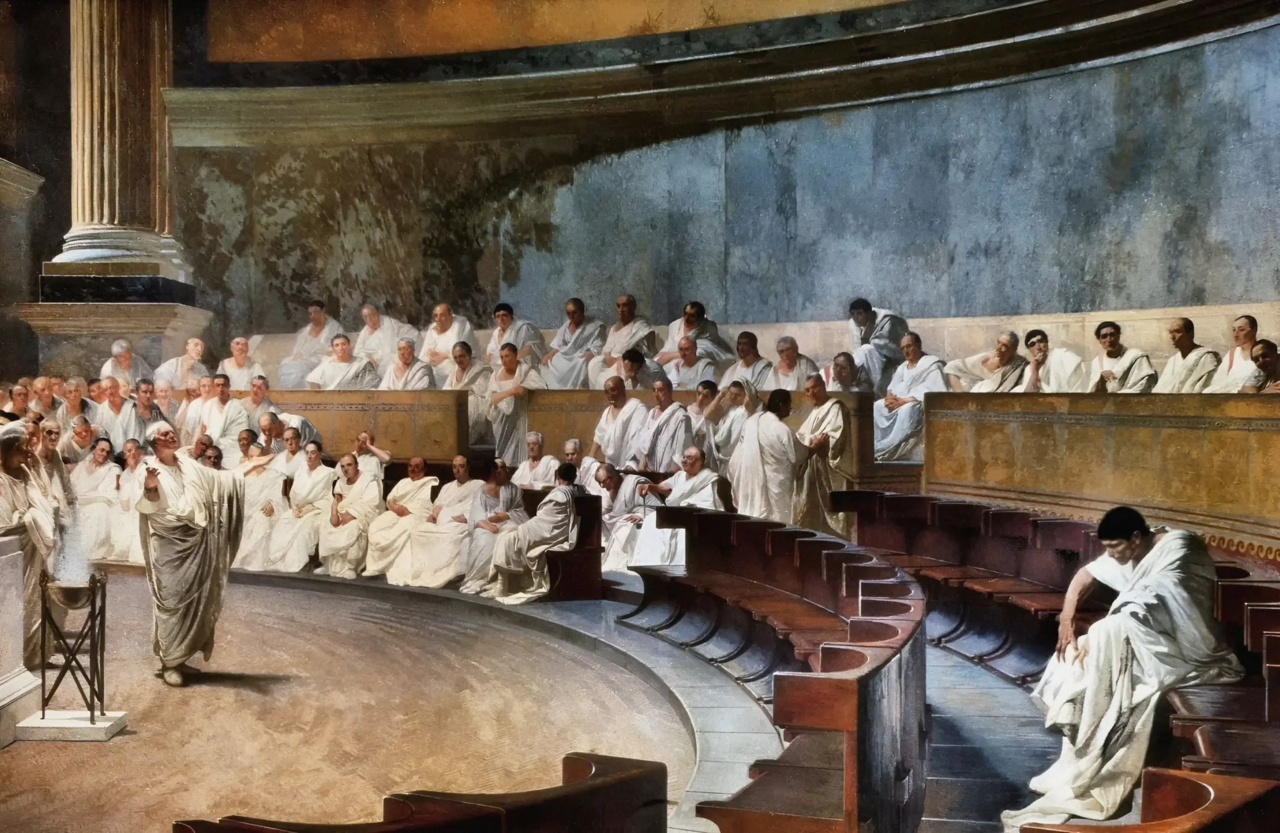
A fresco by Cesare Maccari (1840-1919) depicting Roman senator Cicero (106-43 BCE) denouncing Catiline’s conspiracy to overthrow the Republic in the Roman senate. (Palazzo Madama, Rome).
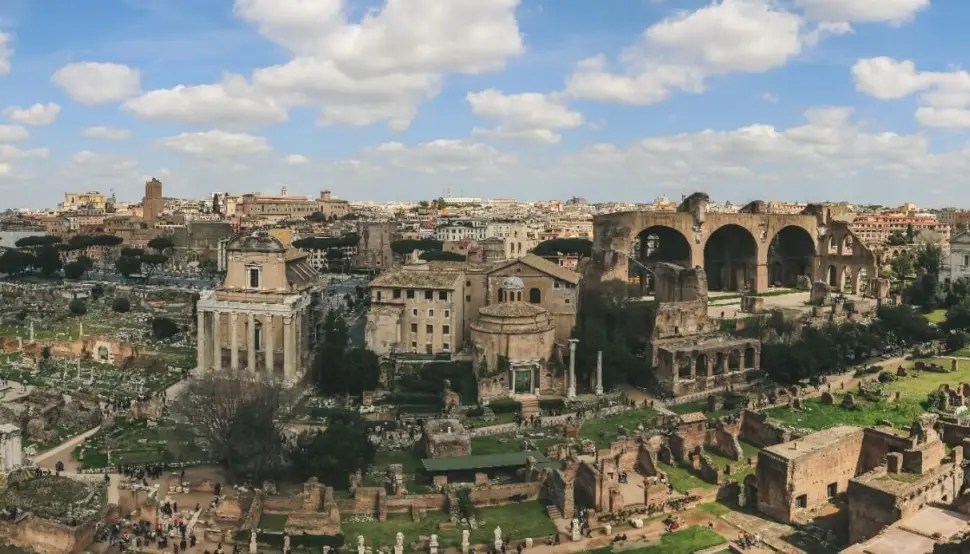
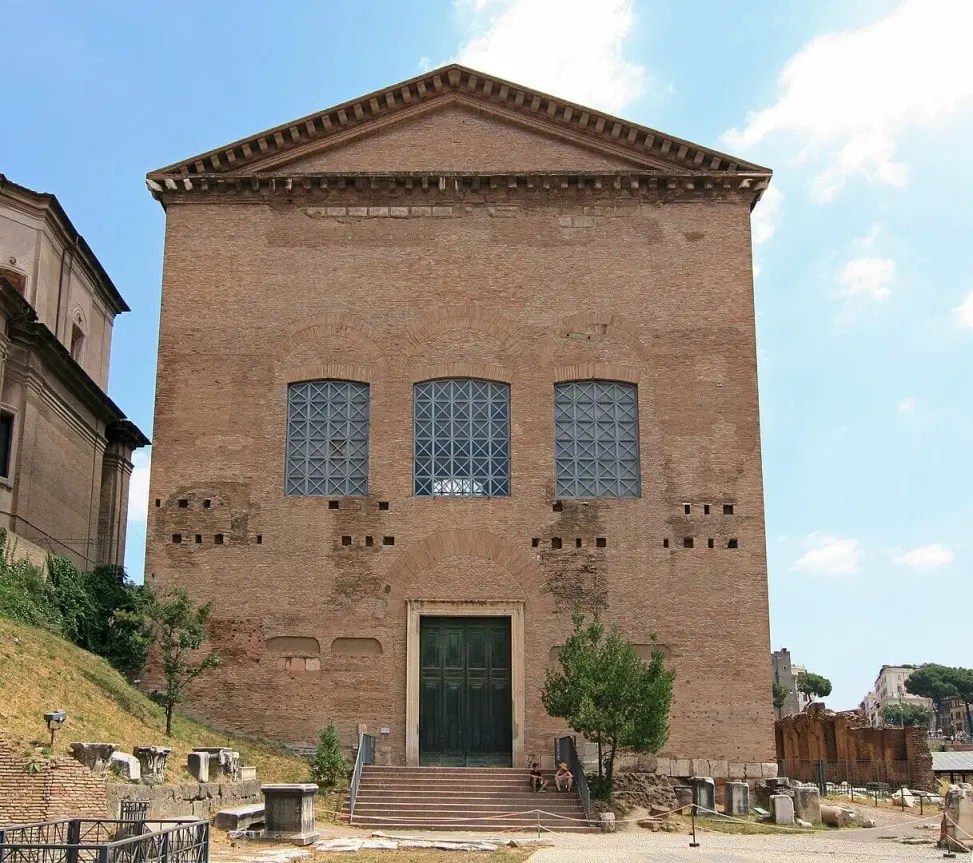
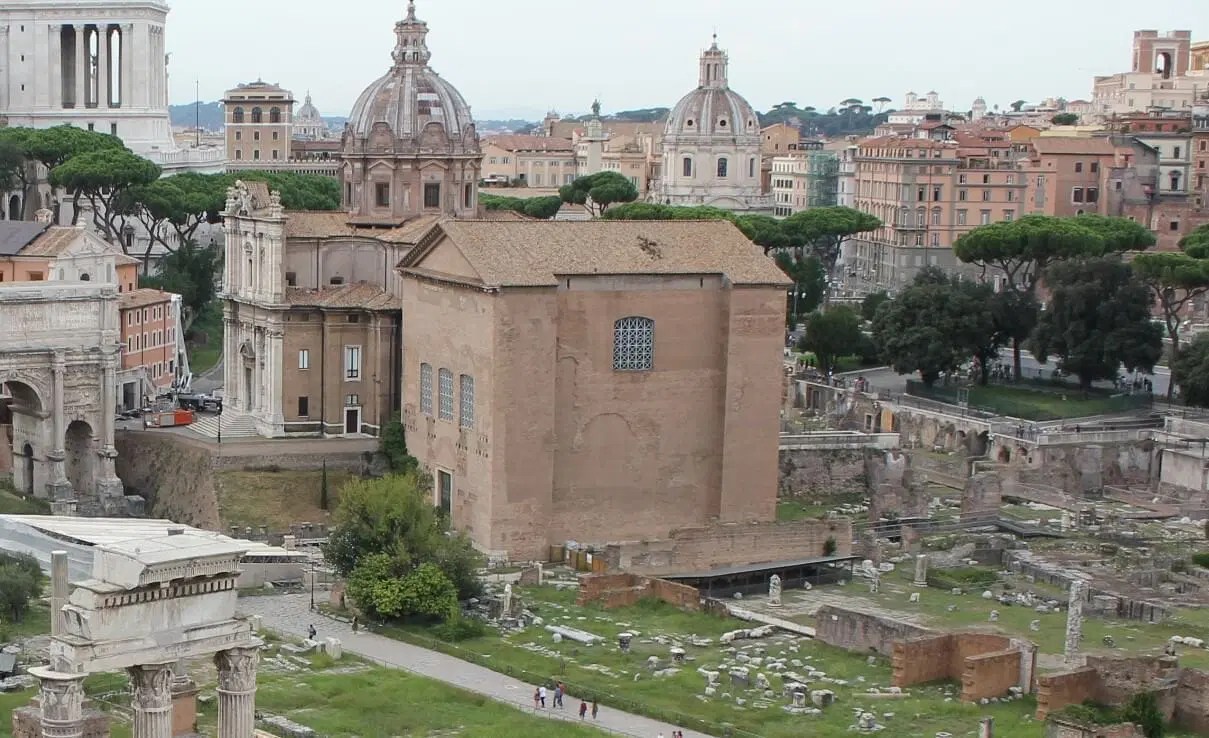
The Curia at the Forum. The meeting house of the Senate of Rome. The present building was begun by Julius Caesar in 44 BCE and later completed and dedicated by Augustus Caesar around 29 BCE. The building was rebuilt around 238 CE by Diocletian.
Part III – The Roman Republic Compared With Others
Part IV – On Military Leadership
Part V – Rise of Hannibal Barca
Part VI – The Siege At Syracuse
Part VII – Publius Cornelius Scipio Africanus
Part VIII – On Historians and The Methods of Composing History
Part IX – Criticism of Timaeus
Part XI – Epilogue: The Decline and Fall of American Civilization
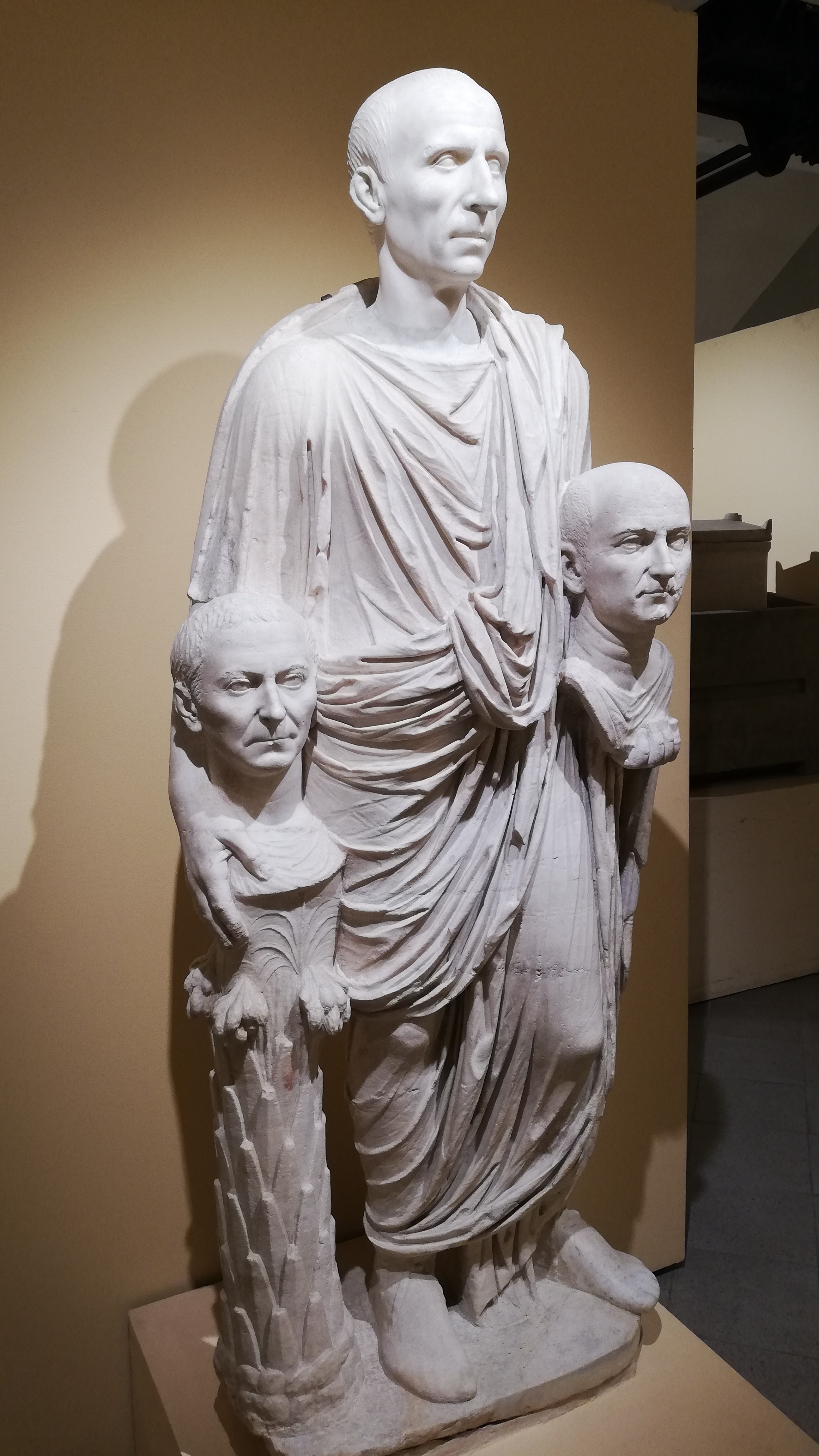
The “Togatus Barberini“, a statue depicting a Roman senator holding the images of deceased ancestors in his hands. Marble, late 1st century BC.
All Primary Text Taken From:
See Also:
Livy’s Class Warfare – 2700 Hundred Years and Counting
Thomas Hobbes: The Long Reach of the Leviathan
Ahmad al-Mansur (1549-1603) Renaissance Diplomacy Moroccan Style


