Category Archives: Essays

The Art of the Con: The Great American Narrative

Sarah Huckabee Sanders is leaving us. She is turning in her tin star to ride off into the sunset. The hornswoggling daughter of an accomplished Arkansas hoodwinker, Sanders made the big time by fronting for the ultimate flimflan man, Donald Trump. It’s the great American story. From PT Barnum and Buffalo Bill to Bernie Madoff and the TV evangelists (and TV Generals too) America’s history is littered with “heroes” whose only great talents were for fooling us, sometimes for a quick buck, sometimes for political or ideological gain, sometimes for both.

How do they do it, especially in this time when we supposedly have access to all of the data we need to make informed judgments right at our finger tips?

In this age of media saturation we live in a country that has defined itself through its deceptions. We the people are delusional about who we are and who we’ve been. The spirit of our age is firmly rooted in a seedbed of contrived stories consumed through mass communication. We are never satisfied because our extravagant expectations rarely match up with reality and so we are forever searching for the next big thing, or hitting it big, or making the big time. Our story is fed to us through the filtering medium of the lens and the slanting pens of editorial offices.* Kennedy won the election because Nixon didn’t have a close enough shave, but Nixon really won because Kennedy cheated in Texas and Chicago. Kennedy was a good guy killed by a lone outlaw and Nixon was an outlaw killed by a two good guys, a deep throat and a tape recorder. Kennedy goes down as hero, Nixon as villain. As unseemly as it all sounds it has become national folklore. Within this communal hallucination “all that is solid melts into air.” The real has become laborious, its minutiae too difficult to comprehend and its details too boring to memorize. The condensed, filtered, repackaged fantastic interpretation becomes more appealing, more exciting, easier. It’s almost as if we like to be duped. As if, like Barnum told us, being suckered is part of the experience of being American. The art of the con itself is based on creating illusions, and the best artists are the most deceptive ones.

A by-product of this simulated reality is the creation of the celebrity. A person who, as Daniel Boorstin points out, is well-known for no good reason other than for his/her well-known ness. The existence of public relations and marketing (fantasy image makers that have actually made themselves into a fantasy image–Madison Avenue and Mad Men) is largely dependent on convincing the masses to admire people who have never done anything to help them and to buy things that they don’t really need. (See Boorstin, Daniel. The Image: A Guide to Pseudo Events in America. Atheneum: New York, 1962). In this they have been wildly successful. Celebrities occupy the highest rung on the status ladder in America today, higher than teachers, higher than workers, higher than doctors (although many celebrities have become famous for playing them on TV), firefighters, architects, reporters, politicians, higher than pretty much everyone who actually contributes to the well-being of society. Only businessmen rival celebrities in popularity, many of whom have become celebrities themselves, thanks again to the sleight of hand of public relations and marketing.

In Gunfighter Nation, Author Richard Slotkin posits convincingly that, when considering our culture, politics, and foreign policy, the myth of the frontier has been, and still is, the primary frame within which our imaginations are stirred to action. The role of the frontier hero, usually represented as a tough lawman, tirelessly fighting against outlaws and savages in the name of progress is a dominant theme taken up by leaders from Teddy Roosevelt (The Winning of the West ) to JFK, LBJ and Ronald Reagan to justify everything from gunboat diplomacy to fighting Communism in far away lands, i.e., on the frontier. That skewed worldview has been faithfully supported by the culture industry, promoted in fiction and Dime novels, and in Hollywood, especially in westerns, but also in war and crime genres. Slotkin argues that simulated heroes played by the likes Buffalo Bill (playing himself), William S. Hart, Gary Cooper and John Wayne are so closely associated with Americans’ conception of the frontier myth because they were such important components in its evolution. There is a reason that Hollywood is called the Dream factory. (see Gunfighter Nation: Myth of the Frontier in Twentieth-Century America Atheneum: New York, 1992)

These threads converge in the Trump scenario. The ascendance of Donald and Sarah, both celebrities, both only recognizable for being recognized in the media, neither with any appreciable “real” talent, represents the reappearance of two of the foundational forms in the American drama- the con man and his trusted sidekick. For Trump, the outlaws are the Democrats and the savages are immigrants, corporate regulators, climate advocates and people seeking assistance from the government. But Trump takes it to a new level by representing the merger of several of the archetypal character types found in the American mythological narrative. Depending on who you ask he assumes the role of con man, outlaw or tough lawman. Sometimes all three at once, and that is somehow ok for many of his supporters. The fact that he seems to stand out above the sordid crowd alerts us to what is most sinister about him. He and Sarah spin up a show that is patently outrageous, they are the attention getters. Yet the true crime, the ongoing stagecoach robbery and swindling of the passengers, continues relatively hidden behind the scenes.

American history is a mythical history. From the frontier days to the modern world the outlaw, the con man and the lawman have been, and continue to be, central characters in that myth. The overarching theme is the struggle for the acquisition of wealth, property and security between the powerful and the powerless, haves and have nots, whites and nonwhites, bosses and workers etc. Depending on the time and circumstances the fortunes of the groups have changed in relation to each other. But the long term trend, albeit not entirely linear, has been the consolidation of victory for the few, many of whom are mere celebrities, Trump being the poster child, Sarah gracing the handbill. Historically a reliable brake against the greed of the powerful, many of them legalized outlaws, con men and law men, has been their fear of the masses. That is, the fear of democracy. Now the stage in the theatre of democracy, upon which our national mythology has been acted out, is in danger of being condemned for its rotting foundations. Historian Eric Hobsbawn put it succinctly– “One of the worst things about the politics of the past 30 years is that the rich have forgotten to be afraid of the poor.” Not only do they no longer fear us they have actually convinced many of us that the outlaw con man is the best lawman. And every good sheriff needs a loyal deputy–adios senora Sarah…

With so many unfilled posts in his administration the next feature on the Donald double-bill: The Searchers

* A side note: one space where the real continues to transfix us is in the realm of true crime reporting. We are fascinated with the spontaneity of crime, it’s one of the rare experiences that is not totally contrived, that’s why its influence is outsized proportionally in the news cycle. We love to make fun of the incompetents, we secretly admire the masterminds, but we are always afraid of being a victim, thus we are easy targets for the personal security rackets. This may also be why sports are so popular. They are one of the few remaining forums for spontaneous non-contrived experiences. That’s not to say that the spectacle surrounding sports isn’t the equivalent of a PT Barnum event– a circus– but the game itself still maintains a sense and tension of the real. Anything can happen. The popularity of pro wrestling on the other hand informs us that the power of the contrived still remains immense in the American psyche, even in the domain of sports.

Related:

McLuhan, Marshall Understanding Media: The Extensions of Man. McGraw-Hill Book Company, New York, 1964

https://parallelnarratives.com/2016/07/11/the-century-of-the-self-bbc/

We know a lot less than we think about the world – which explains the allure of “simplism”

Cambodia, Kent State and the Kissinger Question?

May 4, 1970. Tin soldiers and Nixon coming. One of my long-standing fantasies has been to ask Henry Kissinger: if you could have a do-over, would you still instruct Nixon to invade Cambodia? Of course I’d have to administer some sort of truth serum first….

In many ways the Vietnam war had begun to turn in the United States’ favor by 1970. Albeit a political victory, the Tet Offensive in early 1968 had been a military disaster for the Vietcong.* Thousands of the best VC warriors were killed. As a result the authority of their Northern leaders had eroded greatly in VC eyes. For their part, Hanoi had lost faith in the southerners as surrogate fighters. By 1970 the VC was almost wiped out as a fighting force, and along with it went much of the tactical connection between the revolution and the villagers. The fish had almost been stripped from the water. The war was being fought primarily by NVA troops coming down the Ho Chi Minh Trail. But how long could they keep it up? In addition their de facto fifth column in the States, the anti-war movement, was fading. Peace talks were beginning to bear fruit for the first time. A negotiated settlement, what seemed like a pipe dream just a short time earlier, now seemed a real possibility. 

At home, as mentioned above, after years of marching, much of the anti-war movement had splintered. After turning out by the hundreds of thousands for protest events– Vietnam Day and the Teach-ins in 1965, the March on the Pentagon in 1967, Chicago 1968 and the National Moratorium in 1969– many had become demoralized by the lack of success and had gone home. Press and media coverage was also dissipating, the war was still raging in South Vietnam but it was no longer daily front page news. It seemed that the nation had decided to check out. Then suddenly, out of the blue it, Nixon invaded Cambodia. It was like throwing gas on a fire that appeared to be burning out.

Here is what was lost at that moment, by that decision:

1) World Stage: the war was never really supported by the allies but, not wanting to strain relations with their most powerful partner, most condoned it by looking the other way. Nevertheless, throughout the 1960s America’s credibility steadily plummeted along with its fortunes on the battlefield. Our friends couldn’t reconcile what they were seeing on TV and reading in newspapers with what they were being told by American leadership. This optic had been a signature of the war domestically for years, US military press briefings were famously known as the five o’clock follies, but the allies were slower to come to the conclusion that they too were being taken for a ride.

While Washington publicly denied it the U.S. Air Force had been secretly bombing in Cambodia and Laos throughout much of the war. They got away with it for the most part because the focus of reporting was primarily on what was happening next door in Vietnam. The invasion of Cambodia in 1970 sent reporters streaming across the border along with the troops, many of whom saw the tell-tale signs of previous bombing and reported on it.** Suddenly Cambodia went from a largely unknown sideshow on the world stage to front page news. Whatever credibility Washington still had internationally was severely damaged at this point. 

In truth, I doubt that Nixon or Kissinger gave a damn what the allies thought. In fact, it was deals made later with the enemies, Russia (SALT1) and China (1972 visit), not the allies, for which Nixon would end up being remembered. Those were master strokes indeed, and quickened the end of the war by peeling off the primary bankrollers from the Vietnamese cause, but it’s debatable whether the U.S. has ever fully recovered our prestige in the eyes of the world after our debacle in Vietnam and Cambodia. 

2) Vietnam: by 1970 North Vietnam’s benefactor nations, China and the USSR, were growing impatient with the seemingly endless war (remember the conflict really began way back in 1945 with the French). The war was beginning to become a political liability, especially for the Russians, who were already making overtures to the west to open dialogue on nuclear arms control. It had also become a money pit. Both countries were growing tired of sending support personnel and materials at discounted rates. Ho had died about six months earlier and the pressure was on the North Vietnamese politburo to come to the peace table seriously.

The invasion of Cambodia, its relative failure, and the political reaction to it back in the States, most famously at Kent State, immediately turned the situation back in North Vietnam’s favor. College campuses erupted across the country and protestors flooded back into the streets. Suddenly the North Vietnamese project had new legs as the Chinese and Russians watched the pictures of mayhem and discord in the heart of enemy territory. The time was again right to strike while the iron was hot. Each decided to renew the commitment to the cause. It would be another two and a half years before serious peace talks would resume.

3) Cambodia: Cambodia’s Prince Sihanouk had been walking a tight rope to keep his country out of the war on his doorstep. Under the guise of neutrality, which really wasn’t, he had so far miraculously kept out of the line of fire. But to do it he had made a deal with the North Vietnamese communists to allow them to use bases in his country near the border with South Vietnam and transport war materials through his port, called Sihanoukville. In return the North promised to contain the burgeoning monstrosity growing within Cambodia’s borders, the Khmer Rouge. What happened after they left indicates that the North Vietnamese troops had had a measure of success in this. Here’s how they left…

American generals, and pro-war pundits, had been calling for a Cambodian invasion for years. Because of the allowance by Sihanouk of NVA troops on his territory, in places like the Parrot’s Beak, within quick striking distance of Saigon, they bellowed that it was not a fair fight. They may have been right, but we were in someone else’s neighborhood, and fair doesn’t always enter into the equation. At any rate, LBJ’s fear of condemnation by western allies and world opinion kept him within the lines. But he bowed out in 1968. Enter Nixon/Kissinger. 

In March 1970 Sihanouk was ousted in a coup by Lon Nol. The CIA’s role has been disputed, author Tim Weiner in Legacy of Ashes says that the agency was caught off guard, nevertheless our government quickly backed Lon Nol. Sihanouk was gone, his country seized from him while on vacation. In the ensuing chaos, Lon Nol opened the door for a U.S. invasion. Nixon/Kissinger, motivated by the relentless urging from the Right, and a recent viewing of George C. Scott in Patton, pulled the trigger. The troops poured across the border on May 1, 1970 (ARVN had gone in the day before). In the end the operation was indecisive, several bases were captured, but not the command base that was the object.

From the long view of history though, what did occur was the migration of the North Vietnam troops and bases across the border to relative safety in Laos. Thus removing a critical buffer to the rise of the Khmer Rouge. The vacuum was quickly filled by those murderous thugs. The threat of U.S. military retaliation kept the Khmer insurgency at bay for a time (the U.S. maintained an embassy, an ambassador and military police for five more years in Phnom Penh), but it continued to grow, and kill, in the countryside, waiting for the chance to attack the heart. That chance came when the Americans evacuated in April 1975.

Was the Cambodian genocide inevitable? One can’t really say for sure. One thing is clear though, the removal of the NVA in 1970 allowed the cancer to grow in the shadows. The Vietnamese would not return until 1979, when they came back to crush the Khmer Rouge and put an end to the killing fields. Nearly 2 million Cambodians died in that despicable bloodbath.

4) The United States: when Nixon went on TV in prime-time on the night of April 30, with his bulldog persona and colorful battle maps, the country was blind-sided. Most people had no idea about the secret bombing that had been going on in Cambodia (or Laos). Just days before, Secretary of State William P. Rogers had testified before the House Appropriations Subcommittee saying “the administration had no intentions…to escalate the war. We recognize that if we escalate and get involved in Cambodia with our ground troops that our whole program [Vietnamization] is defeated.” (1) Rogers and Secretary of Defense Melvin Laird were both opposed to any such operation. They argued that it would re-ignite domestic opposition in the U.S. and might derail the ongoing peace negotiations in Paris. Both were allegedly castigated by Henry Kissinger for their lack of enthusiasm. It turned out both were right!

Many watching in the U.S. must have wondered what the hell was going on. By 1970 the line from the war managers was that we were winding down, Nixon had reduced troop levels significantly, in fact he just recently announced the withdrawal of another 150,000 troops later in the year, the boys will be home before you know it, as winners. Then came Cambodia, a well-coordinated American invasion of a new country, an expansion? People watched the carnage on TV in their living rooms, only this time the killing was happening at home, on college campuses. The Kent State massacre, as it has come to be known, was a crucial turning point in public opinion against the war. It took a while though, the original public reaction was strongly against the demonstrators. But over time the image of a student dead on the ground became one of the most lasting images of the war. Eventually even parents and grandparents in middle-America would turn (the war had come home- our kids are now being killed). Tragically, close to nine thousand more Americans would lose their lives before the nightmare finally ended in 1975.

The invasion of Cambodia turned out to be one of the costliest strategic errors in American 20th century foreign policy. It led to unneeded suffering by many thousands of families in Asia and in America, including those of four young innocents in Kent Ohio.

* Tet had been a controversial strategy. There were heated arguments within the communist camp over whether the time was right to launch the third stage of Mao’s revolutionary warfare, large scale battle with the enemy. Much of the VC leadership opposed the idea, they had been having increasing success fighting a second stage guerrilla war. The Hanoi faction on the other hand was growing impatient. They knew their backers in Moscow and Peking wouldn’t stay in forever. But they were also also divided on tactics. For example, the great hero of the victory over the French at Dien Bien Phu, General Vo Nguyen Giap, a northerner, opposed the plan. But he was overruled, by Le Duan and Le Duc Tho, both originally from South Vietnam. The decision was made to launch the sneak attack. They almost pulled it off militarily, but ultimately fell short.

** This scenario would be repeated a year later in Laos with the launching of the ill-fated Operation Lam Son 719.

(1) Lipsman, Samuel; Doyle, Edward (1983). The Vietnam Experience Fighting for Time. Boston Publishing Company)

Robert Motherwell: Elegies to the Spanish Republic


Elegy to the Spanish Republic No. 110 by Robert Motherwell, 1971, Solomon R. Guggenheim Museum

Robert Motherwell’s Elegies to the Spanish Republic has been interpreted as the artist’s on-going personal expression of his belief “that a terrible death happened that should not be forgotten.” Motherwell was referring to the events of the Spanish Civil War (1936-1939). The savage nature of that war—more than 700,000 killed, including the mass-executions of thousands of civilians—roused a legion of artists to action. Pablo Picasso’s famous painting Guernica (1937) expresses his outrage over the unfair nature of the conflict, specifically the bombing of defenseless civilians from the sky by the Generalissimo’s Nazi allies. That painting has become the enduring symbol of the war.

For Robert Motherwell, the war became a metaphor for all injustice. Elegies to the Spanish Republic (over 100 paintings completed between 1948 and 1967) is a commemoration of human courage in the face of terror and suffering. He saw the heroism of the defenders of the elected government in stark contrast to the duplicitous dealings of the fascist alliance that ultimately prevailed. To portray this visually Motherwell’s recurring theme is a sublime contemplation of life and death, equating to light and dark. The abstract concept common to the Elegies—an alternating pattern of oval shapes slotted between columnar forms—has been said to represent the dialectical nature of life itself, expressed through the juxtaposition of black against white—the colors of death and life. The Republic is evoked as a bull (the symbol of Spain), once strong and radiant, heartbreakingly butchered by Franco, now only a dark memory.


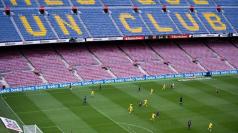
Barcelona v. Las Palmas match played without fans amid Catalonia vote

The match between FC Barcelona and UD Las Palmas was played with empty stands at Camp Nou in protest of the Spanish government’s actions in Catalonia. (Alex Caparros / Getty Images)

Barcelona plays Las Palmas in an empty stadium due to the vote today for Catalonian independence from Spain. Barcelona is in Catalonia. Las Palmas is in the Canary Islands. In the Spanish Civil War (1936-1939) one of the great fears of the Nationalists was that the Republican government would allow Catalonia to split from Spain. When the Nationalists launched the war to overthrow the elected Republican government their top general, Francisco Franco, was flown from the Canary Islands to lead the insurgency. In the decades that followed the Nationalist victory, a victory aided and abetted by Hitler and Mussolini, Franco brutalized the Catalonians. One of the only avenues left for them to get back at him, and hold on to their independence, was through their beloved soccer club– Barcelona. Today Las Palmas wore the Spanish national flag on their uniforms to protest the vote. History rhymes in mysterious ways. Barcelona won the game! We’ll see what happens with the vote.