Category Archives: Essays

UEFA Championship: the Generalisimo’s Legacy Lives On

FutbolThis is the day that rabid futbol fans look forward to all year. The UEFA Champions League Final is the culmination of a season long tournament between the best clubs from the best leagues from across Europe. This year’s tournament has seen some big surprises— the two favorites (reigning champ FC Barcelona and Bayern Munich) were both eliminated by an under the radar Atletico Madrid club. One thing that is not a surprise though is the total dominance of Spain’s La Liga. In fact both finalists in today’s big match are from Madrid! Later today scrappy Atletico Madrid will try to keep long-time powerhouse Real Madrid from taking a record 11th European championship. Sevilla has already won the Europa Cup (which might be compared to the NIT tournament in American basketball for reference). Amazingly Barcelona, arguably the best club in the world, winner of La Liga and the Copa Del Rey, is out. So how did Spanish futbol become so powerful?

Soccer has the unique ability to represent and strengthen different cultural identities and ideologies throughout the world. Perhaps nowhere can this be seen more prominently than in Spain. Importantly, many of Spain’s soccer clubs reflect the politics of the region they represent. The story really begins with the Generalisimo– Francisco Franco. It centers around what might be the most hated rivalry in sports, known as el clasico, between Real Madrid and FC Barcelona. A rivalry that has at times seen such brutality, including state-sponsored murder and imprisonment, that to this day it is as much political, maybe more so, as it is sporting (see Catalonian separatist movement).

 The Spanish Civil War has been described as the warm-up for the Second World War. The end came in 1939 when the insurgent rebel Nationalist forces of General Francisco Franco finally defeated the army of the popularly elected Republican Government to take control of the country. The unmerciful civil war, fueled by political, religious and sectarian hatred, had dragged on for three terribly bloody years. Franco’s allies in the war had been Mussolini, Hitler and the Catholic Church. When Franco’s troops captured Madrid on March 28th to end the war his primary task, after executing tens of thousands of his enemies, many in Barcelona, was to forcefully unify his new Spanish state. A long campaign of murder, torture and political oppression ensued leading to decades of fascist-style dictatorship. Separatists from previously autonomous regions, especially those in Catalonia and Basque country, came in for extra harsh scrutiny. Both fought Franco’s policies very bitterly, so his gaze was squarely fixed upon them.

From the start the Generalisimo brilliantly co-opted the beautiful game as one of his most successful propaganda tools. He had seen how his benefactors, Mussolini and Hitler, had manipulated the sport in their own countries to great advantage and quickly followed suite. Immediately he adopted Real Madrid as his, and hence the nation’s, club. He then used the club masterfully to build domestic support for the Falangist state, to build positive exposure for the regime in the eyes of the world, to divert domestic attention from the economic dislocation and bankruptcy that plagued the regime, and most importantly for this discussion, as a vehicle to crush the persistent Catalonian resistance and suppress Catalan language and culture. He did this in part by stigmatizing (criminalizing?) support for the other great Spanish club, FC Barcelona, the symbol of Catalonian pride. Barca, in turn, would become arguably the single most important symbol of republican resistance against the regime for decades to come. The rivalry was quite literally about life and death, and it escalated accordingly over the years with each side always striving to outdo the other.

Today most of the clubs competing professionally in Spain are listed under the legal status of sports companies, whose ownership is in the hands shareholders. With the appearance in recent years of mega-dollar private television deals many clubs have drastically increased income, allowing for the hiring of many of the best players in the world. But as these things go many clubs over-spent and with the collapse of the world economy in 2009 many have fallen into financial turmoil. The two powerful clubs, Real and Barca, have weathered the storm with great success, but many others have not been so lucky. Atletico Madrid, Sevilla (and occasionally Valencia) continue to be very competitive but have tiny war-chests by comparison.

So in a few hours from now, at San Siro stadium in Milan, built by the industrial kingpin Pirelli during Mussolini’s fascist rule, Atletico Madrid will try to derail another title bid by Franco’s club, the world’s most valuable sports franchise. GO ATLETICO!

 Check out this excellent BBC documentary on these times:

Read about more recent history of the rivalry between Barcelona and Real Madrid.

**FAIR USE NOTICE**
These Videos May Contain Copyrighted (© ) Material. The Use of Which Has Not Always Been Specifically Authorized by The Copyright Owner. Such Material is Made Available to Advance Understanding of Ecological, Political, Human Rights, Economic, Democracy, Scientific, Moral, Ethical, Social Justice Issues, Teaching, and Research. It is believed that this Constitutes a ”Fair Use” of Any Such Copyrighted Material as Provided For in Section 107 of the US Copyright Law. In Accordance With Title – 17 U.S.C. Section 107, This Material is Distributed Without PROFIT to Those Who Have Expressed a Prior General Interest in Receiving Similar Information For Research and Educational Purposes. For More Information:http://www.law.cornell.edu/uscode

Hello Michelangelo- Your Conference Call ID# is MDXII

800px-Michelango_Portrait_by_VolterraMichelangelo, master creator of great works of art like the Pietà and David and the Sistine Chapel, was also apparently far ahead of the curve when it came to telecommuting. Here’s how he put it, in a letter to his boss, Pope Julius II, making his case for the privilege of working from home:

“Now you write to me on the pope’s behalf, so you can read the pope this: let His Holiness understand that I am more willing than ever to carry on with the work; and if he wants the tomb come what may, he shouldn’t be bothered about where I work on it, provided that, at the end of the five years we agreed on, it is set up in St Peter’s, wherever he likes; and that it is something beautiful, as I have promised it will be: for I’m sure that if it’s completed, there will be nothing like it in the world.

“I have many marbles on order in Carrara which I shall have brought here along with those I have in Rome. Even if it meant a serious loss to me, I shouldn’t mind so long as I could do the work here; and I would forward the finished pieces one by one so that His Holiness would enjoy them just as much as if I were working in Rome — or even more, because he would just see the finished pieces without having any other bother. ”

The folks at Forbes Magazine announced in 2014 that “telecommuting is the future of work.” Little did they know that Michelangelo had beaten them to the punch by over a half millennium!

Source:

Selected Poems and Letters
by Michelangelo (Author), Anthony Mortimer (Editor, Translator, Introduction)  (Penguin Classics) Paperback – December 18, 2007

Portrait of Michelangelo by Daniele da Volterra

Chamber of Commerce – The Wages of Sin

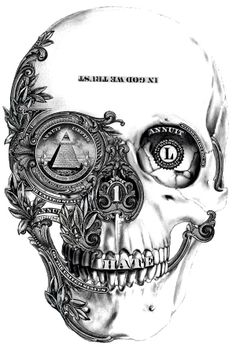
Skull MoneyElections are just around the corner again and one thing is certain– we’ll be hearing plenty from the U.S. Chamber of Commerce. After all it has a cozy, some might even call it incestuous, relationship with every mainstream media outlet. Big money buys big access and the Chamber is one of the biggest spenders on the planet. In fact it is the largest lobbying group in the U.S., spending more money than any other organization on a yearly basis. It is also one of the most conservative.

The Chamber of Commerce was founded in 1912 by Taft as a firewall against what was seen by business interests as an increasingly powerful federal government (remembering Teddy Roosevelt’s trust-busting administration) and a surging labor movement (Eugene Debs’ Socialist Party won 6 percent in the 1912 election). From the beginning the Chamber’s raison d’etre was to undermine organized labor. It schemed in concert with another extreme anti-union outfit called the National Association of Manufacturers, which opposed efforts to expand workers’ compensation and ban child labor. They were quite successful (with an assist from politicians and police who dutifully ginned-up the Red Scare in 1919), leading to previously unparalleled business prosperity in the roaring 20s. But the party came at the expense of the working classes, the fortunes were made by speculators, corporation owners and bankers, not by those who produced and bought goods. We all know how that ended, with the stock market crash and the Great Depression.  

Unfazed after helping run the country aground, the Chamber then tried to block the rescue boats from entering the harbor. It despised the New Deal, accusing Franklin Roosevelt of attempting to ‘Sovietize’ America, lobbying heavily against the president’s entire legislative package. Later, with the onset of war in Europe, these folks were so wrapped in ideological hatred for FDR that, incredibly, they opposed the Lend-Lease program, designed to supply the allies with critical material to fight the Germans (and which ultimately made their business constituents millions). Here is a question worth asking: had it not been for the devastation of U.S. industry in the Depression, and had not so many of the nation’s factories been laying fallow, would the Chamber and its allies have allowed FDR to so easily transition the industrial base to create the “arsenal of democracy” to fight and win WWII?

In the 1940s, as the nation’s economy recovered, so did the Chamber of Commerce. In 1947 it was instrumental in passing the anti-labor Taft-Hartley Act, the first major blow in the fight to emasculate a newly emboldened organized labor. In addition, the Chamber established itself as a permanent source of funds for America’s Cold Warriors. In the 1950s, learning from earlier successes, the Chamber was instrumental in bringing us the second Red Scare by lending critical financial and political support to Senator Joe McCarthy’s witch hunt to root out communists in the trade unions, schools and government, ruining countless innocent careers and lives in the process; in the 1960s it lobbied, unsuccessfully, for the killing of Medicare; in the 1980s it campaigned against regulations on nuclear plants and mine safety rules. The list goes on, and on, ad infinitum (ad nauseam). But that’s the price of doing business, right?

Throughout its existence the Chamber of Commerce has consistently fought against healthcare reform, unionization, living wages, workplace safety, progressive taxation, progressive education and environmental action. In the fight against global warming poll after poll shows that a large majority of Americans believe the climate science, they understand that the planet has never faced a bigger challenge, but nearly all attempts at remedial action have been completely blocked in Washington, and the U.S. Chamber is a major reason why. It has lobbied against every effort to cut carbon emissions, most recently celebrating a SCOTUS decision allowing coal plants to continue to foul the air with mercury. Enormous amounts of Chamber of Commerce electoral contributions go to climate change deniers. The NAFTA and TPP trade deals, bad news for American workers and the environment, were practically authored by Chamber lobbyists.

One agenda where the Chamber of Commerce has failed miserably at home in recent decades has been in its effort to support big tobacco. But has that stopped these assassins? Nope, the Chamber continues to see no evil in killing people for profit, it has just pointed its death-ray at new targets:

U.S. Chamber of Commerce Works Globally to Fight Anti-Smoking Measures

So next election season, when I see those campaign ads sponsored by the innocuous sounding Chamber of Commerce, it will be my tipoff to vote for the other candidate. Easy!

You can bet the farm it won’t be bankrolling Bernie Sanders….

Philadelphia Jazz City – The Great Tradition

Hank_MobleyBillie Holiday was born there. John Coltrane, and Dizzy Gillespie called it home during their lifetimes. In addition to being the “cradle of liberty” and the birthplace of the Declaration of Independence and the Constitution, Philadelphia’s contribution to America’s cultural and artistic landscape runs nearly as deep, especially when it comes to jazz.

Philadelphia’s jazz scene developed in the early 20th century, with two clubs, the Standard Theatre and the Dunbar Theatre, hosting most major acts travelling along the Washington, Baltimore, Philadelphia, New York corridor. Later, clubs opened along Columbia Avenue in North Philadelphia and the Clef Club, the Showboat, and Pep’s called South Philly home. From those early beginnings Philadelphia’s association with jazz grew steadily, mirroring the meteoric rise of the art form’s popularity, on through the peak years of the 40s, 50, and 60s. In addition to the giants of jazz listed above an amazing list of jazz greats established themselves there, or called the city home (not in any special order):

Ethel WatersStan GetzClifford BrownPhilly Joe Jones, Reggie Workman, Red Rodney (with the great Frank Young on drums), Jimmy Smith, Hank Mobley, Wilbur Ware, Lee Morgan, Benny Golson, Odean Pope, Kenny BarronHenry Grimes, Jimmy Garrison, McCoy Tyner, Sonny Fortune, Archie Shepp, Rashied Ali, Sun RaStanley ClarkeJamaaladeen Tacuma, Christian McBride… Just to name a few.

Amazing!

Photo: Hank Mobley. Photograph by Ted Williams, circa 1956