Category Archives: Europe

Hello Michelangelo- Your Conference Call ID# is MDXII

800px-Michelango_Portrait_by_VolterraMichelangelo, master creator of great works of art like the Pietà and David and the Sistine Chapel, was also apparently far ahead of the curve when it came to telecommuting. Here’s how he put it, in a letter to his boss, Pope Julius II, making his case for the privilege of working from home:

“Now you write to me on the pope’s behalf, so you can read the pope this: let His Holiness understand that I am more willing than ever to carry on with the work; and if he wants the tomb come what may, he shouldn’t be bothered about where I work on it, provided that, at the end of the five years we agreed on, it is set up in St Peter’s, wherever he likes; and that it is something beautiful, as I have promised it will be: for I’m sure that if it’s completed, there will be nothing like it in the world.

“I have many marbles on order in Carrara which I shall have brought here along with those I have in Rome. Even if it meant a serious loss to me, I shouldn’t mind so long as I could do the work here; and I would forward the finished pieces one by one so that His Holiness would enjoy them just as much as if I were working in Rome — or even more, because he would just see the finished pieces without having any other bother. ”

The folks at Forbes Magazine announced in 2014 that “telecommuting is the future of work.” Little did they know that Michelangelo had beaten them to the punch by over a half millennium!

Source:

Selected Poems and Letters
by Michelangelo (Author), Anthony Mortimer (Editor, Translator, Introduction)  (Penguin Classics) Paperback – December 18, 2007

Portrait of Michelangelo by Daniele da Volterra
John G. Morris – 20th Century Little Big Man

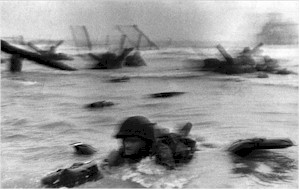
Capa,_D-Day1In 1964 Thomas Berger published Little Big Man. Filmed later as an anti-war parody by director Arthur Penn, the satirical novel recounts the exploits of 111-year-old Jack Crabb, as he wanders through the history of nineteenth-century western America. Along the way his life intersects with the likes of Wild Bill Hickok, Wyatt Earp, Buffalo Bill, and Custer. Through it all he has a front row seat to the so-called “winning of the West”— and he doesn’t like what he sees.

Crabb was a fictional character but each era seems to have its real life Jack Crabbs–  people whose long lives spanned critical historical events, and whose actions, usually associated with their work, influenced events behind the scenes. One such real life character is John G. Morris (1916 –  ). Quietly Morris became a key figure in the story of the 20th-century through his photo editing. He was on the scene in downtown Los Angeles early in 1942 to photograph the first wave of Japanese men, women and children being packed off to internment camps in the high desert. He then went to London as Life magazine’s lead photo editor in Europe during World War II and was in charge of coordinating the visual coverage of the Western Front. It was Morris who managed to save a handful of historic images shot by Robert Capa at D-Day when it was feared the entire set had been lost when damaged in development. Morris went to Normandy himself shortly after the invasion and snapped some memorable photos of his own. After the war, while at Ladies Home Journal, Morris published Women and Children of the Soviet Union with photos taken by Robert Capa. The photos provided Americans with a rare glimpse behind the Iron Curtain at the onset of the Cold War.

His career spans tenures with Life magazine, the Magnum photo agency, Ladies’ Home JournalThe Washington Post, The New York Times, and the National Geographic magazine. He knew and worked with the most celebrated war chroniclers of the times– Robert Capa, Henri Cartier-Bresson, W. Eugene Smith, Ernest Hemingway and David Duncan to name just a few. While he was the photo editor for The New York Times during the Vietnam War, Morris put Nick Ut’s “Napalm Girl” and Eddie Adams’ Saigon execution and John Filo’s student crying at Kent State on the front page — photos that greatly affected public perception of the Vietnam War. Morris is passionately anti-war, and much like Jack Crabb, it becomes abundantly clear upon listening to him speak that he doesn’t like what he sees. View an excellent documentary about John G. Morris called Get The Picture.

Career:

Daily Maroon (The Chicago Maroon), University of Chicago student newspaper, 1933-37

Pulse, University of Chicago student magazine, Editor, 1937-38

LIFE (magazine), Editorial Staff, 1939-46 : New York, Los Angeles, Washington, London, Chicago, Paris

Ladies’ Home Journal, Associate Editor (Pictures), 1946-52

Magnum News Service, Editor, 1952-63

The Washington Post, Assistant Managing Editor (Graphics), 1964-65

Time/Life Books, editor, 1966-67

The New York Times, Picture Editor, 1967-74; Editor, NYT Pictures, 1975-76

Quest/77-79, Contributing Editor, 1977-79

National Geographic, European Correspondent, 1983-89

Spanish Civil War: La Pasionaria’s Farewell Address to the International Brigades

Dolores Ibárruri, La Pasionaria
Barcelona, November 1, 1938:

“From all peoples, from all races, you came to us like brothers, like sons of immortal Spain; and in the hardest days of the war, when the capital of the Spanish Republic was threatened, it was you, gallant comrades of the International Brigades, who helped save the city with your fighting enthusiasm, your heroism and your spirit of sacrifice. – And Jarama and Guadalajara, Brunete and Belchite, Levante and the Ebro, in immortal verses sing of the courage, the sacrifice, the daring, th  discipline of the men of the International Brigades… MORE>>

French Armed Forces in Indochina, 1945-54

képi blanc de la Légion étrangère vu de profile

Image via Wikipedia

In the course of the First Indochina War the French Expeditionary Force endured terrible losses. Entire classes from the most elite military schools perished. The French were increasingly forced to fall back on locally recruited material. This tendency, which the French called jaunissement, the “yellowing” of the army, was increasingly apparent by 1952-53… MORE>>