Forward Into The Past: Utah, In Fit of Nostalgia, Brings Back The Firing Squad

BatistaFireSquadA notable philosopher once wrote: “all great world-historic facts and personages appear, so to speak, twice… the first time as tragedy, the second time as farce.”

The tragedy: occurred in November 1915 when labor organizer and songwriter Joe Hill was convicted on uncorroborated circumstantial evidence and executed by a Utah firing squad. Hill’s case, appearing to be clearly rigged against him, became a national cause célèbre, with many personalities of the day weighing-in on his behalf. President Woodrow Wilson even tried to intervene to stay the execution. But in the grand tradition of states rights Utah would have none of it. After all, the after-party was set and invitations already printed. For his part, Joe Hill had already come to the conclusion (correctly as it turned out) that he was more valuable to the labor movement dead than alive. In a last letter to labor leader “Big Bill” Haywood, Hill asked to be buried across the state line, indicating that he wouldn’t want to be caught dead in Utah.  His last word, shouted while standing blindfolded, was “Fire!”  

The farce: Utah Gov. Gary Herbert signed a bill bringing back the firing squad as a method of execution. Fox News, America’s most trusted purveyors of farce, reported it this way: at the beginning of the article we learn that “The bill’s sponsor, Republican Rep. Paul Ray of Clearfield, touted the measure as being a more humane form of execution. Ray argued that a team of trained marksmen is faster and more humane than the drawn-out deaths that have occurred in botched lethal injections. The bill gives Utah options, he said. “We would love to get the lethal injection worked out so we can continue with that but if not, now we have a backup plan.” How reasonable.

In the name of fair and balanced reporting, Fox gives opponents their say a little further into the story: “Opponents, however, said firing squads are a cruel holdover from the state’s wild West days and will earn the state international condemnation.” And the last paragraph in the article: “The Washington, D.C.-based Death Penalty Information Center, which opposes capital punishment, says a firing squad is not a foolproof execution method because the inmate could move or shooters could miss the heart, causing a slower, more painful death. One such case appears to have happened in Utah’s territorial days back in 1879, when a firing squad missed Wallace Wilkerson’s heart and it took him 27 minutes to die, according to newspaper accounts.” 1879! 

And then there’s Gary Gilmore.

Here’s an idea: let’s bring the execution process into the 21st century. Why not just put the prisoner’s name on the Military’s High Value Target (HVT) hit list and send a drone to kill him one day while out exercising in the prison yard? That is clearly a more humane solution than a firing squad since the prisoner won’t even know what him/her. 

Listen to Ohio State’s own rebel songwriter Phil Ochs sing “The Ballad of Joe Hill”:

Citation:

“Utah lawmakers vote to become only state to allow firing squad.” Fox News Channel. Published December 20, 2015 2:35pm EST
Momentous Days: March 7-8, 1965

On March 7, 1965 the protest marches from Selma to Montgomery Alabama began. The first march was ended by state troopers and some county citizens, who charged on about 600 unarmed protesters after they crossed the Edmund Pettus Bridge in the direction of Montgomery. The event became known as Bloody Sunday. By Monday morning LBJ was knee-deep in a political confrontation of epic proportions. His recorded phone conversations that day show that he was more upset with MLK than with Wallace.

Meanwhile, on the other side of the world, with much less fanfare, his Marines were landing on Red Beach 2 near Da Nang in South Vietnam, marking the beginning of what the Vietnamese call the “American War.” That was March 8, 1965. The next day LBJ authorized the use of Napalm. Before the year was out he would be “waist deep in the big muddy.” Quite a weekend.

Note: six years later, on March 8, 1971, anti-war protesters broke into a Media, Pennsylvania FBI office and stole a trove of classified documents that revealed the FBI’s COINTELPRO (Counter Intelligence Program). The covert program was aimed at spying on, discrediting, and disrupting domestic political organizations, primarily the anti-Vietnam War movement. One of the principal players in the COINTELPRO story was one Mark Felt, later revealed as “Deep Throat” in the Watergate Scandal:


Neon: the 20th Century’s Sign of the Times

“…a city that was to live by night after the wilderness had passed. A city that was to forge out of steel and blood-red neon its own peculiar wilderness.” – Nelson Algren

Click Here For Many More Examples of Classic Neon

John G. Morris – 20th Century Little Big Man

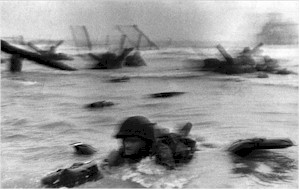
Capa,_D-Day1In 1964 Thomas Berger published Little Big Man. Filmed later as an anti-war parody by director Arthur Penn, the satirical novel recounts the exploits of 111-year-old Jack Crabb, as he wanders through the history of nineteenth-century western America. Along the way his life intersects with the likes of Wild Bill Hickok, Wyatt Earp, Buffalo Bill, and Custer. Through it all he has a front row seat to the so-called “winning of the West”— and he doesn’t like what he sees.

Crabb was a fictional character but each era seems to have its real life Jack Crabbs–  people whose long lives spanned critical historical events, and whose actions, usually associated with their work, influenced events behind the scenes. One such real life character is John G. Morris (1916 –  ). Quietly Morris became a key figure in the story of the 20th-century through his photo editing. He was on the scene in downtown Los Angeles early in 1942 to photograph the first wave of Japanese men, women and children being packed off to internment camps in the high desert. He then went to London as Life magazine’s lead photo editor in Europe during World War II and was in charge of coordinating the visual coverage of the Western Front. It was Morris who managed to save a handful of historic images shot by Robert Capa at D-Day when it was feared the entire set had been lost when damaged in development. Morris went to Normandy himself shortly after the invasion and snapped some memorable photos of his own. After the war, while at Ladies Home Journal, Morris published Women and Children of the Soviet Union with photos taken by Robert Capa. The photos provided Americans with a rare glimpse behind the Iron Curtain at the onset of the Cold War.

His career spans tenures with Life magazine, the Magnum photo agency, Ladies’ Home JournalThe Washington Post, The New York Times, and the National Geographic magazine. He knew and worked with the most celebrated war chroniclers of the times– Robert Capa, Henri Cartier-Bresson, W. Eugene Smith, Ernest Hemingway and David Duncan to name just a few. While he was the photo editor for The New York Times during the Vietnam War, Morris put Nick Ut’s “Napalm Girl” and Eddie Adams’ Saigon execution and John Filo’s student crying at Kent State on the front page — photos that greatly affected public perception of the Vietnam War. Morris is passionately anti-war, and much like Jack Crabb, it becomes abundantly clear upon listening to him speak that he doesn’t like what he sees. View an excellent documentary about John G. Morris called Get The Picture.

Career:

Daily Maroon (The Chicago Maroon), University of Chicago student newspaper, 1933-37

Pulse, University of Chicago student magazine, Editor, 1937-38

LIFE (magazine), Editorial Staff, 1939-46 : New York, Los Angeles, Washington, London, Chicago, Paris

Ladies’ Home Journal, Associate Editor (Pictures), 1946-52

Magnum News Service, Editor, 1952-63

The Washington Post, Assistant Managing Editor (Graphics), 1964-65

Time/Life Books, editor, 1966-67

The New York Times, Picture Editor, 1967-74; Editor, NYT Pictures, 1975-76

Quest/77-79, Contributing Editor, 1977-79

National Geographic, European Correspondent, 1983-89