
On Historians and The Role of Composing Universal History:
“it is impossible for historians of particular places to get a view of universal history. For how is it possible for a man who has only read a separate history of Sicilian or Spanish affairs to understand and grasp the greatness of the events? Or, what is still more important, in what manner and under what form of polity fortune brought to pass that most surprising of all revolutions that have happened in our time, I mean the reduction of all known parts of the world under one rule and governance, a thing unprecedented in the history of mankind. In what manner the Romans took Syracuse or Iberia may be possibly learned to a certain extent by means of such particular histories; but how they arrived at universal supremacy, and what opposition their grand designs met with in particular places, or what on the other hand contributed to their success, and at what epochs, this it is difficult to take in without the aid of universal history. Nor, again, is it easy to appreciate the greatness of their achievements except by the latter method. For the fact of the Romans having sought to gain Iberia, or at another time Sicily; or having gone on a campaign with military and naval forces, told by itself, would not be anything very wonderful. But if we learn that these were all done at once, and that many more undertakings were in course of accomplishment at the same time,—all at the cost of one government and commonwealth; and if we see what dangers and wars in their own territory were, at the very time, encumbering the men who had all these things on hand: thus, and only thus, will the astonishing nature of the events fully dawn upon us, and obtain the attention which they deserve. So much for those who suppose that by studying an episode they have become acquainted with universal history…”-Polybius The Histories. Bk 8 section 4.
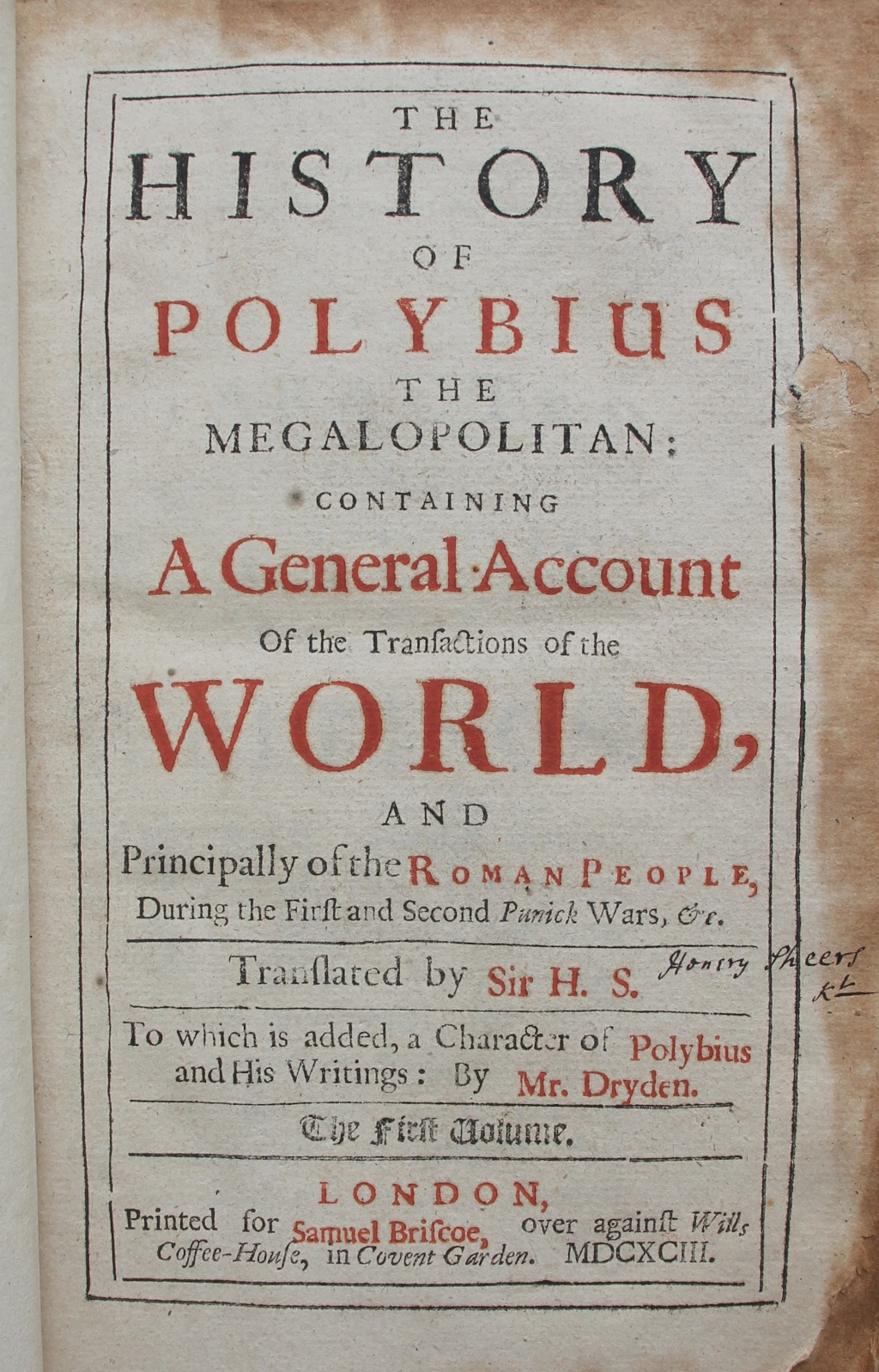
The history of Polybius the Megalopolitan: containing a general account of the transactions of the world, and principally of the Roman people, during the first and second Punick Wars, &c. Translated by Sir H.S. To which is added, a character of Polybius and his writings: by Mr. Dryden …, 2 vols. Photo: Edward Worth Library
A digression on Polybius’s method in writing history, and his avoidance of imaginary details: Other historians [have spoken in exaggerated terms] of the Syrian war. And the reason is one which I have often mentioned. Though their subjects are simple and without complications, they seek the name and reputation of historians not from the truth of their facts, but the number of their books; and accordingly they are obliged to give petty affairs an air of importance, and fill out and give rhetorical flourishes to what was originally expressed briefly; dress up actions and achievements which were originally quite secondary; expatiate on struggles; and describe pitched battles, in which sometimes ten or a few more infantry fell, and still fewer cavalry. As for sieges, local descriptions, and the like one cannot say that their treatment is adequate, because they have no facts to give. But a writer of universal history must pursue a different plan; and therefore I ought not to be condemned for minimising the importance of events, if I sometimes pass over affairs that have met with wide fame and laboured description, or for mentioning them with brevity; but I ought to be trusted to give to each subject the amount of discussion which it deserves. Such historians as I refer to, when they are describing in the course of their work the siege, say of Phanoteia, or Coroneia, or [Haliartus], are forced to display all the contrivances, bold strokes, and other features of a siege; and when they come to the capture of Tarentum, the sieges of Corinth, Sardis, Gaza, Bactra, and, above all, of Carthage, they must draw on their own resources to prolong the agony and heighten the picture, and are not at all satisfied with me for giving a more truthful relation of such events as they really occurred. Let this statement hold good also as to my description of pitched battles and public harangues, as well as other departments of history; in all of which I might fairly claim considerable indulgence, as also in what is now about to be narrated, if I am detected in some inconsistency in the substance of my story, the treatment of my facts, or the style of language; and also if I make some mistakes in the names of mountains or rivers, or the special features of localities: for indeed the magnitude of my work is a sufficient excuse in all these points, unless, indeed, I am ever detected in deliberate or interested misstatements in my writings: for such I ask no indulgence, as I have repeatedly and explicitly remarked in the course of my history….Bk 29 Section 12
Why History is Essential to Understanding the Present:
“Some uncritical readers may perhaps say that such minute discussion on points of this kind is unnecessary. And if any man were entirely self-sufficing in every event, I might allow that the accurate knowledge of the past, though a graceful accomplishment, was perhaps not essential: but as long as it is not in mere mortals to say this, either in public or private affairs,—seeing that no man of sense, even if he is prosperous for the moment, will ever reckon with certainty on the future,—then I say that such knowledge is essential, and not merely graceful. For take the three commonest cases. Suppose, first, a statesman to be attacked either in his own person or in that of his country: or, secondly, suppose him to be anxious for a forward policy and to anticipate the attack of an enemy: or, lastly, suppose him to desire to maintain the status quo. In all these cases it is history alone that can supply him with precedents, and teach him how, in the first case, to find supporters and allies; in the second, to incite co-operation; and in the third, to give vigour to the conservative forces which tend to maintain, as he desires, the existing state of things. In the case of contemporaries, it is difficult to obtain an insight into their purposes; because, as their words and actions are dictated by a desire of accommodating themselves to the necessity of the hour, and of keeping up appearances, the truth is too often obscured. Whereas the transactions of the past admit of being tested by naked fact; and accordingly display without disguise the motives and purposes of the several persons engaged; and teach us from what sort of people to expect favour, active kindness, and assistance, or the reverse. They give us also many opportunities of distinguishing who would be likely to pity us, feel indignation at our wrongs, and defend our cause,—a power that contributes very greatly to national as well as individual security. Neither the writer nor the reader of history, therefore, should confine his attention to a bare statement of facts: he must take into account all that preceded, accompanied, or followed them. For if you take from history all explanation of cause, principle, and motive, and of the adaptation of the means to the end, what is left is a mere panorama without being instructive; and, though it may please for the moment, has no abiding value.”
Another mistake is to look upon my history as difficult to obtain or master, because of the number and size of the books. Compare it in these particulars with the various writings of the episodical historians. Is it not much easier to purchase and read my forty books, which are as it were all in one piece, and so to follow with a comprehensive glance the events in Italy, Sicily, and Libya from the time of Pyrrhus to the fall of Carthage, and those in the rest of the world from the flight of Cleomenes of Sparta, continuously, to the battle between the Achaeans and Romans at the Isthmus? To say nothing of the fact that the compositions of these historians are many times as numerous as mine, it is impossible for their readers to get any certain information from them: first, because most of them differ in their account of the same transactions; and secondly, because they omit contemporary history,—the comparative review of which would put a very different complexion upon events to that derived from isolated treatment,—and are unable to touch upon the most decisive events at all. For, indeed, the most important parts of history are those which treat the events which follow or accompany a certain course of conduct, and pre-eminently so those which treat of causes. For instance, we see that the war with Antiochus took its rise from that with Philip; that with Philip from the Hannibalian; and the Hannibalian from the Sicilian war: and though between these wars there were numerous events of various character, they all converged upon the same consummation. Such a comprehensive view may be obtained from universal history, but not from the histories of particular wars, such as those with Perseus or Philip; unless we fondly imagine that, by reading the accounts contained in them of the pitched battles, we gain a knowledge of the conduct and plan of the whole war. This of course is not the case; and in the present instance I hope that there will be as wide a difference between my history and such episodical compositions, as between real learning and mere listening.-Polybius The Histories. Bk 3 section 31-32.
Digression on the limits of history:
I can conceive some readers complaining that, while devoting a great deal of space to Libya and Iberia, I have said little or nothing about the strait of the Pillars of Hercules, the Mare Externum, or the British Isles, and the manufacture of217 tin in them, or even of the silver and gold mines in Iberia itself, of which historians give long and contradictory accounts. It was not, let me say, because I thought these subjects out of place in history that I passed them over; but because, in the first place, I did not wish to be diffuse, or distract the attention of students from the main current of my narrative; and, in the next place, because I was determined not to treat of them in scattered notices or casual allusions, but to assign them a distinct time and place, and at these, to the best of my ability, to give a trustworthy account of them. On the same principle I must deprecate any feeling of surprise if, in the succeeding portions of my history, I pass over other similar topics, which might seem naturally in place, for the same reasons. Those who ask for dissertations in history on every possible subject, are somewhat like greedy guests at a banquet, who, by tasting every dish on the table, fail to really enjoy any one of them at the time, or to digest and feel any benefit from them afterwards. Such omnivorous readers get no real pleasure in the present, and no adequate instruction for the future.
There can be no clearer proof, than is afforded by these particular instances, that this department of historical writing stands above all others in need of study and correction. For as all, or at least the greater number of writers, have endeavoured to describe the peculiar features and positions of the countries on the confines of the known world, and in doing so have, in most cases, made egregious mistakes, it is impossible to pass over their errors without some attempt at refutation; and that not in scattered observations or casual remarks, but deliberately and formally. But such confutation should not take the form of accusation or invective. While correcting their mistakes we should praise the writers, feeling sure that, had they lived to the present age, they would have altered and corrected many of their statements. The fact is that, in past ages, we know of very few Greeks who undertook to investigate these remote regions, owing to the insuperable difficulties of the attempt. The dangers at sea were then more than can easily be calculated, and those on land more numerous still. And even if one did reach these countries on the confines of the world, whether compulsorily or voluntarily, the difficulties in the way218 of a personal inspection were only begun: for some of the regions were utterly barbarous, others uninhabited; and a still greater obstacle in way of gaining information as to what he saw was his ignorance of the language of the country. And even if he learnt this, a still greater difficulty was to preserve a strict moderation in his account of what he had seen, and despising all attempts to glorify himself by traveller’s tales of wonder, to report for our benefit the truth and nothing but the truth.
All these impediments made a true account of these regions in past times difficult, if not impossible. Nor ought we to criticise severely the omissions or mistakes of these writers: rather they deserve our praise and admiration for having in such an age gained information as to these places, which distinctly advanced knowledge. In our own age, however, the Asiatic districts have been opened up both by sea and land owing to the empire of Alexander, and the other places owing to the supremacy of Rome. Men too of practical experience in affairs, being released from the cares of martial or political ambition, have thereby had excellent opportunities for research and inquiry into these localities; and therefore it will be but right for us to have a better and truer knowledge of what was formerly unknown. And this I shall endeavour to establish, when I find a fitting opportunity in the course of my history. I shall be especially anxious to give the curious a full knowledge on these points, because it was with that express object that I confronted the dangers and fatigues of my travels in Libya, Iberia, and Gaul, as well as of the sea which washes the western coasts of these countries; that I might correct the imperfect knowledge of former writers, and make the Greeks acquainted with these parts of the known world. – Polybius The Histories Bk 3 sections 37-39
“The special province of history is, first, to ascertain what the actual words used were; and secondly, to learn why it was that a particular policy or argument failed or succeeded. For a bare statement of an occurrence is interesting indeed, but not instructive: but when this is supplemented by a statement of cause, the study of history becomes fruitful. For it is by applying analogies to our own circumstances that we get the means and basis for calculating the future; and for learning from the past when to act with caution, and when with greater boldness, in the present. The historian therefore who omits the words actually used, as well as all statement of the determining circumstances, and gives us instead conjectures and mere fancy compositions, destroys the special use of history. In this respect Timaeus is an eminent offender, for we all know that his books are full of such writing.”
“In the same way the science of genuine history is threefold: first, the dealing with written documents and the arrangement of the material thus obtained; second, topography, the appearance of cities and localities, the description of rivers and harbours, and, speaking generally, the peculiar features of seas and countries and their relative distances; thirdly, political affairs. Now, as in the case of medicine, it is the last branch that many attach themselves to, owing to their preconceived opinions on the subject. And the majority of writers bring to the undertaking no spirit of fairness at all: nothing but dishonesty, impudence and unscrupulousness. Like vendors of drugs, their aim is to catch popular credit and favour, and to seize every opportunity of enriching themselves. About such writers it is not worth while to say more.”
“But some of those who have the reputation of approaching history in a reasonable spirit are like the theoretical physicians. They spend all their time in libraries, and acquire generally all the learning which can be got from books, and then persuade themselves that they are adequately equipped for their task…. Yet in my opinion they are only partially qualified for the production of genuine history. To inspect ancient records indeed, with the view of ascertaining the notions entertained by the ancients of certain places, nations, polities and events, and of understanding the several circumstances and contingencies experienced in former times, is useful; for the history of the past directs our attention in a proper spirit to the future, if a writer can be found to give a statement of facts as they really occurred. But to persuade one’s self, as Timaeus does, that such ability in research is sufficient to enable a man to describe subsequent transactions with success is quite foolish. It is as though a man were to imagine that an inspection of the works of the old masters would enable him to become a painter and a master of the art himself.”
“However, the only effect of such extravagant exaggeration is to bring ridicule upon the men and the transactions which it is his intention to champion; while he himself incurs the same discredit as ill-trained disputants in the Academy; some of whom, in their desire to embarrass their opponents on all subjects, possible or impossible alike, carry their paradoxical and sophistical arguments to such a length as to dispute whether it is possible for people at Athens to smell eggs cooking at Ephesus: and to offer to maintain that, while they are discussing these points, they are lying on their couches at home and carrying on a second discussion on other subjects. This extravagance of paradox has brought the whole school into such disrepute, that even reasonable discussions have lost credit with the world. And apart from their own futility, these persons have inspired our young men with so depraved a taste, that they pay no attention whatever to questions of ethics and politics, which bring benefit to those who study them; but spend their lives in pursuit of an empty reputation for useless and paradoxical verbiage.”
“Nature has bestowed on us two instruments of inquiry and research, hearing and sight. Cp. Herod. 1, 8. Hor. A. P. 180.Of these sight is, according to Heracleitus, by far the truer; for eyes are surer witnesses than ears. And of these channels of learning Timaeus has chosen the pleasanter and the worse; for he entirely refrained from looking at things with his own eyes, and devoted himself to learning by hearsay. But even the ear may be instructed in two ways, reading and answers to personal inquiries: and in the latter of these he was very indolent, as I have already shown. The reason of his preference for the other it is easy to divine. Study of documents involves no danger or fatigue, if one only takes care to lodge in a city rich in such records, or to have a library in one’s neighbourhood. You may then investigate any question while reclining on your couch, and compare the mistakes of former historians without any fatigue to yourself. But personal investigation demands great exertion and expense; though it is exceedingly advantageous, and in fact is the very corner-stone of history.” -Polybius The Histories. Bk 12 sections 25-27.
“But another and the strongest reason was that all such wonderful and striking catastrophes are only worth listening to once; not only are subsequent exhibitions of them unprofitable to ear and eye, but elaborate harping upon them soon becomes simply troublesome. For those who are engaged on representing anything either to eye or ear can have only two objects to aim at,—pleasure and profit; and in history, more than in anything else, excessive prolixity on events of tragic interest fails of both these objects. For, in the first place, who would wish to emulate extraordinary catastrophes? And next, no one likes to be continually seeing and hearing things that are unnatural and beyond the ordinary conceptions of mankind. We are, indeed, eager to see and hear such things once and for the first time, because we want to know that a thing is possible which was supposed to be impossible: but when once convinced on that point no one is pleased at lingering on the Unnatural; but in fact would rather not come across it at all oftener than need be. In fact, the dwelling upon misfortunes which exceed the ordinary limits is more suitable to tragedy than to history. But perhaps we ought to make allowances for men who have studied neither nature nor universal history. They think, I presume, that the most important and astonishing events in all history are those which they happen to have come across themselves or to have heard from others, and they therefore give their attention exclusively to those. They accordingly do not perceive that they are making a mistake in expatiating on events which are neither novel,—for they have been narrated by others before,—nor capable of giving instruction or pleasure. So much on this point….” -Polybius The Histories. Bk 15 section 36.
In regard to these men, it should not be a matter of surprise if we leave for a while the ordinary method and spirit of our narrative to give a clearer and more elaborate exposition of their character. I am aware that some may be found, regarding it as their first duty to cast a veil over the errors of the Greeks, to accuse us of writing in a spirit of malevolence. But for myself, I conceive that with right-minded persons a man will never be regarded as a true friend who shrinks from and is afraid of plain speech, nor indeed as a good citizen who abandons the truth because of the offence he will give to certain persons at the time. But a writer of public history above all deserves no indulgence whatever, who regards anything of superior importance to truth. For in proportion as written history reaches larger numbers, and survives for longer time, than words spoken to suit an occasion, both the writer ought to be still more particular about truth, and his readers ought to admit his authority only so far as he adheres to this principle. At the actual hour of danger it is only right that Greeks should help Greeks in every possible way, by protecting them, veiling their errors or deprecating the wrath of the sovereign people,—and this I genuinely did for my part at the actual time: but it is also right, in regard to the record of events to be transmitted to posterity, to leave them unmixed with any falsehood: so that readers should not be merely gratified for the moment by a pleasant tale, but should receive in their souls a lesson which will prevent a repetition of similar errors in the future. Enough, however, on this subject….Bk 38 Section 6
A defence of the historian’s method of parallel histories of several countries, each kept up to date: I am fully aware that some will be found to criticise my work, on the ground that my narrative of events is incomplete and disconnected; beginning, for instance, the story of the siege of Carthage, and then leaving it half told, and interrupting the stream of my history, I pass over to Greek affairs, and from them to Macedonian or Syrian, or some other history; whereas students require continuity, and desire to hear the end of a subject; for the combination of pleasure and profit is thus more completely secured. But I do not think this: I hold exactly the reverse. And as a witness to the correctness of my opinion I might appeal to nature herself, who is never satisfied with the same things continuously in any of the senses, but is ever inclined to change; and, even if she is satisfied with the same things, wishes to have them at intervals and in diversity of circumstance. This may be illustrated first by the sense of hearing, which is never gratified either in music or recitations by a continuance of the same strains or subjects; it is the varied style, and, in a word, whatever is broken up into intervals and has the most marked and frequent changes, that gives it pleasurable excitement. Similarly one may notice that the palate can never remain gratified by the same meats, however costly, but grows to feel a loathing for them, and delights in changes of diet, and often prefers plain to rich food merely for the sake of variety. The same may be noticed as to the sight: it is quite incapable of remaining fixed on the same object, but it is a variety and change of objects that excites it. And this is more than all the case with the mind; for changes in the objects of attention and study act as rests to laborious men.
Accordingly the most learned of the ancient historians have, as it seems to me, taken intervals of rest in this way: some by digressions on myths and tales, and others by digressions on historical facts,—not confining themselves to Greek history, but introducing disquisitions on points of foreign history as well. As, for instance, when, in the course of a history of Thessaly and the campaigns of Alexander of Pherae, they introduce an account of the attempts of the Lacedaemonians in the Peloponnese; or those made by the Athenians; or actions which took place in Macedonia or Illyria: and then break off into an account of the expedition of Iphicrates into Egypt, and the iniquitous deeds of Clearchus in the Pontus. This will show you that these historians all employ this method; but, whereas they employ it without any system, I do so on a regular system. For these men, after mentioning, for instance, that Bardylis, king of the Illyrians, and Cersobleptes, king of the Thracians, established their dynasties, neither go on continuously with the stories nor return to them after an interval to take them up where they left off, but, treating them like an episode in a poem, they go back to their original subject. But I made a careful division of all the most important countries in the world and the course of their several histories; pursued exactly the same plan in regard to the order of taking the several divisions; and, moreover, arranged the history of each year in the respective countries, carefully keeping to the limits of the time: and the result is that I have made the transition backwards and forwards between my continuous narrative and the continually recurring interruptions easy and obvious to students, so that an attentive reader need never miss anything….Bk 39 Section 1


