
Polybius Describes How to Assess the Characteristics of Good Leaders:
“In private life if you wish to satisfy yourself as to the badness or goodness of particular persons, you would not, if you wish to get a genuine test, examine their conduct at a time of uneventful repose, but in the hour of brilliant success or conspicuous reverse. For the true test of a perfect man is the power of bearing with spirit and dignity violent changes of fortune.”-Polybius The Histories. Bk 6 Preface
For Polybius the prototype was Publius Cornelius Scipio (236/235–c. 183 BC), often regarded as one of the greatest military commanders and strategists of all time. Polybius deeply admired him, famously calling him “perhaps the most illustrious man of any born before the present generation.” He was a survivor of Hannibal’s greatest victory, the Battle of Cannae (216 BC), living to fight another day. His revenge came years later when he masterminded Hannibal’s greatest defeat at the Battle of Zama (202 BC), earning himself the honorific title Africanus (“the African”).
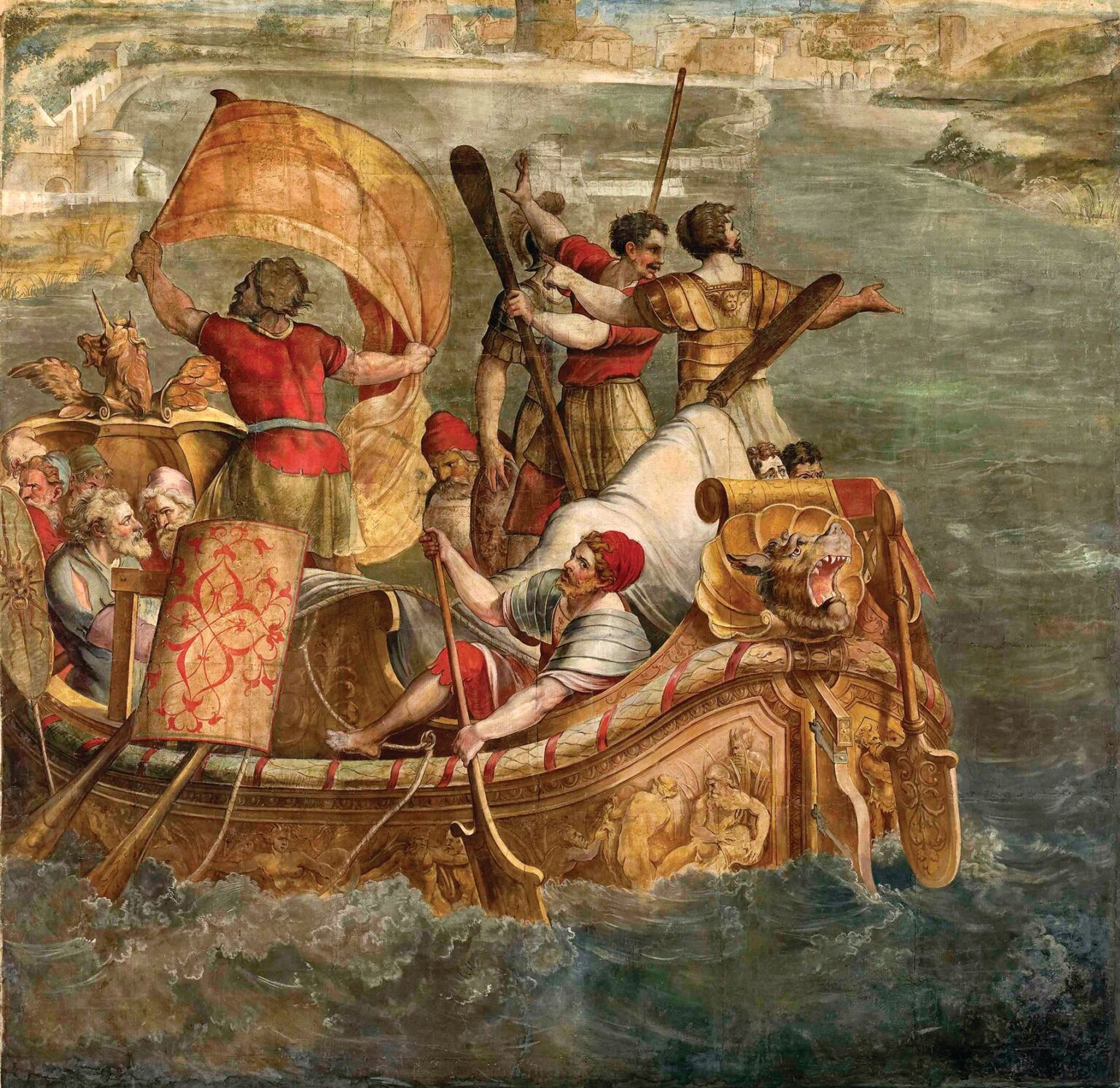
“Landing of Scipio Africanus at Carthage,” attributed to Michiel Coxcie (Belgium,1499-1592), shows the Roman general arriving in Africa. He would defeat Hannibal and the Carthaginians at the Battle of Zama in 202 BCE, effectively ending the Second Punic War.

Engraving of the Battle of Zama by Cornelis Cort, 1567.
“There are three methods followed by those who wish to arrive at an intelligent knowledge of tactics. The first is by the study of history, the second by the use of scientific treatises composed by specialists, the third by actual experience on the field.” -Polybius The Histories. Bk 11 section 8.
“In all human affairs perhaps one ought to regulate every undertaking by considerations of time; but this is especially true in war, in which a moment makes all the difference between success and failure, and to miss this is the most fatal of errors….
Many men desire honour, but it is only the few who venture to attempt it; and of those who do so, it is rare to find any that have the resolution to persevere to the end….” -Polybius The Histories. Bk 27 section 20.
Hannibal correctly judges the character of Flaminius:
“it is mere blind ignorance to believe that there can be anything of more vital importance to a general than the knowledge of his opponent’s character and disposition, —so must a commander of an army look out for the weak place, not in the body, but in the mind of the leader of the hostile force. For it has often happened before, that from mere idleness and lack of energy, men have let not only the welfare of the state, but even their private fortunes fall to ruin: some are so addicted to wine that they cannot sleep without bemusing their intellects with drink; and others so infatuated in their pursuit of sensual pleasures, that they have not only been the ruin of their cities and fortunes, but have forfeited life itself with disgrace. In the case of individuals, however, cowardice and sloth bring shame only on themselves; but when it is a commander-in-chief that is concerned, the disaster affects all alike and is of the most fatal consequence. It not only infects the men under him with an inactivity like his own; but it often brings absolute dangers of the most serious description upon those who trust such a general. For rashness, temerity, and uncalculating impetuosity, as well as foolish ambition and vanity, give an easy victory to the enemy, and are the source of numerous dangers to one’s friends: for a man who is the prey of such weaknesses falls the easiest victim to every stratagem, ambush or ruse. The general then who can gain a clear idea of his opponent’s weaknesses, and direct his attack on the point where he is most open to it, will very soon be the victor in the campaign. For as a ship, if you deprive it of its steerer, falls with all its crew into the hands of the enemy; so, in the case of an army in war, if you outwit or out-manœuvre its general, the whole will often fall into your hands.” – Polybius The Histories. Bk 3 section 81.
Note: on June 24, 217 BC, during the Battle of Lake Trasimene in the Second Punic War Flaminius was ambushed and killed along with most of his legions by the Carthaginian army led by Hannibal.
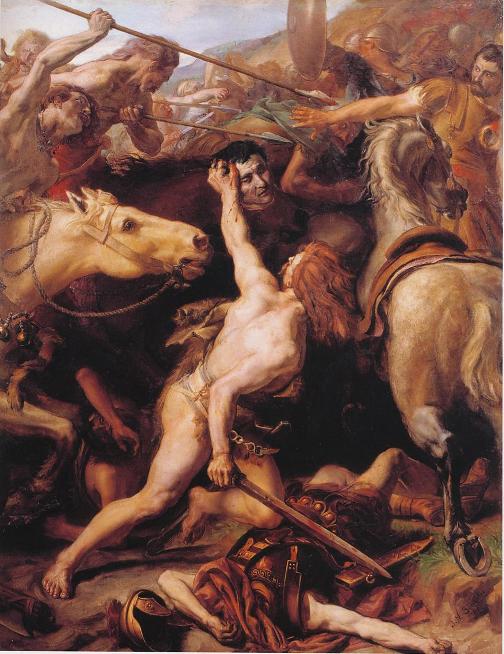
The Gaul Ducar beheads the Roman general Flaminius in the Battle of Lake Trasimeno. 1882. by Joseph-Noël Sylvestre (Musée des Beaux-Arts, Béziers) / Musée des Beaux-Arts de Béziers.
The Necessity of Caution in Dealing With an Enemy:
“The conclusion, then, is that those who put themselves in the power of the enemy from want of proper precaution deserve blame; but those who use every practicable precaution not so: for to trust absolutely no one is to make all action impossible; but reasonable action, taken after receiving adequate security, cannot be censured. Adequate securities are oaths, children, wives, and, strongest of all, a blameless past. To be betrayed and entrapped by such a security as any of these is a slur, not on the deceived, but on the deceiver. The first object then should be to seek such securities as it is impossible for the recipient of the confidence to evade; but since such are rare, the next best thing will be to take every reasonable precaution one’s self: and then, if we meet with any disaster, we shall at least be acquitted of wrong conduct by the lookers on. And this has been the case with many before now: of which the most conspicuous example, and the one nearest to the times on which we are engaged, will be the fate of Achaeus. He omitted no possible precaution for securing his safety, but thought of everything that it was possible for human ingenuity to conceive: and yet he fell into the power of his enemies. In this instance his misfortune procured the pity and pardon of the outside world for the victim, and nothing but disparagement and loathing for the successful perpetrators….” -Polybius The Histories. Bk 8 Section 2
“Thus Achaeus, in spite of having taken every reasonable precaution, lost his life by the perfidy of those in whom he trusted. His fate may teach posterity two useful lessons,—not to put faith in any one lightly; and not to be over-confident in the hour of prosperity, knowing that, in human affairs, there is no accident which we may not expect… -Polybius The Histories. Bk 8 Section 2
Two Methods of Encouraging Troops for Battle:
“The two armies being now within a short distance of each other, Hannibal and Publius both thought it necessary to address their men in terms suitable to the occasion…”
“The manner in which Hannibal tried to encourage his army was this. He mustered the men, and caused some youthful prisoners whom he had caught when they were attempting to hinder his march on the Alpine passes, to be brought forward. They had been subjected to great severities with this very object, loaded with heavy chains, half-starved, and their bodies a mass of bruises from scourging. Hannibal caused these men to be placed in the middle of the army, and some suits of Gallic armour, such as are worn by their kings when they fight in single combat, to be exhibited; in addition to these he placed there some horses, and brought in some valuable military cloaks. He then asked these young prisoners, which of them were willing to fight with each other on condition of the conqueror taking these prizes, and the vanquished escaping all his present miseries by death. Upon their all answering with a loud shout that they were desirous of fighting in these single combats, he bade them draw lots; and the pair, on whom the first lot fell, to put on the armour and fight with each other. As soon as the young men heard these orders, they lifted up their hands, and each prayed the gods that he might be one of those to draw the lot. And when the lots were drawn, those on whom they fell were overjoyed, and the others in despair. When the fight was finished, too, the surviving captives congratulated the one who had fallen no less than the victor, as having been freed from many terrible sufferings, while they themselves still remained to endure them. And in this feeling the Carthaginian soldiers were much disposed to join, all pitying the survivors and congratulating the fallen champion…”
“Having by this example made the impression he desired upon the minds of his troops, Hannibal then came forward himself and said, “that he had exhibited these captives in order that they might see in the person of others a vivid representation of what they had to expect themselves, and might so lay their plans all the better in view of the actual state of affairs. Fortune had summoned them to a life and death contest very like that of the two captives, and in which the prize of victory was the same. For they must either conquer, or die, or fall alive into the hands of their enemies; and the prize of victory would not be mere horses and military cloaks, but the most enviable position in the world if they became masters of the wealth of Rome: or if they fell in battle their reward would be to end their life fighting to their last breath for the noblest object, in the heat of the struggle, and with no sense of pain; while if they were beaten, or from desire of life were base enough to fly, or tried to prolong that life by any means except victory, every sort of misery and misfortune would be their lot: for it was impossible that any one of them could be so irrational or senseless, when he remembered the length of the journey he had performed from his native land, and the number of enemies that lay between him and it, and the size of the rivers he had crossed, as to cherish the hope of being able to reach his home by flight. They should therefore cast away such vain hopes, and regard their position as being exactly that of the combatants whom they had but now been watching. For, as in their case, all congratulated the dead as much as the victor, and commiserated the survivors; so they should think of the alternatives before themselves, and should, one and all, come upon the field of battle resolved, if possible, to conquer, and, if not, to die. Life with defeat was a hope that must by no means whatever be entertained. If they reasoned and resolved thus, victory and safety would certainly attend them: for it never happened that men who came to such a resolution, whether of deliberate purpose or from being driven to bay, were disappointed in their hope of beating their opponents in the field. And when it chanced, as was the case with the Romans, that the enemy had in most cases a hope of quite an opposite character, from the near neighbourhood of their native country making flight an obvious means of safety, then it was clear that the courage which came of despair would carry the day.”
“When he saw that the example and the words he had spoken had gone home to the minds of the rank and file, and that the spirit and enthusiasm which he aimed at inspiring were created, he dismissed them for the present with commendations, and gave orders for an advance at daybreak on the next morning…”
“About the same day Publius Scipio (father of Scipio Africanus), having now crossed the Padus, and being resolved to make a farther advance across the Ticinus, ordered those who were skilled in such works to construct a bridge across this latter river; and then summoned a meeting of the remainder of his army and addressed them: dwelling principally on the reputation of their country and of the ancestors’ achievements. But he referred particularly to their present position, saying, “that they ought to entertain no doubt of victory, though they had never as yet had any experience of the enemy; and should regard it as a piece of extravagant presumption of the Carthaginians to venture to face Romans, by whom they had been so often beaten, and to whom they had for so many years paid tribute and been all but slaves. And when in addition to this they at present knew thus much of their mettle,—that they dared not face them, what was the fair inference to be drawn for the future? Their cavalry, in a chance encounter on the Rhone with those of Rome, had, so far from coming off well, lost a large number of men, and had fled with disgrace to their own camp; and the general and his army, as soon as they knew of the approach of his legions, had beat a retreat, which was exceedingly like a flight, and, contrary to their original purpose, had in their terror taken the road over the Alps. And it was evident that Hannibal had destroyed the greater part of his army; and that what he had left was feeble and unfit for service, from the hardships they had undergone: in the same way he had lost the majority of his horses, and made the rest useless from the length and difficult nature of the journey. They had, therefore, only to show themselves to the enemy.” But, above all, he pointed out that “his own presence at their head ought to be special encouragement to them: for that he would not have left his fleet and Spanish campaign, on which he had been sent, and have come to them in such haste, if he had not seen on consideration that his doing so was necessary for his country’s safety, and that a certain victory was secured to him by it.”
“The weight and influence of the speaker, as well as their belief in his words, roused great enthusiasm among the men; which Scipio acknowledged, and then dismissed them with the additional injunction that they should hold themselves in readiness to obey any order sent round to them.” -Polybius The Histories Bk 3, sections 62-64
Hannibal’s Speech before the Battle of Cannae:
“Then Hannibal, seeing that his circumstances called for a battle with the enemy, being anxious lest his troops should be depressed by their previous reverse, and believing that it was an occasion which required some encouraging words, summoned a general meeting of his soldiers. When they were assembled, he bid them all look round upon the country, and asked them, “What better fortune they could have asked from the gods, if they had had the choice, than to fight in such ground as they saw there, with the vast superiority of cavalry on their side?” And when all signified their acquiescence in such an evident truth, he added: “First, then, give thanks to the gods: for they have brought the enemy into this country, because they designed the victory for us. And, next to me, for having compelled the enemy to fight,—for they cannot avoid it any longer,—and to fight in a place so full of advantages for us. But I do not think it becoming in me now to use many words in exhorting you to be brave and forward in this battle. When you had had no experience of fighting the Romans this was necessary, and I did then suggest many arguments and examples to you. But now seeing that you have undeniably beaten the Romans in three successive battles of such magnitude, what arguments could have greater influence with you in confirming your courage than the actual facts? Now, by your previous battles you have got possession of the country and all its wealth; in accordance with my promises: for I have been absolutely true in everything I have ever said to you. But the present contest is for the cities and the wealth in them: and if you win it, all Italy will at once be in your power; and freed from your present hard toils, and masters of the wealth of Rome, you will by this battle become the leaders and lords of the world. This, then, is a time for deeds, not words: for by God’s blessing I am persuaded that I shall carry out my promises to you forthwith.” His words were received with approving shouts, which he acknowledged with gratitude for their zeal; and having dismissed the assembly, he at once formed a camp on the same bank of the river as that on which was the larger camp of the Romans.” -Polybius The Histories Bk 3, sections 111
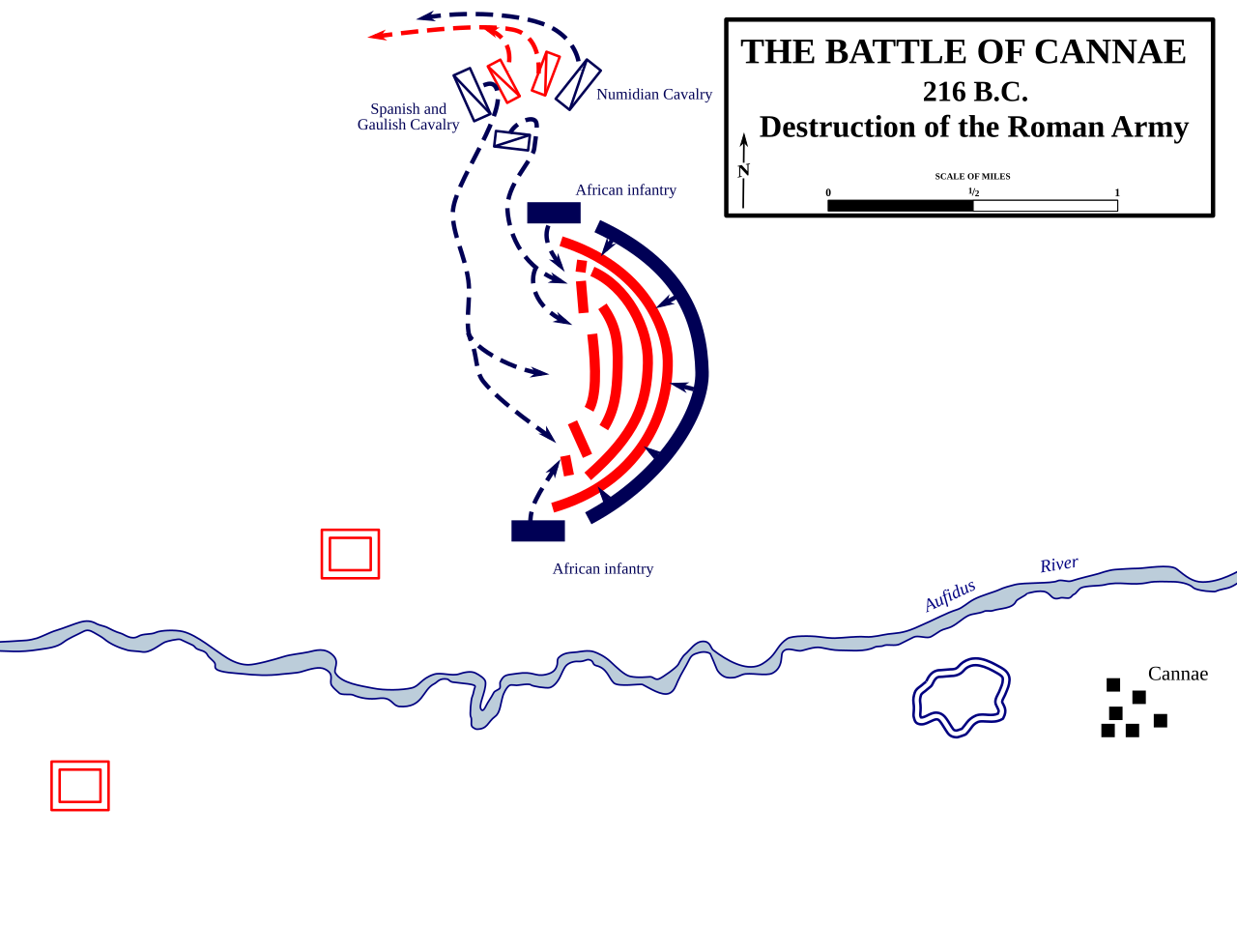
The destruction of the Roman army (red) at Cannae, courtesy of the Department of History, United States Military Academy

Hannibal’s troops take trophies from their dead Roman foes after the Battle of Cannae. English illustration, 19th century © Bridgeman Images.
Polybius tells us the best course of action for a conqueror to take:
“But the fact is, that whereas the taking and demolishing an enemy’s forts, harbours, cities, men, ships and crops, and other such things, by which our enemy is weakened, and our own interests and tactics supported, are necessary acts according to the laws and rights of war; to deface temples, statues, and such like erections in pure wantonness, and without any prospect of strengthening oneself or weakening the enemy, must be regarded as an act of blind passion and insanity. For the purpose with which good men wage war is not the destruction and annihilation of the wrongdoers, but the reformation and alteration of the wrongful acts. Nor is it their object to involve the innocent in the destruction of the guilty, but rather to see that those who are held to be guilty should share in the preservation and elevation of the guiltless. It is the act of a tyrant to inflict injury, and so to maintain his power over unwilling subjects by terror,—hated, and hating those under him: but it is the glory of a king to secure, by doing good to all, that he should rule over willing subjects, whose love he has earned by humanity and beneficence…For in truth to conquer one’s enemies in integrity and equity is not of less, but of greater, practical advantage than victories in the field. In the one case the defeated party yields under compulsion; in the other with cheerful assent. In the one case the victor effects his reformation at the cost of great losses; in the other he recalls the erring to better courses without any damage to himself. But above all, in the one case the chief credit of the victory belongs to the soldiers, in the other it falls wholly and solely to the part of the leaders.” – Polybius The Histories Bk 5, section 12
Note: Scipio Africanus largely followed this advice as he conquered Spain on his march to Zama, as did Caesar and many future emperors, most famously Trajan and Hadrian. The U.S. Marshall Plan and reconstruction of Japan post WWII are modern day successful examples.
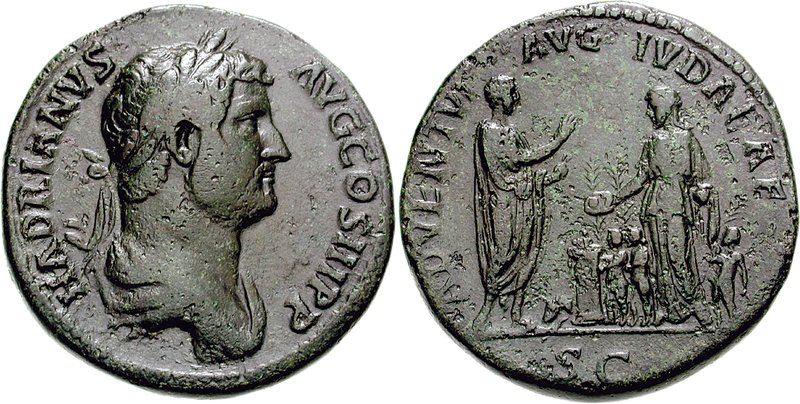
Coinage minted to mark Hadrian’s visit to Judea.
And the least best course of action for a conqueror to take: The Spoils of Syracuse:
Note: Syracuse was taken in the autumn, B.C. 212. “The ornaments of the city, statues and pictures were taken to Rome.” Livy, 25, 40, cp. 26, 21.
“A city is not really adorned by what is brought from without, but by the virtue of its own inhabitants….
“The Romans, then, decided to transfer these things to their own city and to leave nothing behind. Whether they were right in doing so, and consulted their true interests or the reverse, is a matter admitting of much discussion; but I think the balance of argument is in favour of believing it to have been wrong then, and wrong now. If such had been the works by which they had exalted their country, it is clear that there would have been some reason in transferring thither the things by which they had become great. But the fact was that, while leading lives of the greatest simplicity themselves, as far as possible removed from the luxury and extravagance which these things imply, they yet conquered the men who had always possessed them in the greatest abundance and of the finest quality. Could there have been a greater mistake than theirs? Surely it would be an incontestable error for a people to abandon the habits of the conquerors and adopt those of the conquered; and at the same time involve itself in that jealousy which is the most dangerous concomitant of excessive prosperity. For the looker-on never congratulates those who take what belongs to others, without a feeling of jealousy mingling with his pity for the losers. But suppose such prosperity to go on increasing, and a people to accumulate into its own hands all the possessions of the rest of the world, and moreover to invite in a way the plundered to share in the spectacle they present, in that case surely the mischief is doubled. For it is no longer a case of the spectators pitying their neighbours, but themselves, as they recall the ruin of their own country. Such a sight produces an outburst, not of jealousy merely, but of rage against the victors. For the reminder of their own disaster serves to enhance their hatred of the authors of it. To sweep the gold and silver, however, into their own coffers was perhaps reasonable; for it was impossible for them to aim at universal empire without crippling the means of the rest of the world, and securing the same kind of resources for themselves. But they might have left in their original sites things that had nothing to do with material wealth; and thus at the same time have avoided exciting jealousy, and raised the reputation of their country: adorning it, not with pictures and statues, but with dignity of character and greatness of soul. I have spoken thus much as a warning to those who take upon themselves to rule over others, that they may not imagine that, when they pillage cities, the misfortunes of others are an honour to their own country. The Romans, however, when they transferred these things to Rome, used such of them as belonged to individuals to increase the splendour of private establishments, and such as belonged to the state to adorn the city…”-Polybius The Histories. Bk 9 section 10.
Note: Hannibal looted and ruled harshly over conquered municipalities and citizens, and ultimately found himself isolated in a small area of southern Italy by B.C 204. The Nazi’s harsh treatment of conquered Europeans, with their widespread looting of art, food, money, property and forced relocation of millions of people illustrates Polybius well. When their fortunes changed for the worse militarily few of their conquered tenants came to their aid. Instead most stood aside, or actively encouraged and participated, as Allied forces approached Paris and Berlin after D-Day. Other recent examples that Polybius may have frowned upon: the looting of museums, building a green zone fortress in Baghdad, and the destruction of mosques in Iraq; constant night raids on civilians involving looting and mistreatment, combined with the desecration of their religion, by the U.S. troops in Afghanistan. These types of actions are usually treated as sideshows to great battles by most historians, but Polybius shows throughout The Histories that they matter greatly. The historical record backs him up.
On the Commanding of Armies:
“The chances and accidents that attend military expeditions require great circumspection; and it is possible to provide for all of them with precision, provided that a man gives his mind to the conduct of his plan of campaign. Now that fewer operations in war are carried out openly and by mere force, than by stratagem and the skillful use of opportunity, any one that chooses may readily learn from the history of the past. And again that operations depending on the choice of opportunity oftener fail than succeed is easily proved from experience. Nor can there be any doubt that the greater part of such failures are due to the folly or carelessness of the leaders. It is time therefore to inquire into the rules of this art of strategy.”
“Such things as occur in campaigns without having been calculated upon in any way we must not speak of as operations, but as accidents or casualties. It is the conduct of a campaign in accordance with an exact plan that I am to set forth: omitting all such things as do not fall under a scientific rule, and have no fixed design.”
The points of inherent importance in the conduct of a campaign,—time, place, secrecy, code of signals, agents, and method: “Every operation requires a time fixed for its commencement, a period and place for its execution, secrecy, definite signals, persons by whom and with whom it is to be executed, and a settled plan for conducting it. It is evident that the man who has rightly provided for each of these details will not fail in the ultimate result, while he who has neglected any single one of them will fail in the whole. Such is the order of nature, that one insignificant circumstance will suffice for failure, while for success rigid perfection of every detail is barely enough.”
Leaders then should neglect no single point in conducting such expeditions.
Things necessary. 1. Silence: “Now the head and front of such precautions is silence; and not to allow either joy at the appearance of an unexpected hope, or fear, or familiarity, or natural affection, to induce a man to communicate his plans to any one unconcerned, but to impart it to those and those alone without whom it is impossible to complete his plan, and not even to them a moment sooner than necessary, but only when the exigencies of the particular service make it inevitable. It is necessary, moreover, not only to be silent with the tongue, but much more so in the mind. For it has happened to many generals before now, while preserving an inviolable silence, to betray their thoughts either by the expression of their countenances or by their actions.”
2. Knowledge of the capabilities of the force in moving: “The second requisite is to know accurately the conditions under which marches by day or night may be performed, and the distances to which they can extend, and not only marches on land, but also voyages by sea.”
“The third and most important is to have some knowledge of the seasons, and to be able to adapt the design to them.”
“Nor again is the selection of the ground for the operation to be regarded as unimportant, since it often happens that it is this which makes what seems impossible possible, and what seemed possible impossible.”
3. Care in concerting signals and…
4. Care in selecting men: “Finally there must be no neglect of the subject of signals and counter signals; and the choice of persons by whom and with whom the operation is to be carried out.”
5. Knowledge of localities: “Of these points some are learnt by experience, some from history, and others by the study of scientific strategy. It is a most excellent thing too that the general should have a personal knowledge both of the roads, and the locality which he has to reach, and its natural features, as well as of the persons by whom and with whom he is to act. If that is not possible, the next best thing is that he should make careful inquiries and not trust just any one: and men who undertake to act as guides to such places should always deposit security with those whom they are conducting.”
6. Accurate knowledge of natural phenomena enabling a general to make accurate calculation of time: “These, and other points like them, it is perhaps possible that leaders may learn sufficiently from the mere study of strategy, whether practical or in books. But scientific investigation requires scientific processes and demonstrations, especially in astronomy and geometry; the working out of which is not much to our present point, though their results are important, and may contribute largely to the success of such undertakings.”
“The most important operation in astronomy is the calculation of the lengths of the days and nights. If these had been uniform it would not have been a matter requiring any study, but the knowledge would have been common to all the world: since however they not only differ with each other but also with themselves, it is plainly necessary to be acquainted with the increase and diminution of both the one and the other. How can a man calculate a march, and the distance practicable in a day or in a night, if he is unacquainted with the variation of these periods of time? In fact nothing can be done up to time without this knowledge,—it is inevitable otherwise that a man should be sometimes too late and sometimes too soon. And these operations are the only ones in which being too soon is a worse fault than being too late. For the general who overstays the proper hour of action only misses his chance, since he can find out that he has done so before he arrives, and so get off safely: but he that anticipates the hour is detected when he comes up; and so not only misses his immediate aim, but runs a risk of ruining himself altogether.”
The divisions of the day: “In all human undertakings opportuneness is the most important thing, but especially in operations of war. Therefore a general must have at his fingers’ ends the season of the summer and winter solstice, the equinoxes, and the periods between them in which the days and nights increase and diminish. For it is by this knowledge alone that he can compute the distance that can be done whether by sea or land. Again, he must necessarily understand the subdivisions both of the day and the night, in order to know at what hour to order the reveillé, or the march out; for the end cannot be attained unless the beginning be rightly taken. As for the periods of the day, they may be observed by the shadows or by the sun’s course, and the quarter of the heaven in which it has arrived, but it is difficult to do the same for the night, unless a man is familiar with the phenomenon of the twelve signs of the Zodiac, and their law and order: and this is easy to those who have studied astronomy. Of the night: For since, though the nights are unequal in length, at least six of the signs of the Zodiac are nevertheless above the horizon every night, it is plain that in the same portions of every night equal portions of the twelve signs of the Zodiac rise. Now as it is known what portion of the sphere is occupied by the sun during the day, it is evident that when he has set the arc subtended by the diameter of his arc must rise. Therefore the length of the night is exactly commensurate with the portion of the Zodiac which appears above the horizon after sunset. And, given that we know the number and size of the signs of the Zodiac, the corresponding divisions of the night are also known. If however the nights be cloudy, the moon must be watched, since owing to its size its light as a general rule is always visible, at whatsoever point in the heaven it may be. The hour may be guessed sometimes by observing the time and place of its rising, or again of its setting, if you only have sufficient acquaintance with this phenomenon to be familiar with the daily variation of its rising. And the law which it too follows admits of being easily observed; for its revolution is limited by the period of one month, which serves as a model to which all subsequent revolutions conform.”
The example of Ulysses. See Odyss. 5, 270 sq: “And here one may mention with admiration that Homer represents Ulysses, that truest type of a leader of men, taking observations of the stars, not only to direct his voyages, but his operations on land also. For such accidents as baffle expectation, and are incapable of being accurately reckoned upon, are quite sufficient to bring us to great and frequent distress, for instance, downpours of rain and rise of torrents, excessive frosts and snows, misty and cloudy weather, and other things like these;—but if we also neglect to provide for those which can be foreseen, is it not likely that we shall have ourselves to thank for frequent failures? None of these means then must be neglected, if we wish to avoid those errors into which many others are said to have fallen…”-Polybius The Histories. Bk 9 sections 12-16.
More from the Hannibalian War:
Fiat experimentum in corpore vili: “Thus fell Marcus Marcellus from an act of incautiousness unworthy of a general. I am continually compelled in the course of my history to draw the attention of my readers to occurrences of this sort; for I perceive that it is this, more than anything else connected with the science of tactics, that ruins commanders. And yet the blunder is a very obvious one. For what is the use of a commander or general, who has not learnt that the leader ought to keep as far as possible aloof from those minor operations, in which the whole fortune of the campaign is not involved? Or of one who does not know that, even if circumstances should at times force them to engage in such subordinate movements, the commanders-in-chief should not expose themselves to danger until a large number of their company have fallen? For, as the proverb has it, the experiment should be made “on the worthless Carian”not on the general. For to say “I shouldn’t have thought it,”—“Who would have expected it?” seems to me the clearest proof of strategical incompetence and dulness.
“And so, though Hannibal’s claims to be reckoned a great general are manifold, there is none more conspicuous than this, that though engaged for a great length of time in an enemy’s country, and though he experienced a great variety of fortune, he again and again inflicted a disaster on his opponents in minor encounters, but never suffered one himself, in spite of the number and severity of the contests which he conducted: and the reason, we may suppose was, that he took great care of his personal safety. And very properly so: for if the leader escapes uninjured and safe, though a decisive defeat may have been sustained, fortune offers many opportunities for retrieving disasters; but if he has fallen, the pilot as it were of the ship, even should fortune give the victory to the army, no real advantage is gained; because all the hopes of the soldiers depend upon their leaders. So much for those who fall into such errors from foolish vanity, childish parade, ignorance, or contempt. For it is ever one or the other of these that is at the bottom of such disasters.” -Polybius The Histories. Bk 10 sections 32-33.
“And now there occurred an undoubted instance of what some doubt, namely, that the issues in war are for the most part decided by the skill or want of skill of the commanders. For though perhaps it is a great thing to be able to follow up a first success properly, it is a greater thing still that, when the first step has proved a failure, a man should retain his presence of mind, keep a good look-out for any error of judgment on the part of the victors, and avail himself of their mistakes. At any rate one often sees the side, which imagines itself to have obtained a clear victory, ultimately lose the day; while those who seemed at first to have failed recover themselves by presence of mind, and ultimately win an unexpected victory.” -Polybius The Histories. Bk 11 section 14.

The Victorious Hannibal Seeing Italy from the Alps for the First Time by Francisco Goya (1771).

Hannibal’s celebrated feat in crossing the Alps with war elephants passed into European legend: detail of a fresco by Jacopo Ripanda, c. 1510, Capitoline Museums, Rome.
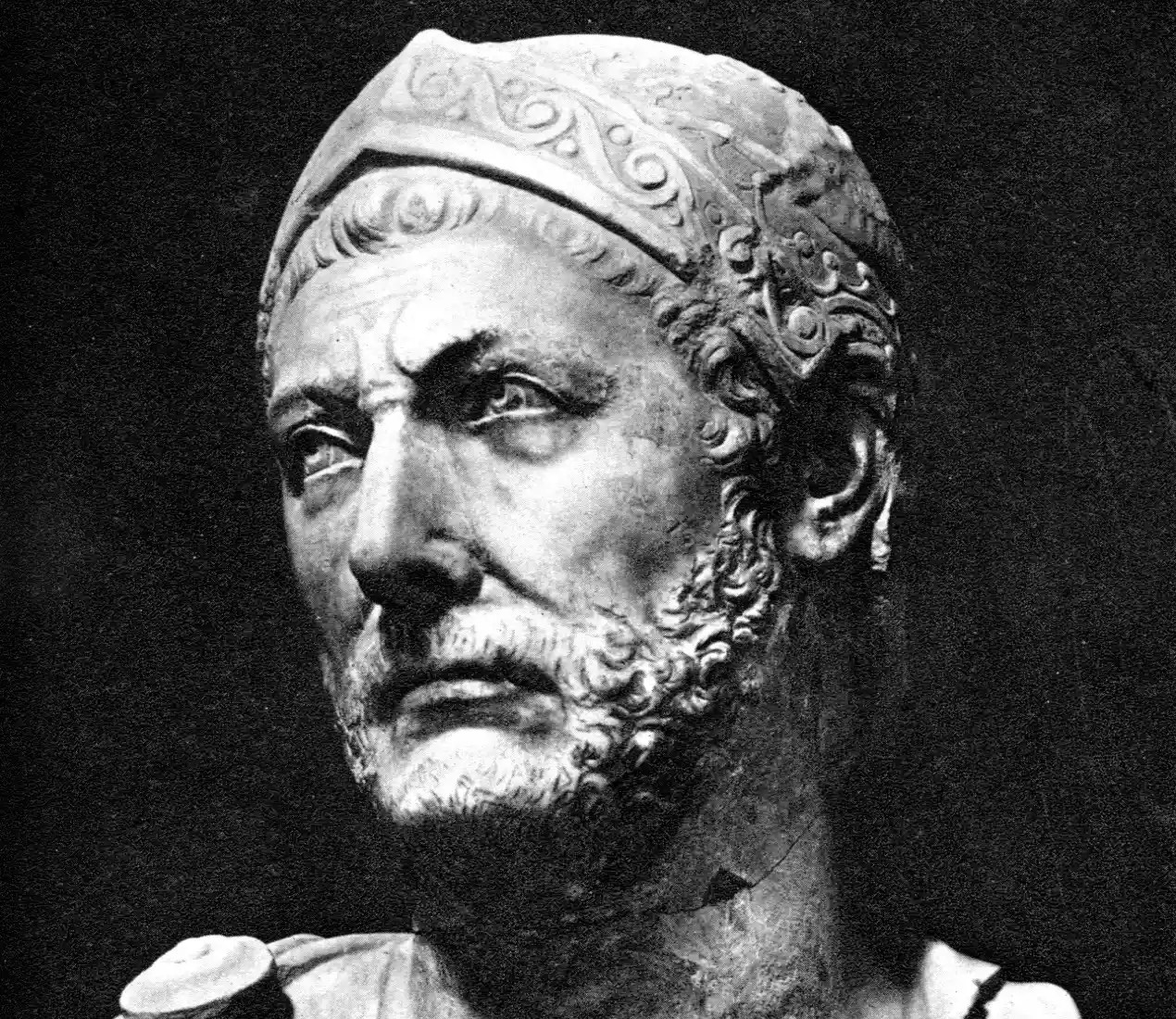
Hannibal. Public Domain.


