Tag Archives: anti-war movement

Vietnam Era Anti-War Stickers and Buttons

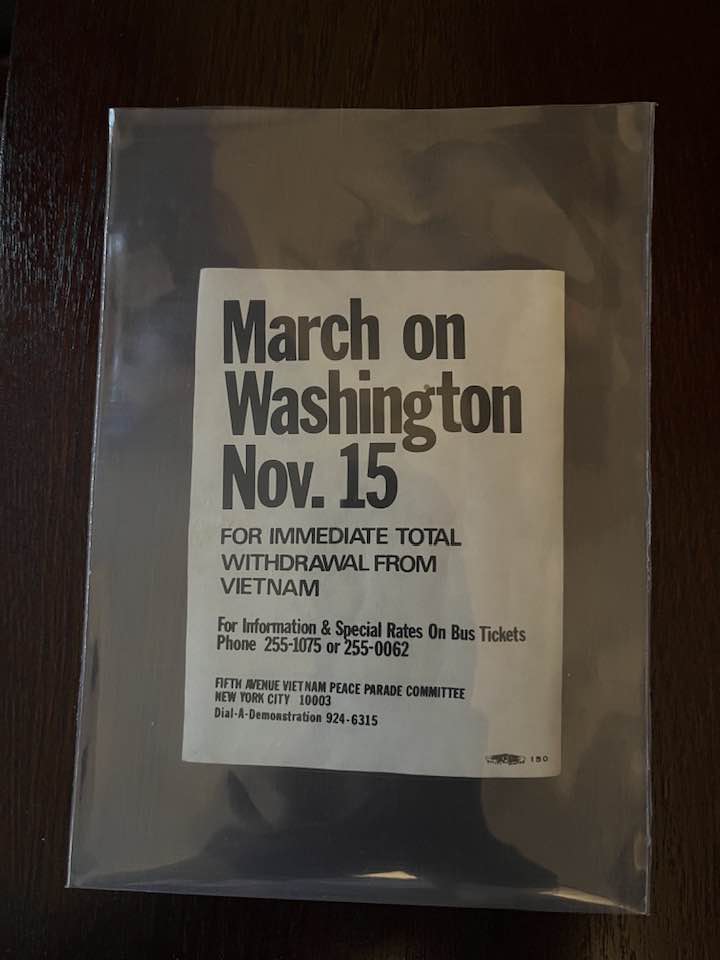
Personal collection of Vietnam era anti-war stickers and buttons. Many of the major events are represented:

– April 15, 1967. Spring Mobe protests in New York City (300,000 meet in Central Park and march to the United Nations) and in San Francisco.

– October 21, 1967. March on the Pentagon. 100,000 are on the National Mall in Washington DC. Norman Mailer’s book The Armies of the Night describes the event.

– October 15, 1969. National “Moratorium to End the War in Vietnam” was a massive demonstration and teach-in across the United States. Over a quarter of million people attended the Moratorium march in Washington, D.C.

– November 14, 1969. National student strike and “March against Death” in front of the White House.

– November 15, 1969. The Mobe’s 2nd Moratorium March mobilizes 500,000 in Wash DC and San Francisco. The news of the My Lai Massacre had broken a few days earlier.

– April 24, 1971. Demonstration on the National Mall draws approximately half a million protestors to D.C. In addition over 100,00 participate in San Francisco, the largest demonstration on the West Coast.

– The large blue button commemorates the peace treaty signed on January 27, 1973. Hoa Binh is Vietnamese for Peace.

– Eugene McCarthy’s 1968 presidential campaign challenged Lyndon B. Johnson on a primarily anti–war platform. Riding a wave of dissatisfaction after the Tet Offensive McCarthy finished in a strong second place in the New Hampshire primary, prompting LBJ to decline a run for re-election.

– Nixon resigned to avoid impeachment during the Watergate scandal. It all began with Daniel Ellsberg and the Pentagon papers published in 1971. The White House approved the formation of “The Plumbers” to silence Ellsberg. Led by G. Gordon Liddy and E. Howard Hunt, the crime committed was to burglarize Ellsberg’s psychiatrist’s office to search for damning information to use to discredit him. They found nothing. The bungled operation started Nixon and his cohorts down the slippery slope of crimes that culminated in the botched break-in at Democratic National Committee headquarters at the Watergate office complex nine months later.

Who Spoke Up? – Voices of Protest Against the War in Vietnam

chicago68_blankfort_smallDuring the Vietnam War nothing got under the skin of the war managers– LBJ, Nixon, their generals, top cops and political cronies — more than public criticism from liberal, and sometimes moderate, members of the intelligentsia, college campuses and the media. The war pushers tried every dirty trick in the book, and then some, to shut these voices down– they labeled dissenters as traitors, commies and un-American; used the FBI to spy on them (Cointelpro) and the IRS to audit them; created laws to throw them in jail for protesting, or sent in ringers and police to start riots during peace marches; and in some cases even shot them dead.

But these tactics ultimately failed. Over time the chorus of voices demanding peace steadily grew in strength and in retrospect history has shown that the opposition interpretation of the war was not only more informed, but also much more honest, than that of the establishment. In fact, we know now that, from Tonkin to Cambodia, there was no lie too big for LBJ and Nixon if it served their purposes of continuing a failed policy in the hopes of pulling off a hail Mary pass late in the game–which of course did not happen.

A true turning point in modern American politics, the shady events of the war years marked the beginning of a damaging turn toward cynicism by the American public regarding the honesty and integrity of their government. Prior to Vietnam, people may have disagreed about politics, but they essentially believed their leaders were, for the most part, honest people, public administrators with honorable intentions. But the Vietnam War– with its phony after battle briefings, trumped up body counts, constant false optimism, secret bombing campaigns and duplicitous foreign diplomacy– shattered that glossy veneer. The trend was accelerated by Watergate and then officially codified into right-wing ideology by Ronald Reagan. The fallout from the war, the war at home, started the nation on the path that has left us deeply divided, and apparently paralyzed politically.

Listen to archival broadcasts from the period featuring those who stood up against the war:

IF Stone – Vietnam Day Protest UC Berkeley 1965:

Writers Against The War 1967:

MLK Santa Rita Jail and Los Angeles 1968:

UC Berkeley Sproul Hall Sit-in 1968: 

Columbia University Student Strike 1968:

Chicago 1968: 

Soldiers Against the War 1968:

Noam Chomsky on Draft Resistance 1968: 

Dr Benjamin Spock – UC Berkeley 1968:

Seymour Hersh Exposes My Lai Massacre 1969:

MLK Beyond Vietnam Speech 1967

The Complete Pentagon Papers 

List of Anti-Vietnam War Protests

Note: with the most recent national military debacle – the Iraq War – flaming out of control again, and the hawks circling above calling for US involvement, these recordings take on a renewed significance, if for nothing else than to remind ourselves that it is possible to speak out and influence events– it’s one of the only real powers “we the people” have.